
Pepperoni
Also known as salame piccante (loosely)
United States, Italian-American
Overview
Pepperoni is a small red sausage with fine fat, paprika, fennel or anise and chilli heat. dry pepperoni should slice cleanly and show a controlled acid tang without becoming sour or greasy. A small red sausage with fine fat, paprika, fennel or anise and chilli heat. Dry pepperoni should slice cleanly and show a controlled acid tang without becoming sour or greasy. The Codex treats it as a complete production system, not merely a familiar name. Raw material, cut or particle size, casing, smoke, fermentation, cooking and maturation all contribute to the identity. The current status is Modern American sausage style : no GI. The protected or traditional reference and the Curesmith home method remain separate.
Where it's from
The cut
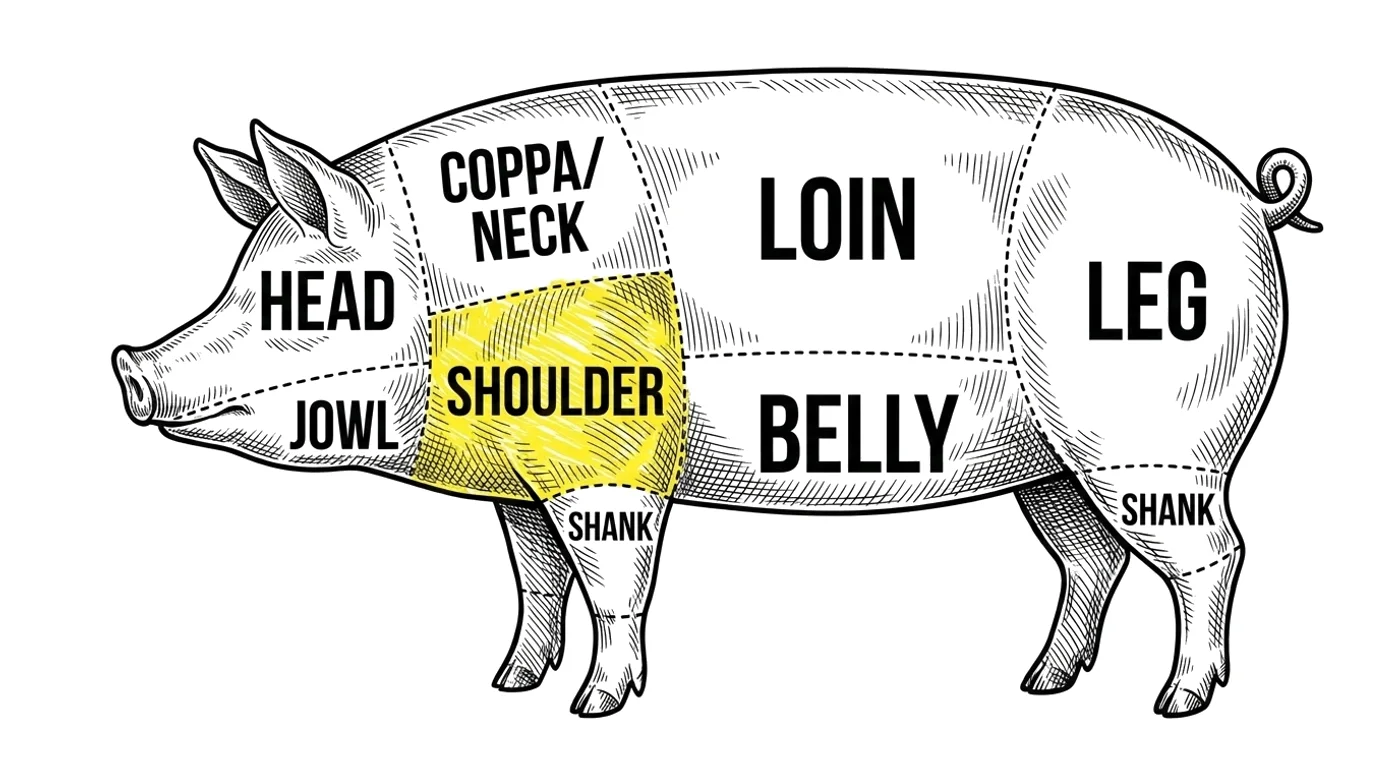
How to recognise it
A small red sausage with fine fat, paprika, fennel or anise and chilli heat. Dry pepperoni should slice cleanly and show a controlled acid tang without becoming sour or greasy. Grease smear, hollow pockets, case hardening, a wet centre, rancidity or uncontrolled dark mould is a production fault.
Origins and history
Pepperoni is an American sausage created within Italian immigrant food culture rather than a traditional Italian salume. Early twentieth-century butchers adapted southern Italian spicy sausages to American pork and beef, smaller casings and a stronger red-pepper colour. The English name appeared in a country where the Italian word peperoni normally means peppers, which is why visitors to Italy do not find an exact native sausage with the same identity. After the Second World War, the growth of pizzerias and frozen pizza made pepperoni's small, uniform slices and spice-rich rendered fat commercially ideal. It became a national pizza topping while remaining legally generic.
Serving and cultural significance
Use thin slices on pizza, where the fat renders and carries chilli into the cheese, or serve it in sandwiches and snack plates. Larger pieces can season beans and pasta, but scorching the paprika creates bitterness.
Recipe and cure
This is not a finished recipe. It is a window into how this meat is traditionally cured. Before you follow any process, run it through one of our curing calculators so the salt, cure and timings are right and safe for your own batch.
Make this — the measured Curesmith version →The cure below is the traditional reference. “Make this” opens the measured Curesmith home recipe, scaled to your batch.
Traditional or protected production
Pepperoni has no geographical specification and is produced in several American styles. Pork, beef or a combination of the two is seasoned with paprika, chilli, garlic and fennel, cured, fermented and stuffed into a relatively small casing. Dry versions are matured to a low water activity, while semi-dry commercial versions may receive smoke and heat treatment. The intended pizza performance strongly influences particle size, diameter and fat behaviour.
- Meat
- beef and pork
- Cut
- minced
- Salt (%)
- 2.2 to 2.5%
- Curing salt
- Cure #2 (dry) or Cure #1 (semi-dry)
- Other agents
- dextrose; paprika, cayenne, anise or fennel, garlic
- Fermented
- Yes
- Target pH
- ~4.8 to 5.0
- Starter or mould
- lactic acid bacteria starter
- Smoked
- sometimes lightly smoked
- Target aW or weight loss
- ~30% weight loss (dry style)
- Temperature (°C)
- warm ferment, then dry 12 to 14
- Humidity (%)
- 72 to 75
- Maturation
- a few weeks
- Basis
- percentage of meat weight
- Style
- minced, fermented, dried
Ingredients
- beef
- pork
- salt
- dextrose
- paprika
- cayenne
- anise or fennel
- garlic
- Cure #1 or #2
Notes
- Nitrite at 156 ppm ingoing; use Cure #2 for a long dry cure, Cure #1 for a short semi-dry one.
- Target roughly pH 4.9 through a fast, clean ferment.
- Convert any volume spice measures to weight as a percentage of the meat.
Safety. A dry fermented sausage: the acid drop and drying carry the safety. Ferment promptly to close the early Staphylococcus aureus window.
In the Codex
What this product teaches, and where to read more.
Temple. Roof, pH