
Pork Shoulder
Also known as Boston butt, pork butt, picnic shoulder, blade shoulder, spalla, paleta, Schulter, épaule, łopatka
The default sausage meat of nearly every tradition, and it earns that place: a hard-working muscle group with roughly the right lean-to-fat balance built in, enough collagen to bind and enough myoglobin for good cured colour.
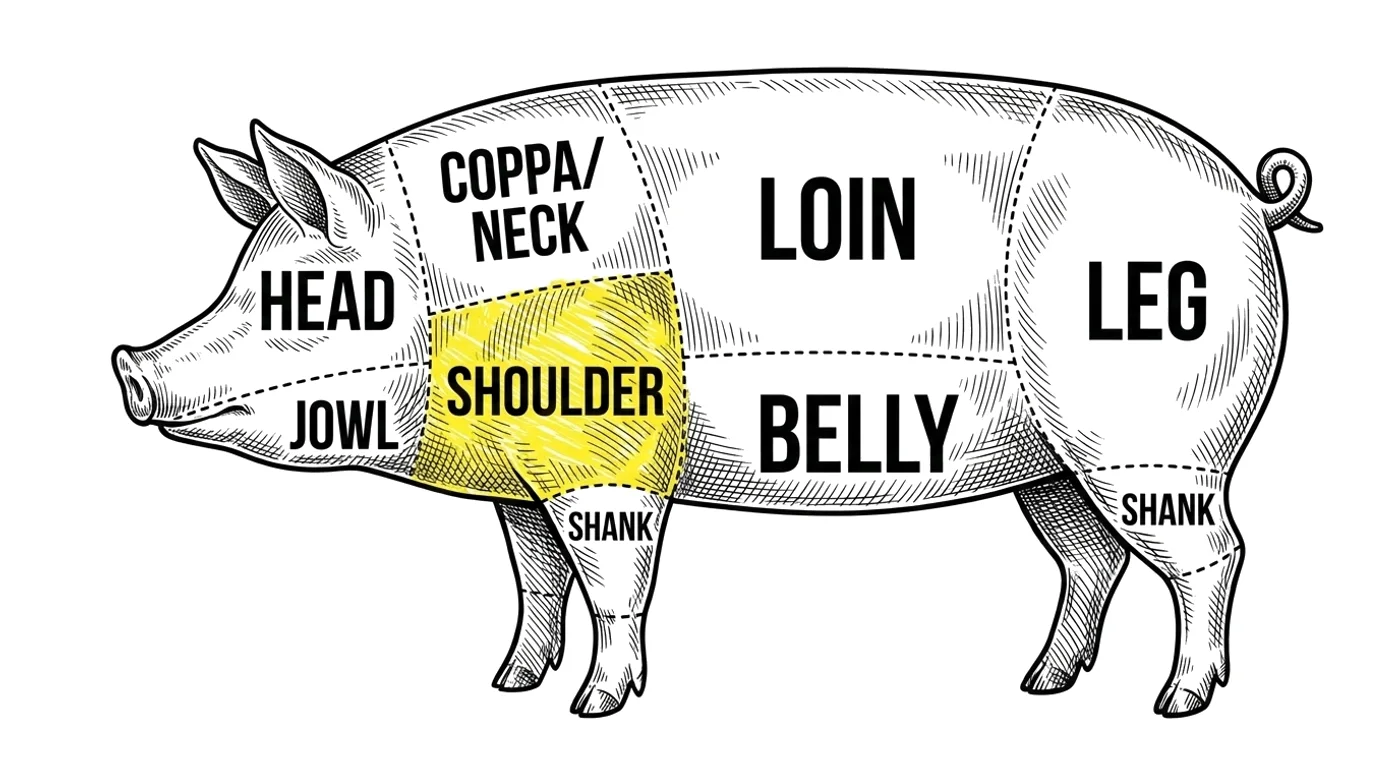
More Curesmith recipes name pork shoulder than any other cut, and the reason is not convenience. The shoulder is a group of muscles that carries the front of a standing animal and drives it forward, and everything useful about it follows from that work.
A muscle that works hard develops three things. It builds connective tissue, chiefly collagen, to transmit force. It accumulates intramuscular fat as a fuel store between the fibres. And it carries more myoglobin, the oxygen-storing pigment, because working muscle needs oxygen delivered and held. Each of those is exactly what a sausage wants. The collagen contributes to bind and, in a cooked product, converts to gelatin and gives succulence. The intramuscular fat is already distributed through the meat rather than sitting in a slab, so the grind carries fat evenly without any being added. The myoglobin is the substrate that nitrite acts on, so shoulder takes a deeper, more convincing cured colour than a pale muscle does.
It also arrives at roughly the right ratio. A trimmed pork shoulder commonly sits somewhere near 20 to 30 per cent fat, which is close to what most sausages want, and that is why so many traditional formulas say pork shoulder and then add no fat at all. Where a recipe specifies shoulder plus back fat, it is pushing the ratio up deliberately for a richer product.
The cut is not one thing. In the American naming that has spread widely, the upper part next to the spine is the Boston butt, blade or simply butt, which is better marbled, more evenly shaped and the usual choice; the lower part running down the front leg is the picnic, which is leaner, more sinewy and cheaper. Butchers in other countries divide it differently and the names do not map cleanly, which is a good reason to buy by looking rather than by name. The neck end of the shoulder is what becomes coppa and capocollo, and where a recipe wants that specific muscle it will say so.
The practical caution is the connective tissue that makes shoulder useful in the first place. In a cooked sausage collagen is an asset. In a dry-cured salami it does not soften, because there is no cooking step to turn it into gelatin, and a heavy seam of sinew that went through the grinder will still be a chewy thread in the finished slice. Trimming the visible silverskin and the heavy sheets before grinding is the difference between a clean salami and a stringy one. The picnic in particular repays trimming.
Shoulder freezes and grinds well, holds its colour, and tolerates being worked. Partially frozen shoulder cut into strips and passed through a chilled plate is the standard approach, and keeping it cold matters more here than with a leaner cut because the intramuscular fat that makes it good is also the fat that smears.
Temple element. Pillar, Meat Quality