
Poultry
Also known as chicken, duck, goose, turkey, Geflügel, volaille, pollame, aves
A different safety class from red meat, cooked to 74°C rather than 71°C, and a different technical problem: poultry fat is soft, poultry skin is where most of the fat lives, and pale breast and dark leg behave nothing alike.
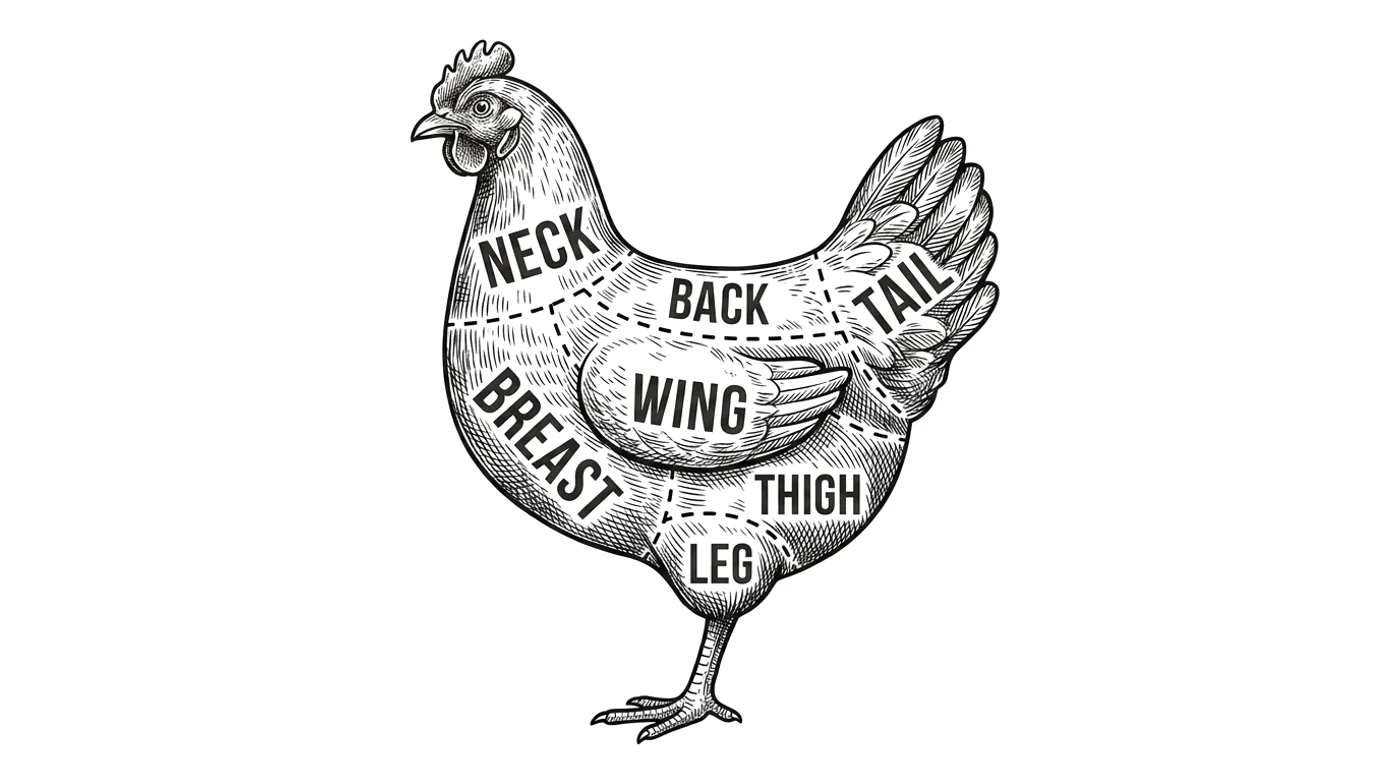
Poultry in charcuterie means chicken, duck, goose and turkey, and the four are not interchangeable. Chicken and turkey are lean and mild. Duck and goose carry a great deal of fat under the skin and a much stronger flavour, and they are the birds the great preparations are built on: confit, rillettes, foie gras, magret séché, duck and goose sausages, and the fat itself as a cooking and preserving medium.
The first thing to understand about a bird is that breast and leg are two different meats. The breast is fast-twitch muscle used for short bursts, so in a domestic bird that barely flies it is pale, very lean and tender. The leg is slow-twitch, worked constantly for standing and walking, so it is darker, richer, tougher and more forgiving. A sausage made from breast alone is dry and bland; leg meat with the skin is what most poultry sausage traditions actually use.
The fat is the technical problem. Poultry fat is far more unsaturated than pork fat, so it is soft at any working temperature, it smears readily, it will not hold a dice, and it oxidises quickly. Most of it sits in the skin rather than distributed through the muscle, which is why poultry sausage formulas so often grind the skin in: it is the fat source. Skin must be ground very cold, ideally partly frozen, or it turns to a paste that will not disperse.
Drying poultry is difficult for the same reason and rare for good ones. Duck magret is the exception that works, being a single dense muscle with a fat cap that can be salted and hung, and it is essentially a whole-muscle cure rather than a sausage.
The safety class is the point that matters most. Poultry carries Salmonella and Campylobacter at rates that red meat does not, and the recognised safe cooking endpoint is higher: 74°C rather than the 71°C the house uses for meat. That figure is why the Atlas runs two cooking tiers, and it applies to any product with poultry in it, not only to a whole bird. Cross-contamination discipline in a workshop handling both is not optional, and a board or grinder that has had raw chicken through it does not then take red meat without cleaning.
Temple element. Pillar, Hygiene Control