
Prosciutto Amatriciano
Amatrice, Lazio, Italy
Balanced between sweet and savoury, with a light peppering and a clean, mountain-cured finish.
Overview
Prosciutto Amatriciano is a mountain ham from the upper Rieti area around Amatrice. It is pear-shaped, deep red and delicately savoury, produced in high country whose cold winters and ventilated summers favour a long natural cure.
Where it's from
Climate. The mountains around Amatrice in the province of Rieti, cool and airy.
Altitude. Central Apennine mountains
The cut
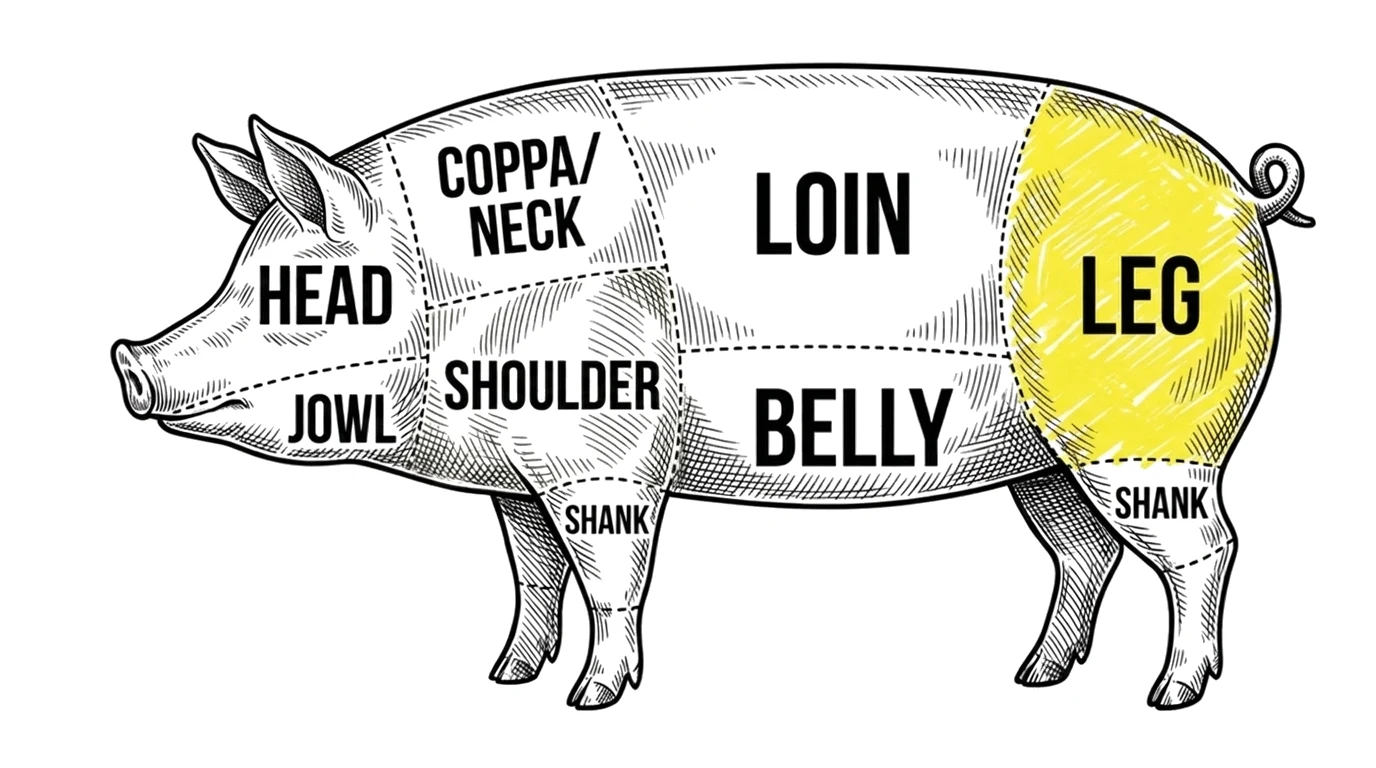
How to recognise it
The ham has a characteristic pear shape and a deep red slice with clean white fat. Aroma is mature and delicately spiced, while the taste is savoury but balanced. Authentic PGI product carries the required identification. Bone taint, rancidity, sourness, excessive salinity or severe case hardening are defects.
- Shape and size
- Whole leg, rounded
- Lean colour
- Deep pink-red
- Fat and marbling
- White
- Casing
- None
- Surface bloom
- None
Origins and history
The uplands around Amatrice lay on routes connecting Lazio, Abruzzo and the old Kingdom of Naples. Sheep, pigs, grain and preserved meat moved through a mountain economy where cash was scarce and durable food had real value. Local records and the protected history describe ham being used in the Middle Ages both as a traded commodity and as payment of dues to feudal lords. The 1811 Statistica Murattiana recorded a pork-processing industry exporting hams to neighbouring provinces and as far as Naples. That history was badly tested by the 2016 earthquakes, which disrupted farms, butcheries and the town itself. Continued PGI production therefore carries cultural and economic importance beyond the ham's flavour.
Name. Prosciutto, 'thoroughly dried'; Amatrice names the mountain town.
- Production today
- Producers in the Rieti mountain zone.
- Protection
- IGP.
- Tradition vs modern
- Mountain-air ageing.
- Seasonality
- Year-round.
Compare with. Prosciutto di Norcia
Serving and cultural significance
Serve thin slices with bread, pecorino, lentils or local mountain vegetables. It can accompany the region's pasta, bean dishes and simple antipasti, particularly with a dry red wine. Add it late to warm food so the cured lean does not harden or release too much salt.
Recipe and cure
This is not a finished recipe. It is a window into how this meat is traditionally cured. Before you follow any process, please run it through one of our curing calculators, so the salt, cure and timings are right and safe for your own batch.
Curesmith home adaptation — not designation-compliant
Make this — the measured Curesmith version →The cure below is the traditional reference. “Make this” opens the measured Curesmith home recipe, scaled to your batch.
Traditional or protected production
PGI production is limited to the specified Rieti municipalities at elevations not exceeding the protected limit. Qualifying pig legs are trimmed, salted, rested, washed, dried and matured. The local climate and established pork-processing knowledge provide the geographical link. The official specification governs weight, shape, process and branding.
Sea salt, salt-box method; no fixed percentage.
- Meat
- pork
- Salt (%)
- traditional, no fixed %
- Curing salt
- Sea salt only, no nitrate (per DOP)
- Fermented
- No
- Smoked
- No
- Target aW or weight loss
- ~28 to 30% weight loss
- Temperature (°C)
- cold salting, then 12 to 15
- Humidity (%)
- 70 to 80
- Maturation
- 12 to 18 months and up
- Basis
- percentage of green meat weight
- Style
- Traditional dry salting (salt-box)
Method
- Salt the leg by feel in the traditional method and rest cold so the salt draws through.
- Wash off the surface salt and begin the slow dry.
- Seal the exposed face with sugna once a crust forms.
- Age to the target weight loss, judging by weight and aroma.
Notes
- The official protected specification controls the named product. Any Curesmith EQ, starter-culture, curing-salt or home-scale adaptation is a separate method and must not be presented as designation-compliant.
- A more efficient way of curing this product is using the EQ Method. No more than 2.5% salt to meat weight is required. To follow the EQ method, please use our whole-muscle EQ curing calculator to work out proper ratios and curing times.
In the Codex
What this product teaches, and where to read more.
Temple. Roof, Microclimate