
Prosciutto di Carpegna
Carpegna, Marche, Italy
Sweet, mild and delicate, with a soft golden fat and a gentle, lingering sweetness.
Overview
Prosciutto di Carpegna is a sweet, deeply aromatic ham made only in the mountain municipality of Carpegna. Heavy Italian pig legs, local air and long maturation create a soft red slice with creamy fat and a gentle seasoning character.
Where it's from
Climate. Carpegna in the Montefeltro hills of the Marche, clean upland air.
Altitude. Montefeltro hills
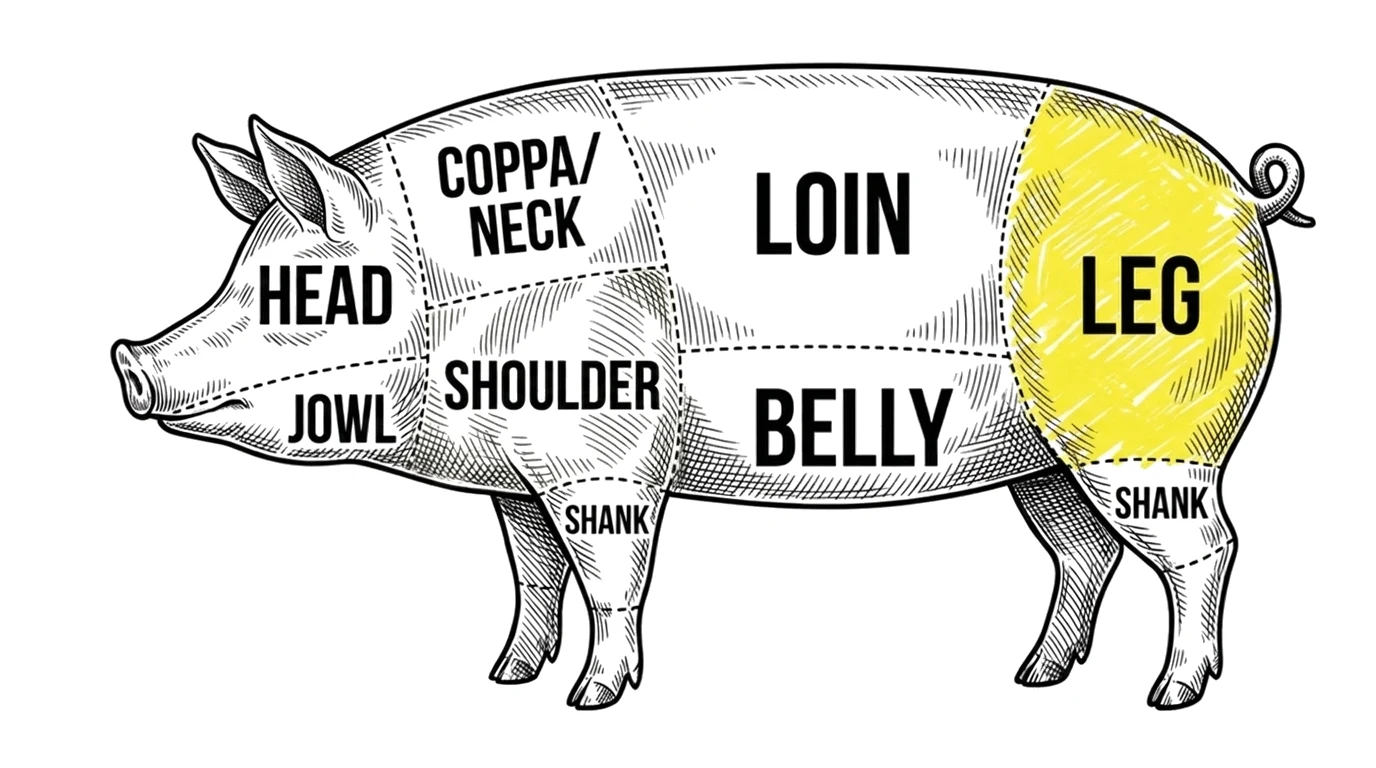
The cut
How to recognise it
The ham is rounded and compact, with a red to deep pink slice and creamy white fat. Texture is tender and melting rather than dry. Aroma should be sweet, mature and lightly spicy. The official brand identifies protected production. Bone taint, rancidity, excessive salt, a hard shell or sour odour are defects.
- Shape and size
- Whole leg, rounded, amber-gold fat
- Lean colour
- Salmon-pink to red
- Fat and marbling
- Golden-white
- Casing
- None
- Surface bloom
- None
Origins and history
Carpegna lies in Montefeltro, between the Apennines and the Adriatic influence. A 1407 act by Guidantonio da Montefeltro ordered a weekly market in nearby Montecerignone and restricted the sale of salted pork elsewhere, showing that preserved meat already carried commercial value. Tradition also links early hams with pigs ranging in the forests around Monte Carpegna and salt arriving from the Cervia coast. Processing remained domestic and artisanal until a dedicated facility was established in the late 1960s. PDO status in 1996 fixed production within the municipality and protected a ham whose reputation rests on a very small mountain place rather than a wide regional zone. The modern consortium was established in 2015.
Name. Prosciutto, 'thoroughly dried'; Carpegna names the town and its mountain.
- Production today
- A single-zone consortium.
- Protection
- DOP.
- Tradition vs modern
- Traditional hill ageing.
- Seasonality
- Year-round.
Compare with. Prosciutto Veneto Berico-Euganeo
Serving and cultural significance
Carve thinly and serve at cool room temperature with bread, figs, mild cheese or a glass of Sangiovese or Bianchello. The creamy fat should remain on the slice because it carries much of the ham's sweetness.
Recipe and cure
This is not a finished recipe. It is a window into how this meat is traditionally cured. Before you follow any process, please run it through one of our curing calculators, so the salt, cure and timings are right and safe for your own batch.
Curesmith home adaptation — not designation-compliant
Make this — the measured Curesmith version →The cure below is the traditional reference. “Make this” opens the measured Curesmith home recipe, scaled to your batch.
Traditional or protected production
PDO production uses qualifying Italian heavy-pig legs, processed and matured in Carpegna. The legs are trimmed, salted, rested, washed, dried and aged for the protected minimum. Sugna protects exposed lean during the long cure. The mountain microclimate and the municipality's specialist workmanship form part of the designation.
Sea salt, salt-box method; no fixed percentage.
- Meat
- pork
- Salt (%)
- traditional, no fixed %
- Curing salt
- Sea salt only, no nitrate (per DOP)
- Fermented
- No
- Smoked
- No
- Target aW or weight loss
- ~28 to 30% weight loss
- Temperature (°C)
- cold salting, then 12 to 15
- Humidity (%)
- 70 to 80
- Maturation
- 12 to 18 months and up
- Basis
- percentage of green meat weight
- Style
- Traditional dry salting (salt-box)
Method
- Salt the leg by feel in the traditional method and rest cold so the salt draws through.
- Wash off the surface salt and begin the slow dry.
- Seal the exposed face with sugna once a crust forms.
- Age to the target weight loss, judging by weight and aroma.
Notes
- The official protected specification controls the named product. Any Curesmith EQ, starter-culture, curing-salt or home-scale adaptation is a separate method and must not be presented as designation-compliant.
- A more efficient way of curing this product is using the EQ Method. No more than 2.5% salt to meat weight is required. To follow the EQ method, please use our whole-muscle EQ curing calculator to work out proper ratios and curing times.
In the Codex
What this product teaches, and where to read more.
Temple. Roof, Microclimate