
Prosciutto di Parma
pro-SHOOT-toh dee PAR-mah
Also known as Parma ham
Langhirano (Parma), Emilia-Romagna, Italy
Sweet, mellow and deeply savoury, its character built from salt, air and long ageing rather than spice.
Overview
Prosciutto di Parma is an unsmoked, bone-in ham whose identity rests on restraint. The protected product is made from selected Italian heavy-pig legs, sea salt, air and time, with no nitrite, nitrate, smoke or added flavouring. Its reputation comes from a supple slice, sweet pork aroma and unusually gentle salinity rather than an assertive spice profile.
Where it's from
Climate. The breezy hills south of Parma around Langhirano, where dry Apennine winds do the slow drying.
Altitude. Low Apennine foothills
The cut
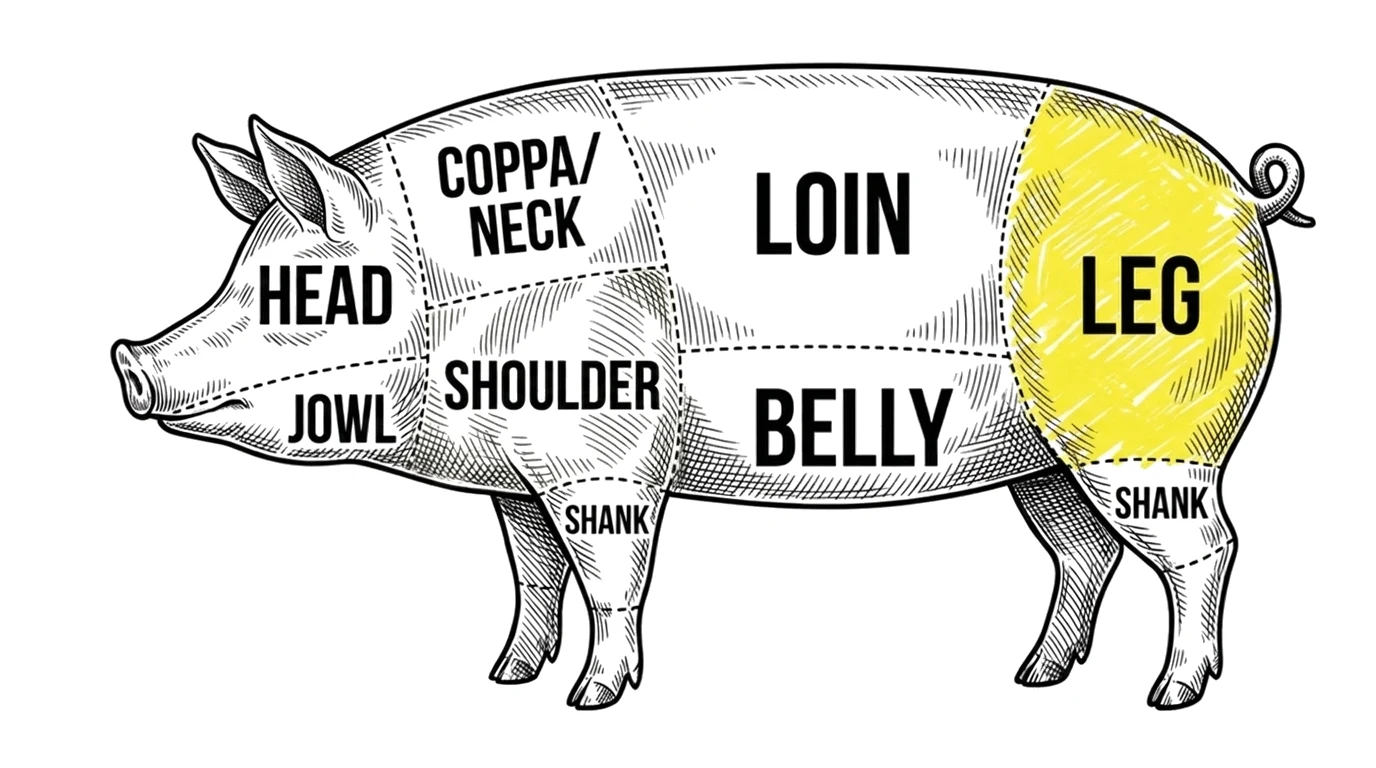
How to recognise it
A whole Parma ham has the familiar elongated leg form and the Ducal Crown firebrand on the rind. The exposed lean is rose-red to deeper red, edged with clean white fat. Thin slices should be soft, almost translucent and easy to fold, with a sweet cured aroma and no smoke. Excessive hardness, a dark dry rim, sharp saltiness, rancid fat or sour odour are faults rather than signs of long maturation.
- Shape and size
- Large rounded whole leg, 7 to 10 kg
- Lean colour
- Rosy pink to deep red
- Fat and marbling
- Clean white, moderate cover
- Casing
- None; exposed face sealed with sugna (lard, rice flour, salt)
- Surface bloom
- None
Origins and history
Pork preservation has deep roots in the Parma region. Heavy pigs developed alongside cereal farming and the dairy economy, where whey from hard-cheese production became an important feed. Roman writers described the skill of northern Italian communities in salting pork, although the modern protected ham took shape through later rural and guild traditions. Parma's position between the Po plain and the Apennines supplied both pigs and a drying climate influenced by air moving through the valleys. By the nineteenth and twentieth centuries, Langhirano and neighbouring towns had become specialist curing centres. Twenty-three producers formed the Parma Ham Consortium in 1963, giving collective protection to a name already widely imitated. European PDO registration followed in 1996.
Name. Prosciutto derives from the Latin perexsuctus, 'thoroughly dried'; Parma names the province.
- Production today
- Many consortium producers across the Parma hills; a large, protected industry.
- Protection
- DOP since 1996; consortium since 1963; salt only, no additives; finished hams carry the five-point ducal crown firebrand.
- Tradition vs modern
- Traditionally dried on natural airflow; modern producers use controlled rooms, but nitrates remain forbidden.
- Seasonality
- Made year-round.
Compare with. Prosciutto di San Daniele, Jamón Serrano
Serving and cultural significance
Slice Parma ham paper-thin across the muscle and serve it cool rather than refrigerator-cold. Melon is the famous summer partner, but figs, pears, mozzarella, Parmigiano Reggiano, bread and mild vegetables allow the ham's sweetness to remain central. On pizza or warm dishes it is normally added after cooking so that the fat softens without making the lean hard and salty.
Recipe and cure
This is not a finished recipe. It is a window into how this meat is traditionally cured. Before you follow any process, please run it through one of our curing calculators, so the salt, cure and timings are right and safe for your own batch.
Curesmith home adaptation — not designation-compliant
Make this — the measured Curesmith version →The cure below is the traditional reference. “Make this” opens the measured Curesmith home recipe, scaled to your batch.
Traditional or protected production
PDO production uses qualifying Italian heavy-pig legs and sea salt only. The legs are trimmed, salted in stages, rested cold, washed, dried and gradually exposed to the Parma curing environment. Exposed lean is protected with sugna, a mixture based on pork fat and rice flour, while maturation continues. Nitrites, nitrates, smoke and flavouring agents are excluded. Only hams made and matured within the defined Parma area and passing inspection receive the crown brand.
Sea salt only, worked in by the salter (salt-box). No fixed percentage.
- Meat
- pork (heavy Italian pigs)
- Cut
- whole hind leg, bone in
- Salt (%)
- traditional, no fixed %
- Curing salt
- Sea salt only, no nitrate (per DOP)
- Other agents
- sea salt only, no nitrates
- Fermented
- No
- Smoked
- No
- Target aW or weight loss
- ~28% weight loss
- Temperature (°C)
- cold salting, then 12 to 15
- Humidity (%)
- 70 to 80
- Maturation
- minimum 14 months under the current DOP specification
- Basis
- percentage of green meat weight
- Style
- Traditional dry salting (salt-box)
Method
- Salt the fresh leg with sea salt, pressing it into the muscle and skin, and rest cold.
- Apply a second, lighter salting to the master salter's judgement, then rest cold for several weeks so the salt draws through.
- Wash off the surface salt and begin the slow dry.
- Seal the exposed face with sugna (lard, salt and rice flour).
- Age in the Parma hills at least twelve months, judging by weight loss and aroma.
Notes
- The official protected specification controls the named product. Any Curesmith EQ, starter-culture, curing-salt or home-scale adaptation is a separate method and must not be presented as designation-compliant.
- A more efficient way of curing this product is using the EQ Method. No more than 2.5% salt to meat weight is required. To follow the EQ method, please use our whole-muscle EQ curing calculator to work out proper ratios and curing times.
Safety. Long dry-cured whole leg, salted by feel in the traditional method. Judge readiness by weight loss and water activity, not the calendar. Verify to your own standard before serving.
In the Codex
What this product teaches, and where to read more.
Temple. Foundation, Time