
Prosciutto di San Daniele
pro-SHOOT-toh dee san dan-YEH-leh
San Daniele del Friuli (Udine), Friuli-Venezia Giulia, Italy
Sweeter, softer and more delicate than Parma, shaped by its valley microclimate.
Overview
Prosciutto di San Daniele is a salt-only, unsmoked PDO ham made in one municipality. It is recognised by the retained hoof, the compact guitar-like outline created by pressing, and a soft, sweet slice. The product shares the Italian heavy-pig tradition with Parma ham, but its shape, place of maturation and local airflow give it a separate identity.
Where it's from
Climate. San Daniele del Friuli, where Alpine air meets Adriatic breeze in a still, favourable pocket.
Altitude. Friulian hill town
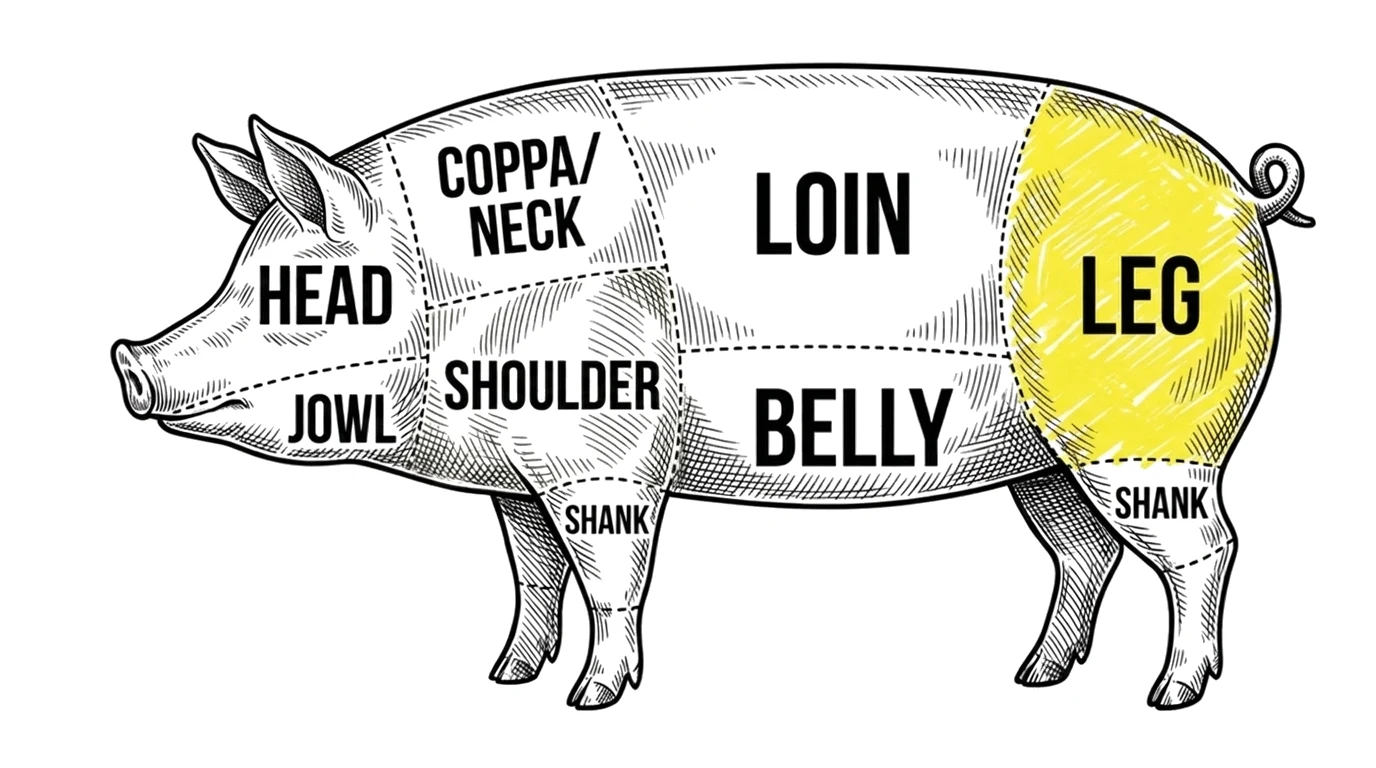
The cut
How to recognise it
The whole ham retains the hoof and has a flattened, guitar-like profile rather than a rounded pear shape. The slice is pink-red with fine white fat and a soft, yielding texture. Aroma should be sweet and delicately cured, with no smoke. Authentic hams carry the San Daniele brand after the required maturation and inspection. Grey bone pockets, sourness, rancid fat, excessive surface dryness or a sharp salty finish are defects.
- Shape and size
- Guitar-shaped pressed leg, trotter attached
- Lean colour
- Rosy, even
- Fat and marbling
- White, soft
- Casing
- None; sealed face
- Surface bloom
- None
Origins and history
Archaeological evidence around San Daniele shows pork use in the area during the first millennium BCE. The town later gained commercial importance through a market privilege documented from 1063 and confirmed in the medieval period. Its position near the Tagliamento, between the Carnic Alps and the Adriatic, made San Daniele a meeting point for mountain and maritime air. Pork curing became part of that local economy, and the ham was sufficiently valued to appear in inventories, trade and accounts of visiting armies. After Friuli joined the Kingdom of Italy, San Daniele ham travelled more widely to courts and urban markets. Producers and local citizens established the protection consortium in 1961. The name received European PDO registration in 1996.
Name. Named for the town of San Daniele del Friuli.
- Production today
- A limited number of producers within the San Daniele production zone.
- Protection
- DOP; must be produced within San Daniele under strict salt, pressing and ageing rules.
- Tradition vs modern
- The retained trotter and the pressing are traditional signatures kept under the DOP.
- Seasonality
- Made year-round.
Compare with. Prosciutto di Parma, Jambon de Bayonne
Serving and cultural significance
Cut the ham very thinly, beginning at the narrow end when working from a whole leg. It is traditionally served with bread, grissini, mild cheese, figs or melon, and works particularly well with the white wines of Friuli. Avoid heavy sauces and strong smoke flavours, which conceal the sweetness that defines the product.
Recipe and cure
This is not a finished recipe. It is a window into how this meat is traditionally cured. Before you follow any process, please run it through one of our curing calculators, so the salt, cure and timings are right and safe for your own batch.
Curesmith home adaptation — not designation-compliant
Make this — the measured Curesmith version →The cure below is the traditional reference. “Make this” opens the measured Curesmith home recipe, scaled to your batch.
Traditional or protected production
PDO San Daniele uses selected Italian heavy-pig legs and sea salt. The hoof remains attached, helping distinguish the product. After trimming and salting, the leg is pressed, a defining step that shapes the ham and supports even internal curing. It is then rested, washed, dried, protected with sugna where needed and matured in San Daniele del Friuli. The product is branded only after the minimum protected maturation and inspection.
Sea salt only, worked in by the salter (salt-box). No fixed percentage.
- Meat
- pork
- Cut
- whole hind leg with the trotter left on, pressed flat
- Salt (%)
- traditional, no fixed %
- Curing salt
- Sea salt only, no nitrate (per DOP)
- Other agents
- sea salt only
- Fermented
- No
- Smoked
- No
- Target aW or weight loss
- ~ weight loss by size
- Temperature (°C)
- cold salting, then 12 to 15
- Humidity (%)
- 70 to 80
- Maturation
- minimum 400 days under the DOP specification
- Basis
- percentage of green meat weight
- Style
- Traditional dry salting (salt-box), pressed
Method
- Salt the leg by feel, with the trotter left on.
- Press the leg flat, the San Daniele signature, and rest cold so the salt draws through.
- Wash and dry slowly.
- Seal the face with sugna and age to the target loss.
Notes
- The official protected specification controls the named product. Any Curesmith EQ, starter-culture, curing-salt or home-scale adaptation is a separate method and must not be presented as designation-compliant.
- A more efficient way of curing this product is using the EQ Method. No more than 2.5% salt to meat weight is required. To follow the EQ method, please use our whole-muscle EQ curing calculator to work out proper ratios and curing times.
Safety. As Parma, with the characteristic pressing and retained trotter. Judge by weight loss and water activity. Verify before serving.
In the Codex
What this product teaches, and where to read more.
Temple. Roof, Microclimate