
Prosciutto Veneto Berico-Euganeo
Berico-Euganeo hills, Veneto, Italy
Sweet, soft and delicate, one of the gentler Italian hams, with a clean, mild finish.
Overview
Prosciutto Veneto Berico-Euganeo is the gently salted ham of the Venetian foothills. Made around Montagnana between the Berici and Euganean hills, it has a compact rounded form, a soft pink slice and a sweet, delicate finish without smoke or aromatic spice in the lean.
Where it's from
Climate. The Berici and Euganei hills south of the Alps, a mild, ventilated pocket.
Altitude. Venetian volcanic hills
The cut
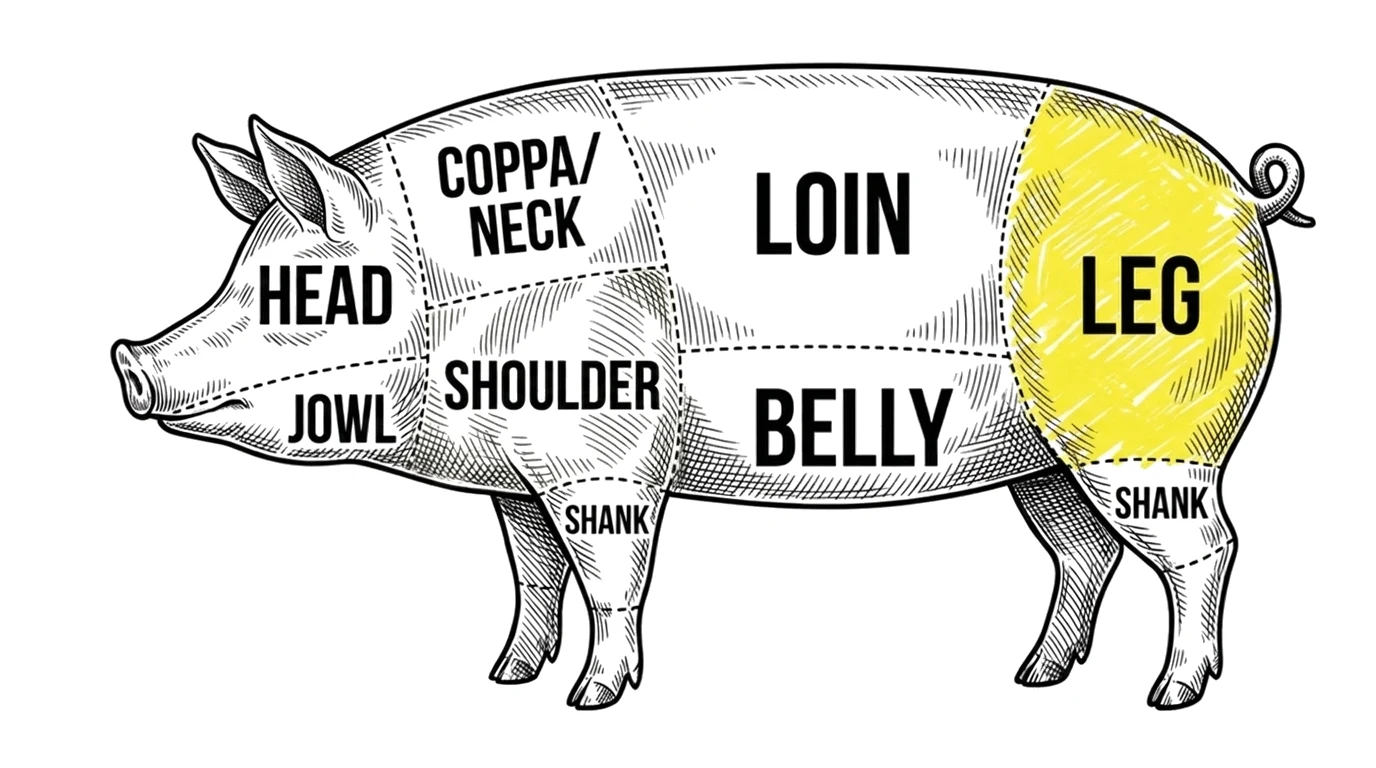
How to recognise it
The whole ham is semi-pressed and rounded, usually without the foot. The slice is soft pink to red with clean white fat, a sweet aroma and a mild savoury flavour. It should be tender rather than leathery and should show no smoke. Authentic product carries the protected brand and traceability marks. Sourness, yellow rancid fat or a hard dark rim are faults.
- Shape and size
- Whole leg, marked with the lion of Saint Mark
- Lean colour
- Rosy red
- Fat and marbling
- White
- Casing
- None
- Surface bloom
- None
Origins and history
The Veneto has a long pig-farming history. Regional accounts connect meat salting with Celtic practice and Roman refinement, while later records describe a Venetian ham known around Padua. Montagnana's position between productive lowlands and ventilated hills made it a natural curing centre. Local fairs around Saint Catherine's Day traditionally marked the season when pig legs were traded and winter processing began. By the nineteenth century producers deliberately reduced salt to compete with milder French hams, helping establish the sweetness now associated with the style. The consortium was founded in Montagnana in 1971, and European PDO protection followed in 1996.
Name. Prosciutto, 'thoroughly dried'; named for the Berici and Euganei hills.
- Production today
- A small consortium in the production zone.
- Protection
- DOP.
- Tradition vs modern
- Hill-air ageing, traditional zone protected.
- Seasonality
- Year-round.
Compare with. Prosciutto di Parma, Prosciutto di Carpegna
Serving and cultural significance
Slice very thinly and serve with bread, melon, figs, young cheese or the white wines of the Veneto. It can wrap asparagus or mild vegetables, but add it after cooking so the delicate sweet slice is not dried out.
Recipe and cure
This is not a finished recipe. It is a window into how this meat is traditionally cured. Before you follow any process, please run it through one of our curing calculators, so the salt, cure and timings are right and safe for your own batch.
Curesmith home adaptation — not designation-compliant
Make this — the measured Curesmith version →The cure below is the traditional reference. “Make this” opens the measured Curesmith home recipe, scaled to your batch.
Traditional or protected production
PDO production uses qualifying Italian heavy-pig legs and takes place within the designated Berico-Euganeo zone. The legs are trimmed, dry salted, rested, washed, dried, protected with sugna and matured. The specification controls raw material, production area, traceability, shape and minimum ageing. The protected flavour depends on restrained salt and local maturation rather than added smoke.
Sea salt, salt-box method; no fixed percentage.
- Meat
- pork
- Salt (%)
- traditional, no fixed %
- Curing salt
- Sea salt with a light pepper and herb touch; no nitrate (per DOP)
- Fermented
- No
- Smoked
- No
- Target aW or weight loss
- ~28 to 30% weight loss
- Temperature (°C)
- cold salting, then 12 to 15
- Humidity (%)
- 70 to 80
- Maturation
- 12 to 18 months and up
- Basis
- percentage of green meat weight
- Style
- Traditional dry salting (salt-box)
Method
- Salt the leg by feel in the traditional method and rest cold so the salt draws through.
- Wash off the surface salt and begin the slow dry.
- Seal the exposed face with sugna once a crust forms.
- Age to the target weight loss, judging by weight and aroma.
Notes
- The official protected specification controls the named product. Any Curesmith EQ, starter-culture, curing-salt or home-scale adaptation is a separate method and must not be presented as designation-compliant.
- A more efficient way of curing this product is using the EQ Method. No more than 2.5% salt to meat weight is required. To follow the EQ method, please use our whole-muscle EQ curing calculator to work out proper ratios and curing times.
In the Codex
What this product teaches, and where to read more.
Temple. Roof, Microclimate