
Rosette de Lyon
ro-ZET duh lee-OHN
Also known as Rosette du Beaujolais
Lyon, Auvergne-Rhône-Alpes, France
Mellow, sweet and evenly cured, its wide casing giving a gentle, rounded flavour.
Overview
Rosette de Lyon is a large, elongated pork saucisson matured in a broad natural rosette casing. Coarse lean, firm fat, pepper, garlic and wine develop slowly beneath a pale bloom. Its diameter and length demand patient drying and distinguish it from smaller everyday saucisson sec.
Where it's from
Climate. Lyon and its surrounds, a charcuterie heartland.
Altitude. Rhone valley
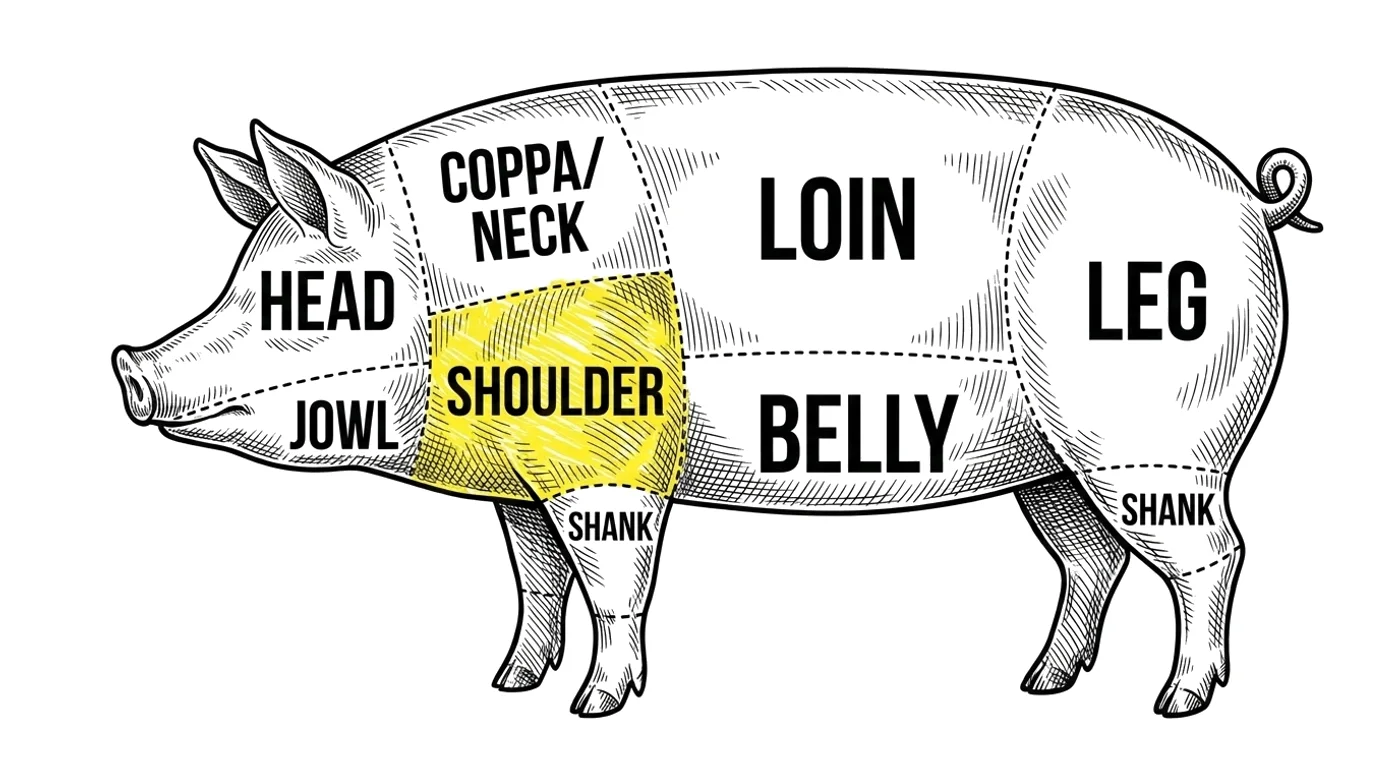
The cut
How to recognise it
A Rosette is long, broad and slightly tapered, usually supported by netting and covered by an even white-grey bloom. The cut surface is deep red with distinct white fat pieces. It should smell of mature pork, pepper, garlic and cellar, with only gentle acidity. A dry shell around a wet centre, hollow gaps, smeared fat or ammonia-heavy mould indicates poor large-diameter drying.
- Shape and size
- Large, plump cylinder, marbled slices
- Lean colour
- Deep rose-red
- Fat and marbling
- Even white flecks
- Casing
- The rosette (wide colon), tied
- Surface bloom
- Natural mould
Origins and history
Lyon became one of France's great charcuterie cities through its location between livestock country, wine routes and urban markets. Pork butchers developed a wide family of sausages, from cooked cervelas to dry Jésus and Rosette. The name Rosette is associated with the natural terminal section of the pig's intestine used as casing and with its pinkish appearance. The broad casing made the sausage a prestige piece because it required good meat, careful stuffing and a long stable cellar cure. It became a fixture of mâchon, the substantial morning meal of Lyon's workers and market traders, and later of bouchon tables. Despite its strong regional identity, Rosette de Lyon is not currently protected by an EU geographical indication.
Name. Named for the rosette, the wide terminal section of the pig's colon it is stuffed into.
- Production today
- Lyon-area charcutiers; unprotected.
- Protection
- Traditional, not origin-protected.
- Tradition vs modern
- A cornerstone of the Lyonnais charcuterie board.
- Seasonality
- Made year-round.
Compare with. Saucisson de Lyon, Saucisson de l'Ardèche
Serving and cultural significance
Slice Rosette thinly across the broad face and serve with bread, cornichons, mustard, cheese and Beaujolais or Côtes du Rhône wine. At a Lyonnais mâchon it appears beside other charcuterie and simple cooked dishes rather than as a delicate garnish.
Recipe and cure
This is not a finished recipe. It is a window into how this meat is traditionally cured. Before you follow any process, please run it through one of our curing calculators, so the salt, cure and timings are right and safe for your own batch.
Make this — the measured Curesmith version →The cure below is the traditional reference. “Make this” opens the measured Curesmith home recipe, scaled to your batch.
Traditional or protected production
There is no registered protected specification. Traditional Lyon practice uses quality pork shoulder or ham trim and firm fat, seasoned with salt, pepper, garlic and sometimes wine. The mixture is packed into a broad natural rosette casing, fermented and matured slowly for weeks or months.
- Meat
- pork
- Cut
- minced pork in the wide end of the colon (the rosette)
- Salt (%)
- 2.5
- Curing salt
- Not included in the base recipe below
- Other agents
- salt, pepper, garlic, sometimes red wine
- Fermented
- Yes
- Target pH
- 4.9
- Starter or mould
- Natural surface mould
- Smoked
- No
- Target aW or weight loss
- ~30% weight loss
- Temperature (°C)
- ferment then dry 13 to 15
- Humidity (%)
- ferment ~90, then 78 to 82
- Maturation
- a month and up
- Basis
- per 1000 g green meat
- Style
- Traditional fermented and dried, wide casing
Ingredients
- sea salt2.5% · 25 g/kg
- black pepper0.3% · 3 g/kg
- garlic0.2% · 2 g/kg
- dextrose0.3% · 3 g/kg
- dry red wine2% · 20 g/kg
Method
- Mix minced pork with pepper, garlic and wine to green weight.
- Stuff into the wide rosette casing.
- Ferment to the target pH.
- Dry slowly; the wide bore gives a mellow, even cure.
Notes
- This traditional recipe uses no nitrite. For safety we recommend adding Cure #2: in a low-oxygen, slow-dried product nitrite is the specific guard against Clostridium botulinum, while salt, acidity and drying control Salmonella, E. coli, Listeria and Staphylococcus.
Safety. The wide casing dries slowly, so control humidity to avoid a hard rim over a soft centre. Verify before serving.
In the Codex
What this product teaches, and where to read more.
Temple. Roof, Water Activity