
Salame della bergamasca
Also known as Salame Bergamasco
Bergamo, Lombardy, Italy
Medium-grained and balanced, an everyday salame of the Bergamo foothills.
Overview
Salame Bergamasco is medium-grained and balanced, an everyday salame of the bergamo foothills. A medium-grained red salame with white fat, gentle garlic-wine aroma and faint nutmeg, clove, cinnamon or mace.
Where it's from
Climate. The pre-Alpine foothills around Bergamo.
Altitude. Orobie foothills
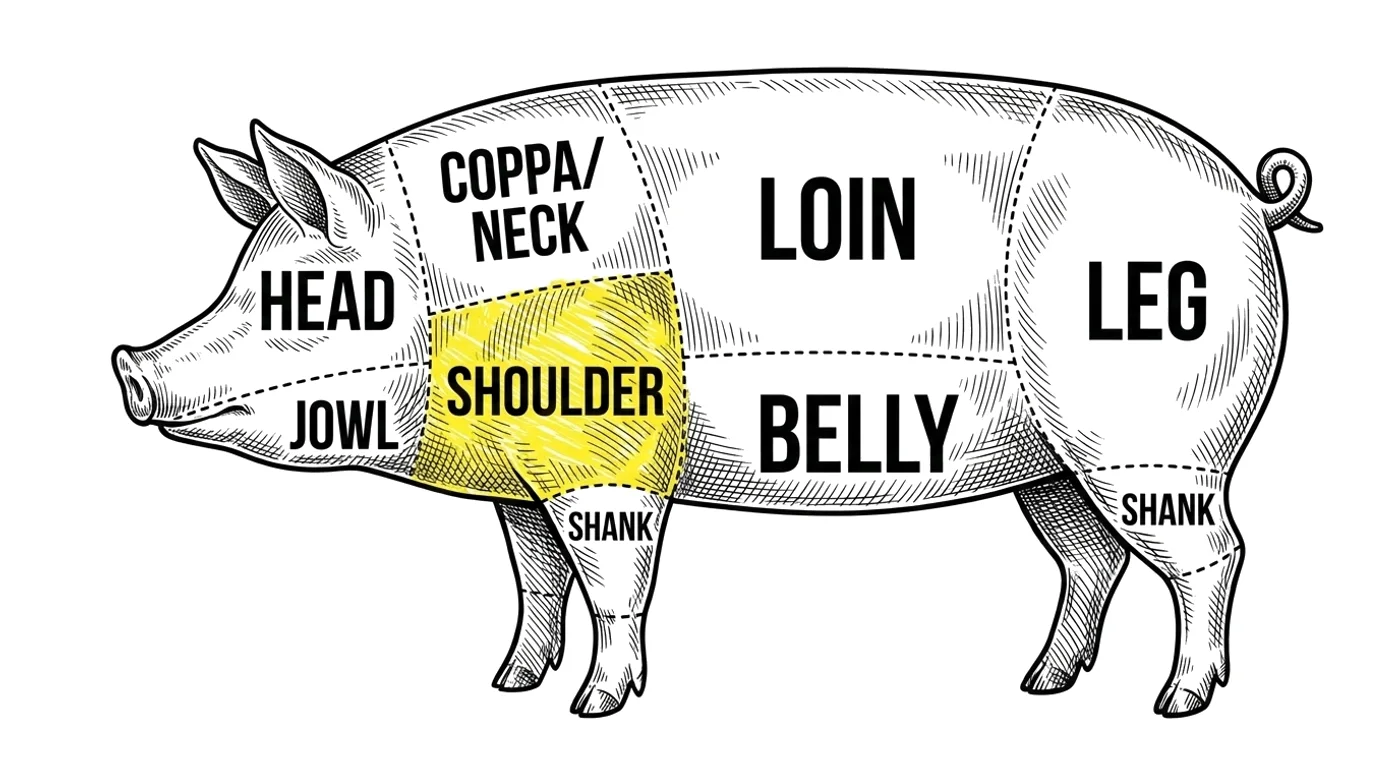
The cut
How to recognise it
A medium-grained red salame with white fat, gentle garlic-wine aroma and faint nutmeg, clove, cinnamon or mace. The medium grain should be even, with no dry rind, black mould, smear or hollow centre.
- Shape and size
- Cylindrical, medium grain
- Lean colour
- Red
- Fat and marbling
- White
- Casing
- Natural, 70 to 80 mm
- Surface bloom
- White mould
Origins and history
This is the honest, everyday salame of the Bergamo foothills, made where families once marked early December with the household pig kill. The day was a communal event directed by the village butcher, who guarded his own blend of spices, some traceable to recipe books several centuries old. Cool cellars, steady humidity and settled mountain air shaped a medium-grained style that is difficult to imitate away from its home valleys.
The December pig slaughter was a communal event directed by a specialist butcher, who often guarded a family spice formula. Cool cellars and settled pre-Alpine humidity shaped the regional dry. The verified production area is Bergamo and the Orobie foothills, Lombardy, Italy. Stories and etymologies are retained when they help explain the tradition, but legends are not used as evidence for the modern specification.
Name. Named for Bergamo.
- Production today
- Producers in the Bergamo area.
- Protection
- Not EU-protected as a general name.
- Tradition vs modern
- A broad everyday tradition.
- Seasonality
- Year-round.
Compare with. Salame Milano
Serving and cultural significance
Slice for a board with polenta, Taleggio or other Bergamo cheeses, pickles and local wine. The medium grain and restrained spice make it suitable for sandwiches and mountain picnics. Allow the slice to warm briefly so the fat softens and the spice blend becomes aromatic.
Recipe and cure
This is not a finished recipe. It is a window into how this meat is traditionally cured. Before you follow any process, please run it through one of our curing calculators, so the salt, cure and timings are right and safe for your own batch.
Make this — the measured Curesmith version →The cure below is the traditional reference. “Make this” opens the measured Curesmith home recipe, scaled to your batch.
Traditional or protected production
Salame Bergamasco is a medium-grained pork salame associated with winter household slaughter in the Bergamo foothills. Garlic infused in wine, pepper and restrained warm spices vary according to the maker.
- Meat
- pork
- Salt (%)
- 2.55
- Curing salt
- Not included in the base recipe below
- Fermented
- Yes
- Target pH
- 4.9
- Starter or mould
- Natural surface mould
- Smoked
- No
- Target aW or weight loss
- ~30% weight loss
- Temperature (°C)
- ferment 22 to 24, then dry 13 to 15
- Humidity (%)
- ferment ~90, then 75 to 80
- Maturation
- 3 to 6 weeks
- Basis
- per 1000 g green meat
- Style
- Traditional fermented and dried salame
Ingredients
- Lean pork (base)100% · 1000 g/kg
- Pork fat33.33% · 333 g/kg
- Dextrose0.2% · 2 g/kg
- Red wine, garlic-infused with the garlic discarded1% · 10 g/kg
- Black pepper0.05% · 0 g/kg
- Nutmeg0.05% · 0 g/kg
- Cloves0.04% · 0 g/kg
- Cinnamon0.03% · 0 g/kg
- Mace0.03% · 0 g/kg
Method
- Mince pork and fat and mix with all ingredients to green meat weight.
- Stuff into casing.
- Ferment to the target pH.
- Dry to the target weight loss.
Notes
- This traditional recipe uses no nitrite. For safety we recommend adding Cure #2: in a low-oxygen, slow-dried product nitrite is the specific guard against Clostridium botulinum, while salt, acidity and drying control Salmonella, E. coli, Listeria and Staphylococcus.
In the Codex
What this product teaches, and where to read more.
Temple. Roof, Water Activity