
Salame Brianza
Brianza, Lombardy, Italy
Smooth, sweet and mild, finely grained and easy-eating.
Overview
Salame Brianza is the mild salami of the Lombard foothills north of Milan. It may be fine or coarse according to size, but the slice remains compact, ruby red and gently sweet. Pepper and optional wine support the pork without producing a heavily garlicky or acidic sausage.
Where it's from
Climate. The Brianza area of Lombardy, north of Milan.
Altitude. Lombard plain and hills
The cut
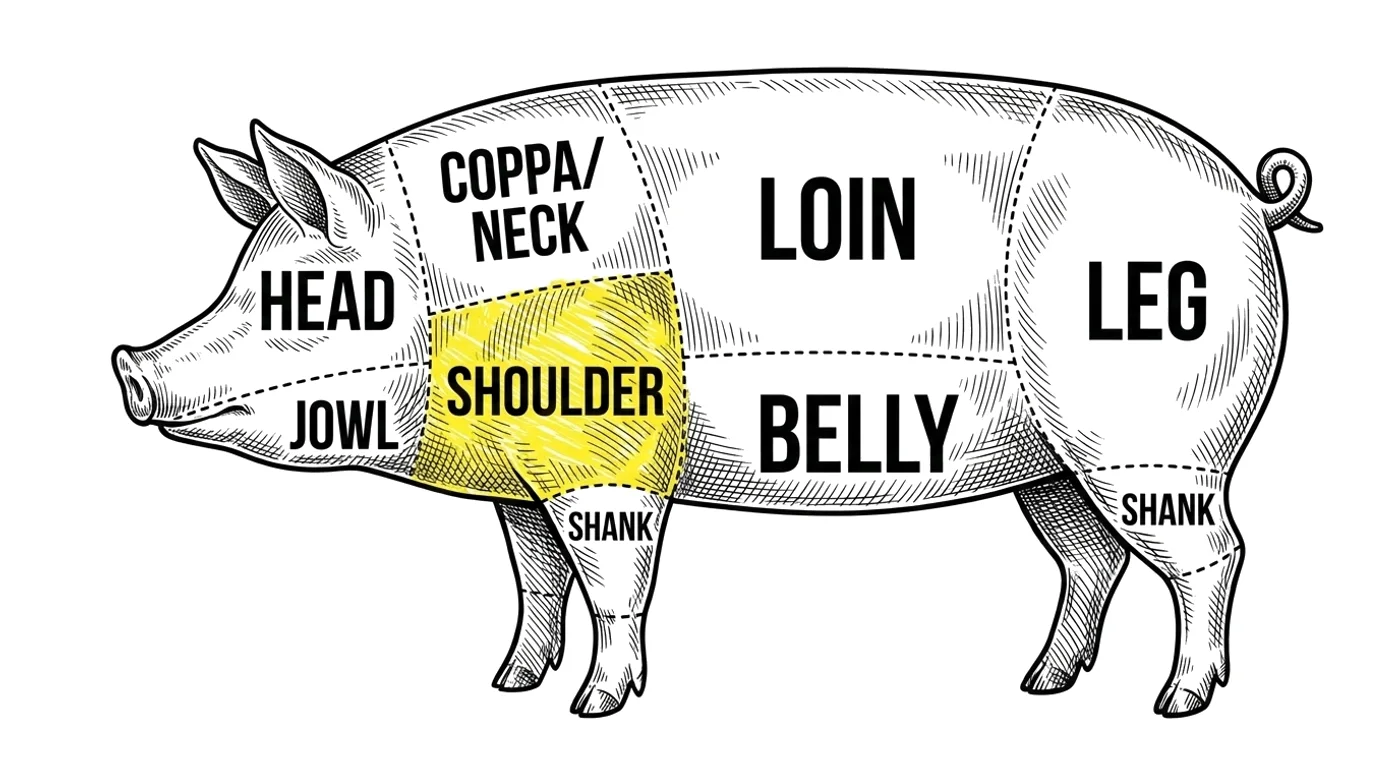
How to recognise it
The salami is cylindrical and can be fine or coarse grained depending on diameter. The slice is compact ruby red with evenly distributed white fat. Aroma is sweet, mild and peppery, sometimes with a wine note. The casing may carry a clean white bloom. Excessive garlic, sharp acid, smeared fat, a hollow centre or a hard dry edge are defects.
- Shape and size
- Cylindrical, fine to medium grind
- Lean colour
- Uniform red
- Fat and marbling
- Fine white
- Casing
- Hog, 40 mm
- Surface bloom
- White mould
Origins and history
Brianza rises above the foggiest part of the Po plain, with hills, temperature changes and better natural ventilation for curing. Pork keeping and sausage making were encouraged by farms, markets and monastic estates across Lombardy. The first frequently cited written references to the Brianza style come from the seventeenth century, followed by more detailed nineteenth-century descriptions. Its growing reputation was visible at the Paris Universal Exposition of 1900, where regional products reached an international audience. Producers created the protection consortium in 1978. European PDO registration in 1996 defined a precise Brianza area bounded by rivers, roads and the foothills, rather than the looser modern cultural use of the regional name.
Name. Named for the Brianza region of Lombardy.
- Production today
- Producers in Brianza.
- Protection
- DOP.
- Tradition vs modern
- Traditional Lombard method.
- Seasonality
- Year-round.
Compare with. Salame Milano
Serving and cultural significance
Serve thin slices with bread, soft cheese, pickles or Lombard red wine. Fine-grain versions suit sandwiches, while broader coarse-grain pieces work well on a charcuterie board. The mild sweetness should not be buried under strong mustard or smoke.
Recipe and cure
This is not a finished recipe. It is a window into how this meat is traditionally cured. Before you follow any process, please run it through one of our curing calculators, so the salt, cure and timings are right and safe for your own batch.
Curesmith home adaptation — not designation-compliant
Make this — the measured Curesmith version →The cure below is the traditional reference. “Make this” opens the measured Curesmith home recipe, scaled to your batch.
Traditional or protected production
PDO production occurs inside the legally defined Brianza area. Qualifying Italian pork and firm fat are seasoned with salt, ground or whole pepper and permitted wine or technological ingredients. Drying and maturation schedules vary with diameter, and the specification recognises both fine and coarse grain.
- Meat
- pork
- Salt (%)
- 2.8
- Curing salt
- Not included in the base recipe below
- Fermented
- Yes
- Target pH
- 4.9
- Starter or mould
- Natural white surface mould
- Smoked
- No
- Target aW or weight loss
- ~30% weight loss
- Temperature (°C)
- ferment 22 to 24, then dry 13 to 15
- Humidity (%)
- ferment ~90, then 75 to 80
- Maturation
- 3 to 8 weeks by size
- Basis
- per 1000 g green meat
- Style
- Traditional fermented and dried salame
Ingredients
- Pork shoulder, lean (base)100% · 1000 g/kg
- Back fat42.86% · 429 g/kg
- White pepper0.2% · 2 g/kg
- Black peppercorns0.4% · 4 g/kg
- Dextrose0.3% · 3 g/kg
- Garlic powder0.3% · 3 g/kg
- White wine1.5% · 15 g/kg
Method
- Mince pork and fat and mix with all ingredients to green meat weight.
- Stuff into casing and inoculate the surface mould.
- Ferment warm until the target pH is reached.
- Dry slowly to the target weight loss.
Notes
- The official protected specification controls the named product. Any Curesmith EQ, starter-culture, curing-salt or home-scale adaptation is a separate method and must not be presented as designation-compliant.
- This traditional recipe uses no nitrite. For safety we recommend adding Cure #2: in a low-oxygen, slow-dried product nitrite is the specific guard against Clostridium botulinum, while salt, acidity and drying control Salmonella, E. coli, Listeria and Staphylococcus.
In the Codex
What this product teaches, and where to read more.
Temple. Roof, Water Activity