
Salame Cremona
Cremona, Po Valley, Italy
Soft, moist and openly garlicky, a yielding lowland salame.
Overview
Salame Cremona is a broad, softly textured salami with a clear crushed-garlic aroma. It developed in the humid Po Valley, where selected fresh pork, natural casing and careful maturation produce a yielding slice rather than a hard dry sausage.
Where it's from
Climate. The Po plain around Cremona.
Altitude. Lowland Po plain
The cut
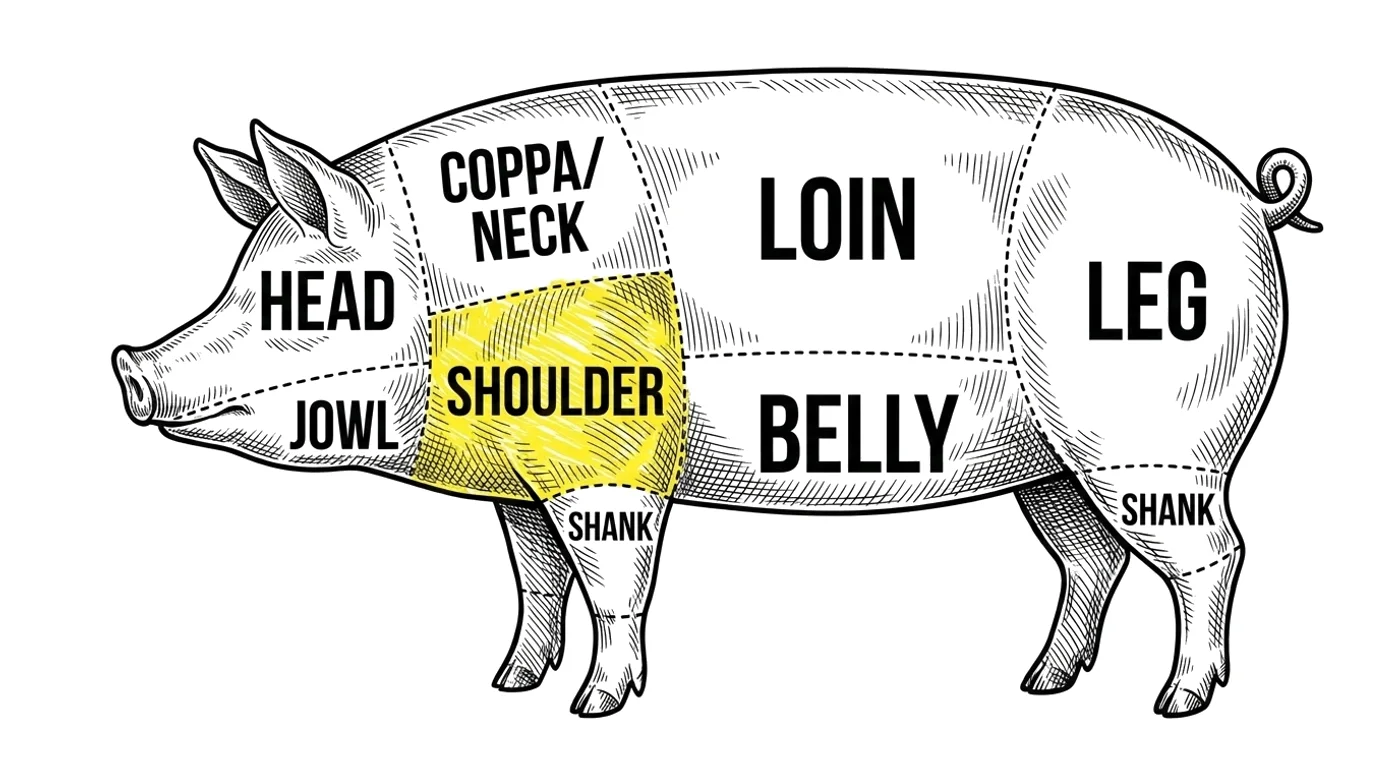
How to recognise it
The salami is cylindrical, weighs more than about 500 g and has an irregular natural surface. The slice is deep red, compact and homogeneous, with visible lean and fat fragments and a soft yielding consistency. Crushed garlic and pepper should be evident. A hard dry casing, wet centre, harsh acidity, grease smear or stale garlic odour are defects.
- Shape and size
- Cylindrical, soft, medium grind
- Lean colour
- Red
- Fat and marbling
- White
- Casing
- Natural, wide calibre, 65 or more mm
- Surface bloom
- White mould
Origins and history
Pig husbandry around Cremona reaches back to Roman agriculture and later expanded beside dairying, where whey and other by-products helped feed heavy pigs. Medieval documents from 1231 record trade in pigs and pork between Cremona and neighbouring territories. Renaissance archives contain further references to a minced, spiced sausage exchanged with convents and noble households. The damp lowland climate did not prevent curing, but demanded skilled control of rooms, casings and airflow. Modern refrigeration allowed year-round production, while the historic supply relationship spread across four northern regions. Salame Cremona received PGI protection in 2007, recognising both the production zone and the characteristic soft, garlic-scented style.
Name. Named for the city of Cremona.
- Production today
- Producers across the Po valley zone.
- Protection
- IGP.
- Tradition vs modern
- Traditional lowland method.
- Seasonality
- Year-round.
Compare with. Salame Milano
Serving and cultural significance
Slice moderately thinly and serve with bread, mustard fruits, cheese and the wines of the Po Valley. Its soft texture suits sandwiches, antipasti and picnic plates, but it should be freshly cut and protected from drying once opened. The crushed-garlic aroma is best balanced by mild cheese or sweet-sharp fruit preserves.
Recipe and cure
This is not a finished recipe. It is a window into how this meat is traditionally cured. Before you follow any process, please run it through one of our curing calculators, so the salt, cure and timings are right and safe for your own batch.
Curesmith home adaptation — not designation-compliant
Make this — the measured Curesmith version →The cure below is the traditional reference. “Make this” opens the measured Curesmith home recipe, scaled to your batch.
Traditional or protected production
PGI production uses fresh selected pork from the recognised northern Italian heavy-pig regions. The meat is ground, seasoned with salt, pepper and crushed garlic, stuffed into natural casing and matured for the specification's minimum period. The broad production zone reflects an established Po Valley raw-material and processing network rather than only the city boundary.
- Meat
- pork
- Salt (%)
- 2.8
- Curing salt
- Not included in the base recipe below
- Fermented
- Yes
- Target pH
- 4.9
- Starter or mould
- Natural white surface mould
- Smoked
- No
- Target aW or weight loss
- ~30% weight loss
- Temperature (°C)
- ferment 22 to 24, then dry 13 to 15
- Humidity (%)
- ferment ~90, then 75 to 80
- Maturation
- 3 to 8 weeks by size
- Basis
- per 1000 g green meat
- Style
- Traditional fermented and dried salame
Ingredients
- Lean pork (base)100% · 1000 g/kg
- Back fat42.86% · 429 g/kg
- Pepper0.2% · 2 g/kg
- Black peppercorns0.2% · 2 g/kg
- Dextrose (or sugar)0.3% · 3 g/kg, or sugar 0.3% · 3 g/kg
- Garlic, smashed0.7% · 7 g/kg
- Red wine0.5% · 5 g/kg
Method
- Mince pork and fat and mix with all ingredients to green meat weight.
- Stuff into casing and inoculate the surface mould.
- Ferment warm until the target pH is reached.
- Dry slowly to the target weight loss.
Notes
- The official protected specification controls the named product. Any Curesmith EQ, starter-culture, curing-salt or home-scale adaptation is a separate method and must not be presented as designation-compliant.
- This traditional recipe uses no nitrite. For safety we recommend adding Cure #2: in a low-oxygen, slow-dried product nitrite is the specific guard against Clostridium botulinum, while salt, acidity and drying control Salmonella, E. coli, Listeria and Staphylococcus.
In the Codex
What this product teaches, and where to read more.
Temple. Roof, Water Activity