
Salame di Fabriano
Fabriano, Marche, Italy
Marbled with hand-cut lard cubes, coarse and rich, a Marche classic.
Overview
Salame di Fabriano is marbled with hand-cut lard cubes, coarse and rich, a marche classic. A red lean slice containing distinct hand-cut white lardons and whole peppercorns. The flavour is direct, pork-led and only lightly spiced.
Where it's from
Climate. The Marche hills around Fabriano.
Altitude. Apennine hills
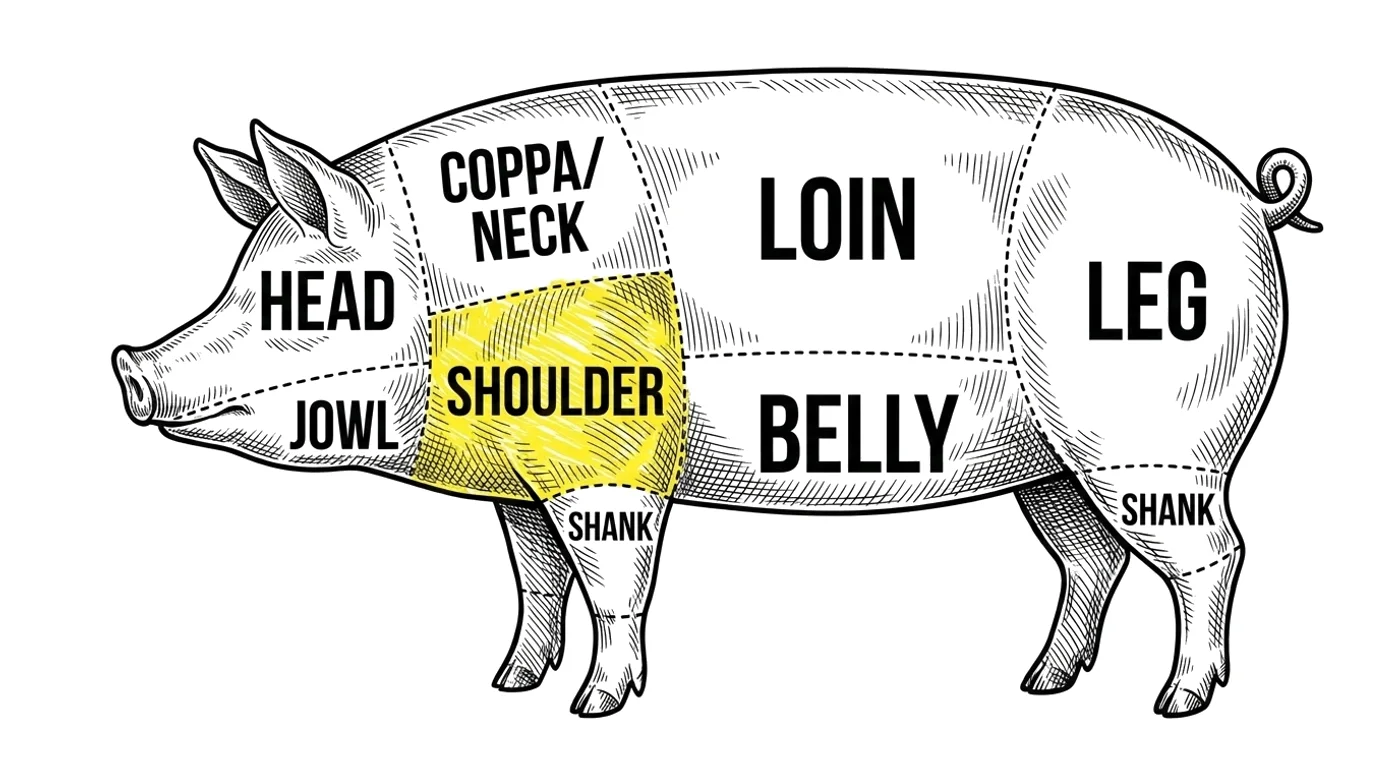
The cut
How to recognise it
A red lean slice containing distinct hand-cut white lardons and whole peppercorns. The flavour is direct, pork-led and only lightly spiced. The slice is compact and sweet; rancid lardons, sticky bloom or a grey centre are defective.
- Shape and size
- Cylindrical, two-tone with lard cubes
- Lean colour
- Deep red
- Fat and marbling
- Distinct white lard cubes
- Casing
- Pork bung
- Surface bloom
- White mould
Origins and history
This salame belongs to the Marche, the hill country that falls away towards the Adriatic, where cured pork has been made since at least the seventeenth century. The older style used pork alone, though many makers now blend in a little beef. What defines it is its plainness: good lean, hand-cut back fat and little more than salt and pepper. The making season traditionally ran from the first cold of autumn through to the start of spring.
Fabriano's hill economy has a documented cured-pork tradition extending back centuries. The making season ran from the first autumn cold until early spring, when natural conditions protected the slow dry. The verified production area is Fabriano and surrounding Marche hills, Italy. Stories and etymologies are retained when they help explain the tradition, but legends are not used as evidence for the modern specification.
Name. Named for the town of Fabriano.
- Production today
- Producers around Fabriano.
- Protection
- Not EU-protected as a general name.
- Tradition vs modern
- Hand-cut lard is the signature.
- Seasonality
- Year-round.
Compare with. Salame Napoli
Serving and cultural significance
Cut the firm sausage thinly to show the deep red lean and hand-cut white lardons. Serve with unsalted bread, pecorino, olives and wines of the Marche. Its sweet, persistent flavour needs little garnish, and the natural dark bloom should be cleaned rather than mistaken for spoilage.
Recipe and cure
This is not a finished recipe. It is a window into how this meat is traditionally cured. Before you follow any process, please run it through one of our curing calculators, so the salt, cure and timings are right and safe for your own batch.
Make this — the measured Curesmith version →The cure below is the traditional reference. “Make this” opens the measured Curesmith home recipe, scaled to your batch.
Traditional or protected production
Salame di Fabriano is a plain Marche salame made from well-trimmed pork and hand-cut cubes of firm back fat, seasoned mainly with salt and pepper. It is included in the Slow Food traditional-food programme rather than an EU GI.
- Meat
- pork
- Salt (%)
- 4
- Curing salt
- Not included in the base recipe below
- Fermented
- Yes
- Target pH
- 4.9
- Starter or mould
- Natural surface mould
- Smoked
- No
- Target aW or weight loss
- ~30% weight loss
- Temperature (°C)
- ferment 22 to 24, then dry 13 to 15
- Humidity (%)
- ferment ~90, then 75 to 80
- Maturation
- 3 to 6 weeks
- Basis
- per 1000 g green meat
- Style
- Traditional fermented and dried salame
Ingredients
- Lean pork, well-trimmed (base)100% · 1000 g/kg
- Back fat, diced33.33% · 333 g/kg
- Black pepper, whole peppercorns0.15% · 2 g/kg
- Black pepper, ground0.05% · 0 g/kg
- White wine0.5% · 5 g/kg
Method
- Mince pork and fat and mix with all ingredients to green meat weight.
- Stuff into casing.
- Ferment to the target pH.
- Dry to the target weight loss.
Notes
- This traditional recipe uses no nitrite. For safety we recommend adding Cure #2: in a low-oxygen, slow-dried product nitrite is the specific guard against Clostridium botulinum, while salt, acidity and drying control Salmonella, E. coli, Listeria and Staphylococcus.
In the Codex
What this product teaches, and where to read more.
Temple. Roof, Water Activity