
Salame di Varzi
Varzi (Pavia), Lombardy, Italy
Coarse and peppery, mellowed and rounded by long, slow ageing.
Overview
Salame di Varzi is the deep, mellow salami of the Staffora Valley. A coarse pork mixture, whole peppercorns, garlic and wine matures slowly in the Oltrepò Pavese hills, creating a sweet, complex slice rather than a sharply fermented one.
Where it's from
Climate. The Oltrepo Pavese hills of Lombardy.
Altitude. Apennine foothills of Pavia
The cut
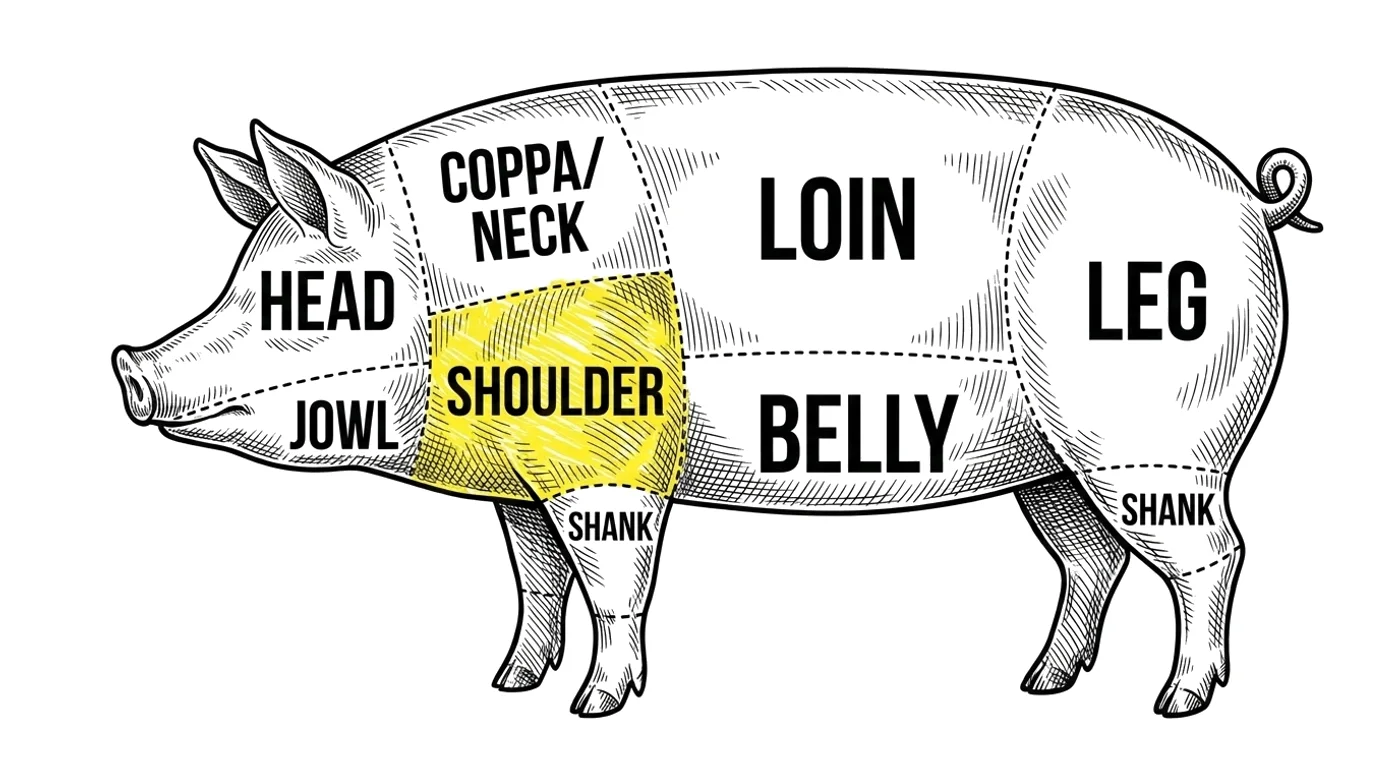
How to recognise it
The salami is cylindrical and often substantial, with a natural casing and white-grey bloom. The slice is bright red, coarsely cut and evenly studded with white fat and pepper. Aroma is sweet, mature and gently garlicky, with wine in the background. Harsh acid, a dry shell, wet centre, rancid fat or ammonia-heavy mould are faults.
- Shape and size
- Large cylinder, coarse, whole peppercorns visible
- Lean colour
- Deep red
- Fat and marbling
- White cubes
- Casing
- Natural pork middles, or a wide pork bung, or a hand-sewn double pork casing, 65 mm
- Surface bloom
- White mould
Origins and history
Varzi lies on an Apennine route between the Po plain and the Ligurian coast, historically important for salt and trade. Local tradition attributes the spread of stuffed pork sausage to the Lombards, who valued portable food during migration. That account cannot be proved as a single invention, but it reflects the old relationship between preserved meat and movement. By the thirteenth century the Malaspina lords are said to have served Varzi salami to important guests, marking its shift from necessity to prestige. Over later centuries farmers and village butchers refined larger sizes and long maturation. The consortium was founded in 1984, and European PDO protection secured the name and the Staffora production area in the 1990s.
Name. Named for the town of Varzi.
- Production today
- Consortium producers in the Varzi zone.
- Protection
- DOP.
- Tradition vs modern
- Traditional slow hill-cellar ageing.
- Seasonality
- Year-round.
Compare with. Salame Piacentino
Serving and cultural significance
Slice across the broad face and serve with bread, pickles, aged cheese and Oltrepò Pavese wine. It also suits a substantial country lunch with polenta or roasted vegetables. A mature example needs little garnish because pepper, garlic and cellar ageing already provide complexity and a long savoury finish.
Recipe and cure
This is not a finished recipe. It is a window into how this meat is traditionally cured. Before you follow any process, please run it through one of our curing calculators, so the salt, cure and timings are right and safe for your own batch.
Curesmith home adaptation — not designation-compliant
Make this — the measured Curesmith version →The cure below is the traditional reference. “Make this” opens the measured Curesmith home recipe, scaled to your batch.
Traditional or protected production
PDO production uses qualifying Italian pork from the permitted regions and takes place in the defined Oltrepò Pavese area. Lean cuts and firm fat are seasoned with salt, pepper, garlic and permitted wine or sugars, stuffed and matured for a period that increases with diameter. The large formats require especially slow, even drying.
- Meat
- pork
- Salt (%)
- 2.8
- Curing salt
- Not included in the base recipe below
- Fermented
- Yes
- Target pH
- 4.9
- Starter or mould
- Natural white surface mould
- Smoked
- No
- Target aW or weight loss
- ~30% weight loss
- Temperature (°C)
- ferment 22 to 24, then dry 13 to 15
- Humidity (%)
- ferment ~90, then 75 to 80
- Maturation
- a few weeks to months
- Basis
- per 1000 g green meat
- Style
- Traditional fermented and dried salame
Ingredients
- Lean pork (base)100% · 1000 g/kg
- Back fat, jowl and pork belly42.86% · 429 g/kg
- Dextrose (or sugar)0.3% · 3 g/kg, or sugar 0.2% · 2 g/kg
- Pepper0.1% · 1 g/kg
- Peppercorns0.2% · 2 g/kg
- Nutmeg0.05% · 0 g/kg
- Garlic and red wine infusion1% · 10 g/kg
Method
- Mince pork and fat and mix with all ingredients to green meat weight.
- Stuff into casing and inoculate the surface mould.
- Ferment warm until the target pH is reached.
- Dry slowly to the target weight loss.
Notes
- The official protected specification controls the named product. Any Curesmith EQ, starter-culture, curing-salt or home-scale adaptation is a separate method and must not be presented as designation-compliant.
- This traditional recipe uses no nitrite. For safety we recommend adding Cure #2: in a low-oxygen, slow-dried product nitrite is the specific guard against Clostridium botulinum, while salt, acidity and drying control Salmonella, E. coli, Listeria and Staphylococcus.
In the Codex
What this product teaches, and where to read more.
Temple. Roof, Water Activity