
Salame d'oca di Mortara
Mortara, Lombardy, Italy
Fine and mild, a goose-and-pork salame with deep local and Jewish roots.
Overview
Salame d'oca di Mortara is fine and mild, a goose-and-pork salame with deep local and jewish roots. A goose-neck or tubular cooked sausage with the skin adhering closely to a compact slice. The flavour is sweet, delicate and gently spiced, with clear goose character.
Where it's from
Climate. The Lomellina rice plain around Mortara in Lombardy.
Altitude. Lomellina plain
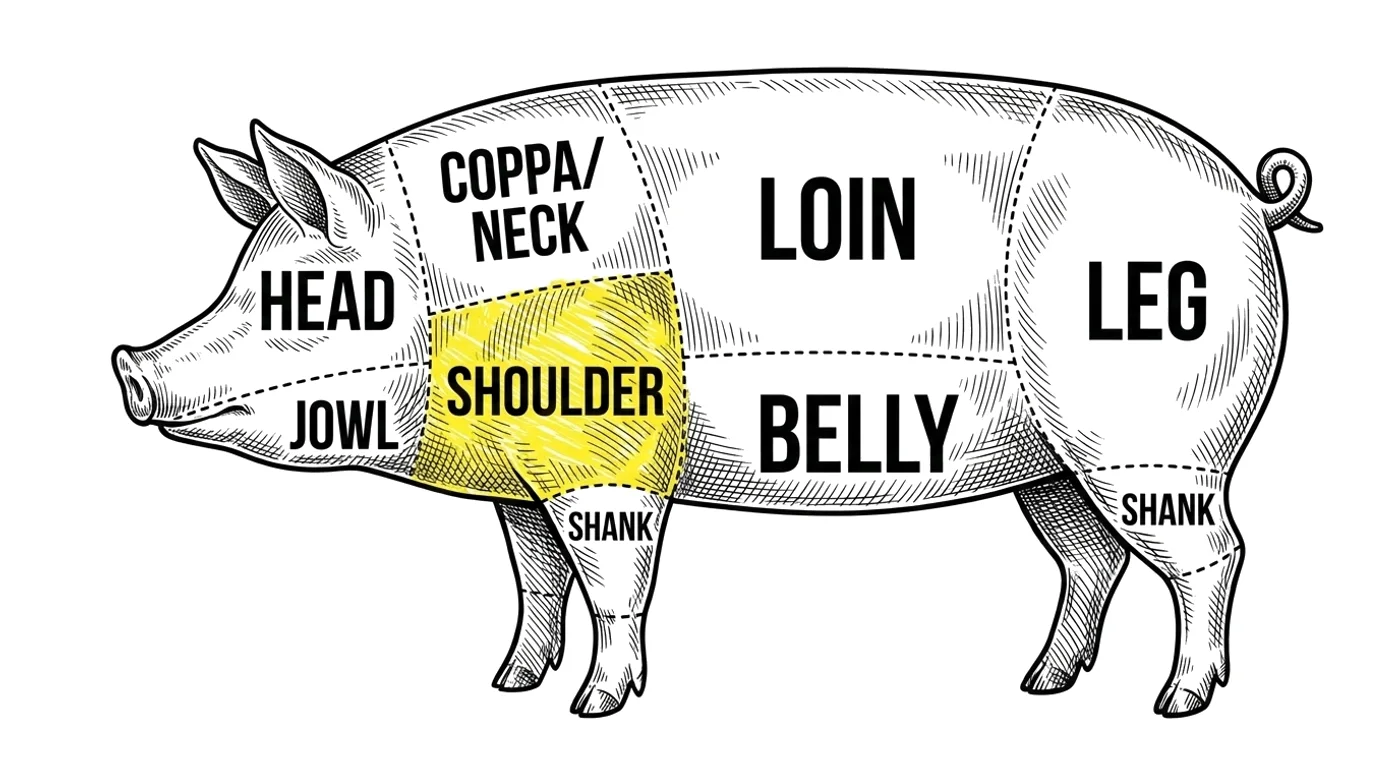
The cut
How to recognise it
A goose-neck or tubular cooked sausage with the skin adhering closely to a compact slice. The flavour is sweet, delicate and gently spiced, with clear goose character. The goose skin should adhere to a compact cooked filling; raw pockets, purge or sourness are faults.
- Shape and size
- Cylindrical, pale
- Lean colour
- Pale rose
- Fat and marbling
- White
- Casing
- Goose skin, or protein-lined fibrous casing, 60 mm
- Surface bloom
- Possible
Origins and history
This goose salame belongs to the Lomellina plain around Mortara in Lombardy, a low, watery country long suited to rearing geese. Its roots reach back to Jewish communities that settled in the area from the late fifteenth century, for whom a pork-free goose sausage answered dietary law. Over time local makers blended goose with pork to suit the wider population, and it is this mixed version that became best known. It now carries protected geographical status.
Goose husbandry suited the wet rice plain of Lomellina. Jewish food traditions encouraged goose sausage, while local non-Jewish butchers later blended goose with pork to create the protected mixed product known today. The verified production area is Lomellina municipalities around Mortara, Pavia, Lombardy, Italy. Stories and etymologies are retained when they help explain the tradition, but legends are not used as evidence for the modern specification.
Name. Salame d'oca, 'goose salame'; Mortara the town.
- Production today
- Producers in the Mortara area.
- Protection
- IGP (Salame d'oca di Mortara).
- Tradition vs modern
- Rooted in Jewish dietary tradition of the Lomellina.
- Seasonality
- Celebrated at the autumn goose fair.
Compare with. Salame Milano
Serving and cultural significance
Serve the cooked goose salami cold in clean slices with bread, mustard, vegetables or a mild white wine. It may also accompany mashed potatoes or warm vegetables. Keep it refrigerated and protect the cut face, because it is a cooked high-moisture product rather than a shelf-stable dry salami.
Recipe and cure
This is not a finished recipe. It is a window into how this meat is traditionally cured. Before you follow any process, please run it through one of our curing calculators, so the salt, cure and timings are right and safe for your own batch.
Make this — the measured Curesmith version →The cure below is the traditional reference. “Make this” opens the measured Curesmith home recipe, scaled to your batch.
Traditional or protected production
Salame d'Oca di Mortara PGI is a cooked charcuterie product stuffed in goose skin. Goose meat is combined with lean pork and pork fat, seasoned, stuffed, dried briefly and cooked. It is not a fermented dry salame.
- Meat
- goose and pork
- Salt (%)
- 1.6
- Curing salt
- Not included in the base recipe below
- Fermented
- Yes
- Target pH
- 4.9
- Starter or mould
- Natural surface mould
- Smoked
- No
- Target aW or weight loss
- ~30% weight loss
- Temperature (°C)
- ferment 22 to 24, then dry 13 to 15
- Humidity (%)
- ferment ~90, then 75 to 80
- Maturation
- 3 to 6 weeks
- Basis
- per 1000 g green meat
- Style
- Traditional fermented and dried salame
Ingredients
- Lean goose meat (base)100% · 1000 g/kg
- pork neck, lean85.71% · 857 g/kg
- Pork belly and jowl100% · 1000 g/kg
- Sugar0.1% · 1 g/kg
- White pepper0.1% · 1 g/kg
- Allspice0.05% · 0 g/kg
- Garlic0.1% · 1 g/kg
- Red wine0.5% · 5 g/kg
Method
- Mince pork and fat and mix with all ingredients to green meat weight.
- Stuff into casing.
- Ferment to the target pH.
- Dry to the target weight loss.
Notes
- This traditional recipe uses no nitrite. For safety we recommend adding Cure #2: in a low-oxygen, slow-dried product nitrite is the specific guard against Clostridium botulinum, while salt, acidity and drying control Salmonella, E. coli, Listeria and Staphylococcus.
In the Codex
What this product teaches, and where to read more.
Temple. Roof, Water Activity