
Salame Felino
Felino (Parma), Emilia-Romagna, Italy
Sweet, mild and delicate, with a soft coarse grain and very little garlic, one of the most refined Italian salami.
Overview
Salame Felino is a mild, tender salami from the Parma hills. A coarse pork-and-fat mixture is seasoned simply with pepper, garlic and wine and stuffed so that one end is broader than the other. Its appeal is sweetness and soft grain rather than sharp acidity or heavy spice.
Where it's from
Climate. Felino in the Parma hills, a renowned salame town.
Altitude. Parma hills
The cut
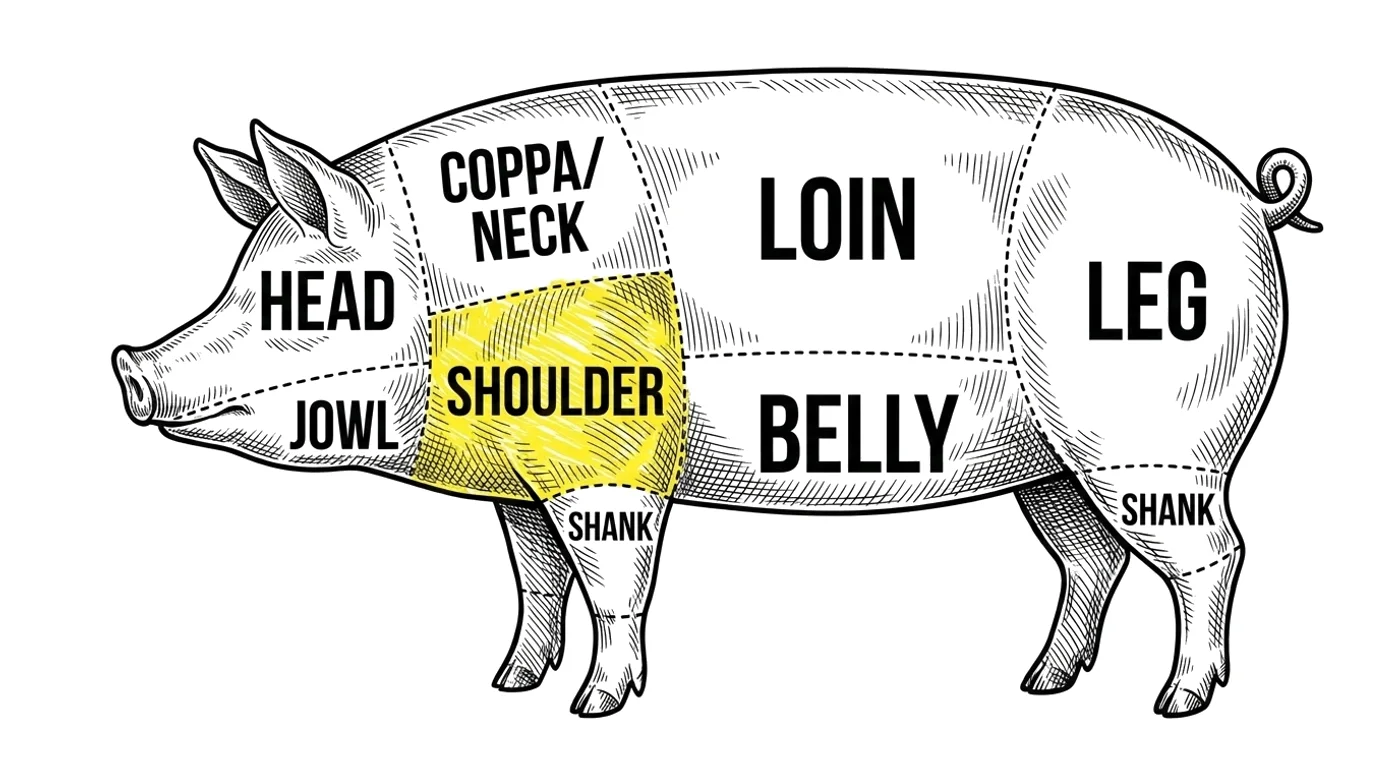
How to recognise it
The sausage is cylindrical with one end visibly larger, in a natural casing with a white-grey surface. Weight can range widely. The slice is ruby red, lean-looking and evenly grained with soft white fat. Taste should be mild and delicate, with pepper, garlic and wine in the background. Rubberiness, harsh acid, grease smear or a dry rim are faults.
- Shape and size
- Slight crescent, coarse cut
- Lean colour
- Rosy red
- Fat and marbling
- White
- Casing
- Natural large pork casing, tied with butcher's twine
- Surface bloom
- Light white mould
Origins and history
The Baganza valley south of Parma offered pigs, salt access, cool hill air and the technical culture created by the region's ham and cheese industries. Classical references show that pork sausages were known in the wider territory, but direct evidence for the Felino form becomes much stronger from the eighteenth and nineteenth centuries. The Baptistery of Parma contains an often-cited medieval depiction of a salami-like product, while Felino's own butchers developed a recognisable coarse, tender style during the nineteenth century. The term Salame Felino entered an Italian dictionary in 1905, and provincial institutions used it formally from the 1920s. PGI registration in 2013 protected production across the province of Parma while retaining Felino as the historical centre.
Name. Named for the town of Felino, south-west of Parma.
- Production today
- Producers in the Parma zone.
- Protection
- IGP.
- Tradition vs modern
- Traditionally little or no starter, natural fermentation.
- Seasonality
- Year-round.
Compare with. Salame Piacentino
Serving and cultural significance
Cut freshly and eat soon after slicing, with bread, Parmigiano Reggiano, pickles or Lambrusco. The mild profile makes it especially useful in sandwiches, picnic meals and mixed antipasti where stronger salami would dominate. Let the slices warm briefly so their soft grain and gentle wine aroma become more apparent.
Recipe and cure
This is not a finished recipe. It is a window into how this meat is traditionally cured. Before you follow any process, please run it through one of our curing calculators, so the salt, cure and timings are right and safe for your own batch.
Curesmith home adaptation — not designation-compliant
Make this — the measured Curesmith version →The cure below is the traditional reference. “Make this” opens the measured Curesmith home recipe, scaled to your batch.
Traditional or protected production
PGI production uses selected fresh pork and firm fat in the province of Parma. The meat is ground to a medium-large grain, seasoned, packed into natural casing, tied and matured. Current controls govern raw material, casing, size, natural processing and labelling. The protected product should remain tender rather than dried to a hard salami.
- Meat
- pork
- Salt (%)
- 2.8
- Curing salt
- Not included in the base recipe below
- Fermented
- Yes
- Target pH
- 4.9
- Starter or mould
- Natural white surface mould
- Smoked
- No
- Target aW or weight loss
- ~30% weight loss
- Temperature (°C)
- ferment 22 to 24, then dry 13 to 15
- Humidity (%)
- ferment ~90, then 75 to 80
- Maturation
- a few weeks
- Basis
- per 1000 g green meat
- Style
- Traditional fermented and dried salame
Ingredients
- Lean pork (base)100% · 1000 g/kg
- Pork belly33.33% · 333 g/kg
- Pork back fat33.33% · 333 g/kg
- Pepper, ground0.1% · 1 g/kg
- Peppercorns, whole0.2% · 2 g/kg
- Dextrose (or sugar)0.3% · 3 g/kg, or sugar 0.2% · 2 g/kg
- Pepper, ground0.2% · 2 g/kg
- Garlic0.35% · 4 g/kg
- Dry white wine0.5% · 5 g/kg
Method
- Mince pork and fat and mix with all ingredients to green meat weight.
- Stuff into casing and inoculate the surface mould.
- Ferment warm until the target pH is reached.
- Dry slowly to the target weight loss.
Notes
- The official protected specification controls the named product. Any Curesmith EQ, starter-culture, curing-salt or home-scale adaptation is a separate method and must not be presented as designation-compliant.
- This traditional recipe uses no nitrite. For safety we recommend adding Cure #2: in a low-oxygen, slow-dried product nitrite is the specific guard against Clostridium botulinum, while salt, acidity and drying control Salmonella, E. coli, Listeria and Staphylococcus.
In the Codex
What this product teaches, and where to read more.
Temple. Roof, Water Activity