
Salame Piacentino
Piacenza, Emilia-Romagna, Italy
Coarse-grained, garlicky and wine-scented, savoury and rustic rather than sweet.
Overview
Salame Piacentino is the coarse, wine-scented member of Piacenza's trio of protected salumi. Pork and firm fat are seasoned with pepper, garlic and wine, stuffed into a natural casing and aged until the slice is bright red, tender and aromatic.
Where it's from
Climate. The Piacenza hills of Emilia, part of the Piacentini trio.
Altitude. Emilian hills
The cut
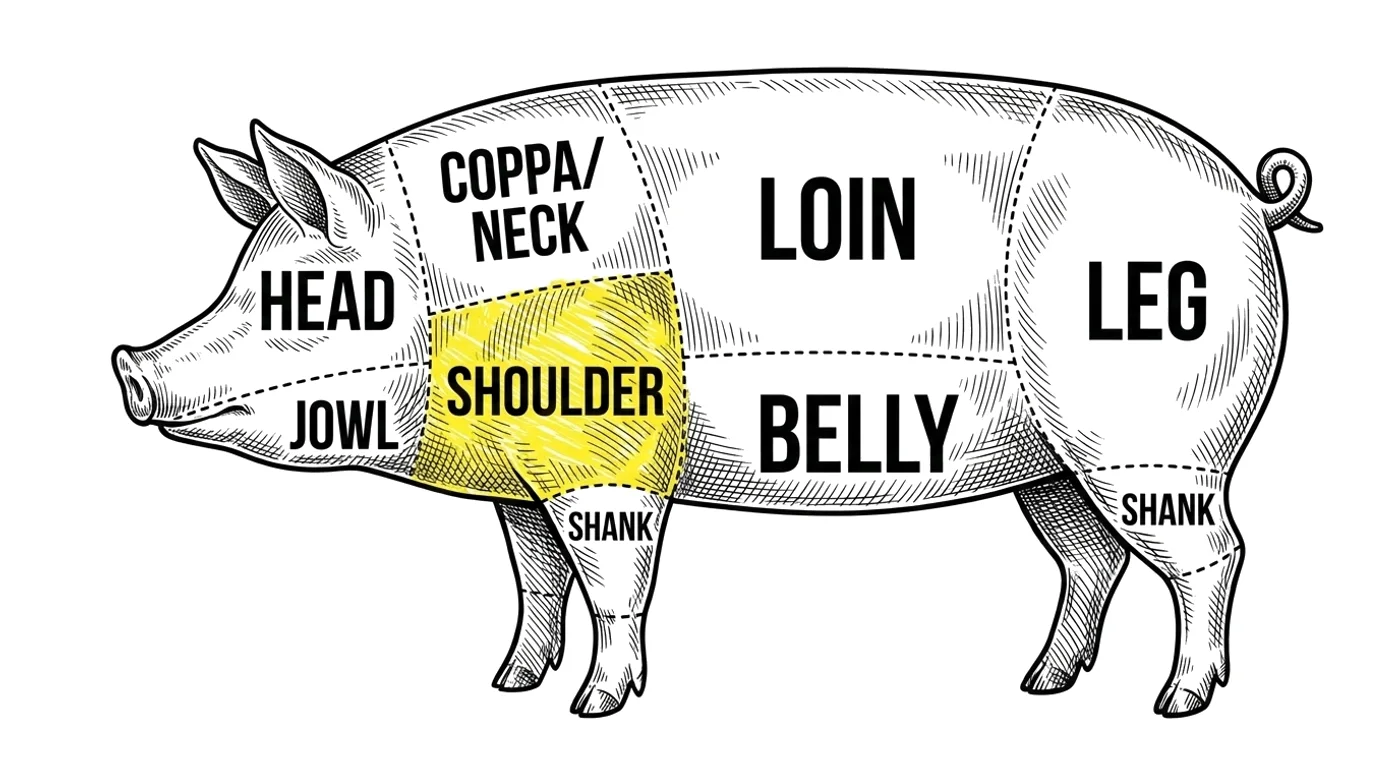
How to recognise it
The salami is cylindrical, normally 400 g to about 1 kg, with a natural casing and pale bloom. The cut surface is vivid red with well-distributed pink-white fat. Garlic, pepper and wine should be clear but balanced. A hard outer ring, wet centre, smeared fat, hollow pockets or aggressive sourness are faults.
- Shape and size
- Cylindrical, coarse cut
- Lean colour
- Ruby red
- Fat and marbling
- White cubes
- Casing
- Natural hog casing, 40 mm
- Surface bloom
- White mould
Origins and history
Piacenza sits between the Po plain, Apennine valleys and old routes that carried salt inland. Archaeological evidence shows pig husbandry in the territory long before Roman rule, while medieval and early modern records describe a thriving trade in salted pork. The hill climate offered cooler, more ventilated rooms than the foggy plain below. Wine from the surrounding countryside entered the salami mixture and became part of the local signature. Salame Piacentino developed beside Coppa Piacentina and Pancetta Piacentina, forming Italy's only provincial trio of PDO salumi. European protection was granted in 1996, fixing production in the province below 900 metres and preserving a salami that remains coarse, sweet and relatively gentle in acidity.
Name. Named for Piacenza and its province.
- Production today
- Consortium producers in Piacenza.
- Protection
- DOP.
- Tradition vs modern
- Traditional hill-cellar ageing.
- Seasonality
- Year-round.
Compare with. Salame Cremona
Serving and cultural significance
Slice it across the coarse grain and serve with bread, pickled vegetables, Grana Padano or local wines. It belongs naturally on a board with the two other Piacenza PDO salumi, where differences in cut and texture become easy to taste.
Recipe and cure
This is not a finished recipe. It is a window into how this meat is traditionally cured. Before you follow any process, please run it through one of our curing calculators, so the salt, cure and timings are right and safe for your own batch.
Curesmith home adaptation — not designation-compliant
Make this — the measured Curesmith version →The cure below is the traditional reference. “Make this” opens the measured Curesmith home recipe, scaled to your batch.
Traditional or protected production
PDO production uses qualifying Italian pork, lean cuts and firm fat within the Piacenza area below 900 metres. Salt, pepper, garlic, wine and permitted sugars or curing agents are mixed with the coarse mince. The sausage is stuffed, dried and matured for at least the protected minimum, commonly no fewer than forty-five days.
- Meat
- pork
- Salt (%)
- 2.8
- Curing salt
- Not included in the base recipe below
- Fermented
- Yes
- Target pH
- 4.9
- Starter or mould
- Natural white surface mould
- Smoked
- No
- Target aW or weight loss
- ~30% weight loss
- Temperature (°C)
- ferment 22 to 24, then dry 13 to 15
- Humidity (%)
- ferment ~90, then 75 to 80
- Maturation
- 3 to 8 weeks by size
- Basis
- per 1000 g green meat
- Style
- Traditional fermented and dried salame
Ingredients
- Lean pork (base)100% · 1000 g/kg
- Back fat or pork belly42.86% · 429 g/kg
- Ground pepper0.1% · 1 g/kg
- Whole peppercorns0.1% · 1 g/kg
- Dextrose (or sugar)0.3% · 3 g/kg, or sugar 0.2% · 2 g/kg
- Nutmeg0.05% · 0 g/kg
- Garlic0.7% · 7 g/kg
- White or red wine0.5% · 5 g/kg
Method
- Mince pork and fat and mix with all ingredients to green meat weight.
- Stuff into casing and inoculate the surface mould.
- Ferment warm until the target pH is reached.
- Dry slowly to the target weight loss.
Notes
- The official protected specification controls the named product. Any Curesmith EQ, starter-culture, curing-salt or home-scale adaptation is a separate method and must not be presented as designation-compliant.
- This traditional recipe uses no nitrite. For safety we recommend adding Cure #2: in a low-oxygen, slow-dried product nitrite is the specific guard against Clostridium botulinum, while salt, acidity and drying control Salmonella, E. coli, Listeria and Staphylococcus.
In the Codex
What this product teaches, and where to read more.
Temple. Roof, Water Activity