
Salame Piemonte
Piedmont (regional), Piedmont, Italy
Wine-scented and savoury, firm and well-balanced.
Overview
Salame Piemonte is a coarse pork salami whose defining regional ingredient is Piedmontese red wine. Nebbiolo, Barbera or Dolcetto gives the mixture a vinous aroma that supports pepper, garlic and warm spice without making the sausage sweet.
Where it's from
Climate. Piedmont, wine country of the north-west.
Altitude. Piedmont hills
The cut
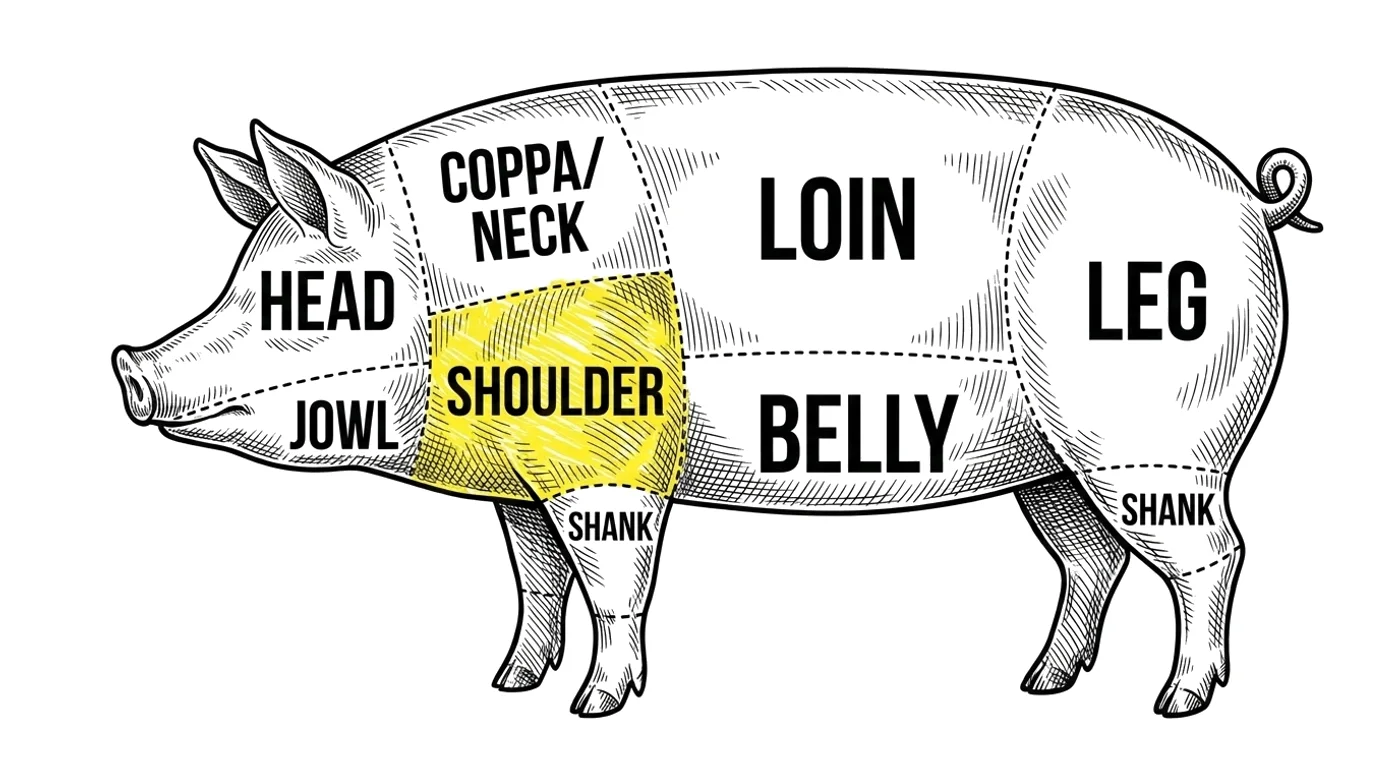
How to recognise it
The sausage is cylindrical with an irregular natural surface. The slice is coarse and ruby red with well-integrated white fat. Pepper and garlic are present, but a clean red-wine aroma should distinguish it. Texture is compact and soft rather than brittle. Vinegar-like acidity, purple staining, smeared fat or a wet centre are faults.
- Shape and size
- Cylindrical, medium grind
- Lean colour
- Red
- Fat and marbling
- White
- Casing
- Natural hog casing, 40 to 90 mm
- Surface bloom
- White mould
Origins and history
Piedmontese households preserved pork in cool cellars across a region shaped by hills, vineyards and the House of Savoy. Much of the craft passed orally, but written recipes provide an unusually clear historical bridge. In the mid-nineteenth century Giovanni Vialardi, chef to the royal household, described a pork salami seasoned with a glass of good Barbera, closely anticipating the protected product. Wine was not an ornamental addition: it linked the sausage directly to the agricultural identity of Piedmont. Producers later standardised the use of recognised regional grape varieties and the heavy-pig meat chain. Salame Piemonte obtained PGI registration in 2015, protecting production throughout the region and the characteristic red-wine ingredient.
Name. Named for the Piedmont region.
- Production today
- Producers across Piedmont.
- Protection
- IGP.
- Tradition vs modern
- Traditional wine seasoning.
- Seasonality
- Year-round.
Compare with. Salame Milano
Serving and cultural significance
Serve with bread, toma cheese, pickled vegetables and the same regional wine used in the formula. It can also accompany polenta, roasted peppers or a Piedmontese antipasto. Avoid heavily smoked accompaniments, because they hide the wine aroma and the restrained pepper-and-nutmeg character.
Recipe and cure
This is not a finished recipe. It is a window into how this meat is traditionally cured. Before you follow any process, please run it through one of our curing calculators, so the salt, cure and timings are right and safe for your own batch.
Curesmith home adaptation — not designation-compliant
Make this — the measured Curesmith version →The cure below is the traditional reference. “Make this” opens the measured Curesmith home recipe, scaled to your batch.
Traditional or protected production
PGI production takes place throughout Piedmont using qualifying Italian heavy-pig meat and fat. Salt, pepper, garlic, permitted sugars and wine made from authorised Piedmontese grapes are mixed with the coarse mince. The sausage is stuffed, dried and matured according to diameter and specification.
- Meat
- pork
- Salt (%)
- 2.8
- Curing salt
- Not included in the base recipe below
- Fermented
- Yes
- Target pH
- 4.9
- Starter or mould
- Natural white surface mould
- Smoked
- No
- Target aW or weight loss
- ~30% weight loss
- Temperature (°C)
- ferment 22 to 24, then dry 13 to 15
- Humidity (%)
- ferment ~90, then 75 to 80
- Maturation
- 3 to 8 weeks by size
- Basis
- per 1000 g green meat
- Style
- Traditional fermented and dried salame
Ingredients
- Lean pork (base)100% · 1000 g/kg
- Pork jowl and belly42.86% · 429 g/kg
- Ground pepper0.1% · 1 g/kg
- Crushed pepper0.1% · 1 g/kg
- Dextrose (or sugar)0.3% · 3 g/kg, or sugar 0.2% · 2 g/kg
- Minced garlic0.7% · 7 g/kg
- Nutmeg0.1% · 1 g/kg
- Red wine1% · 10 g/kg
Method
- Mince pork and fat and mix with all ingredients to green meat weight.
- Stuff into casing and inoculate the surface mould.
- Ferment warm until the target pH is reached.
- Dry slowly to the target weight loss.
Notes
- The official protected specification controls the named product. Any Curesmith EQ, starter-culture, curing-salt or home-scale adaptation is a separate method and must not be presented as designation-compliant.
- This traditional recipe uses no nitrite. For safety we recommend adding Cure #2: in a low-oxygen, slow-dried product nitrite is the specific guard against Clostridium botulinum, while salt, acidity and drying control Salmonella, E. coli, Listeria and Staphylococcus.
In the Codex
What this product teaches, and where to read more.
Temple. Roof, Water Activity