
Salchichón de Málaga
Malaga, Andalusia, Spain
Peppery and mild, an Andalusian salchichon.
Overview
Salchichón de Málaga is peppery and mild, an andalusian salchichon. A soft, pale pink-red sausage with visible fat, whole black pepper and restrained cinnamon and nutmeg. It should be sliceable but distinctly tender.
Where it's from
Climate. The Malaga hinterland of Andalusia.
Altitude. Andalusian hills
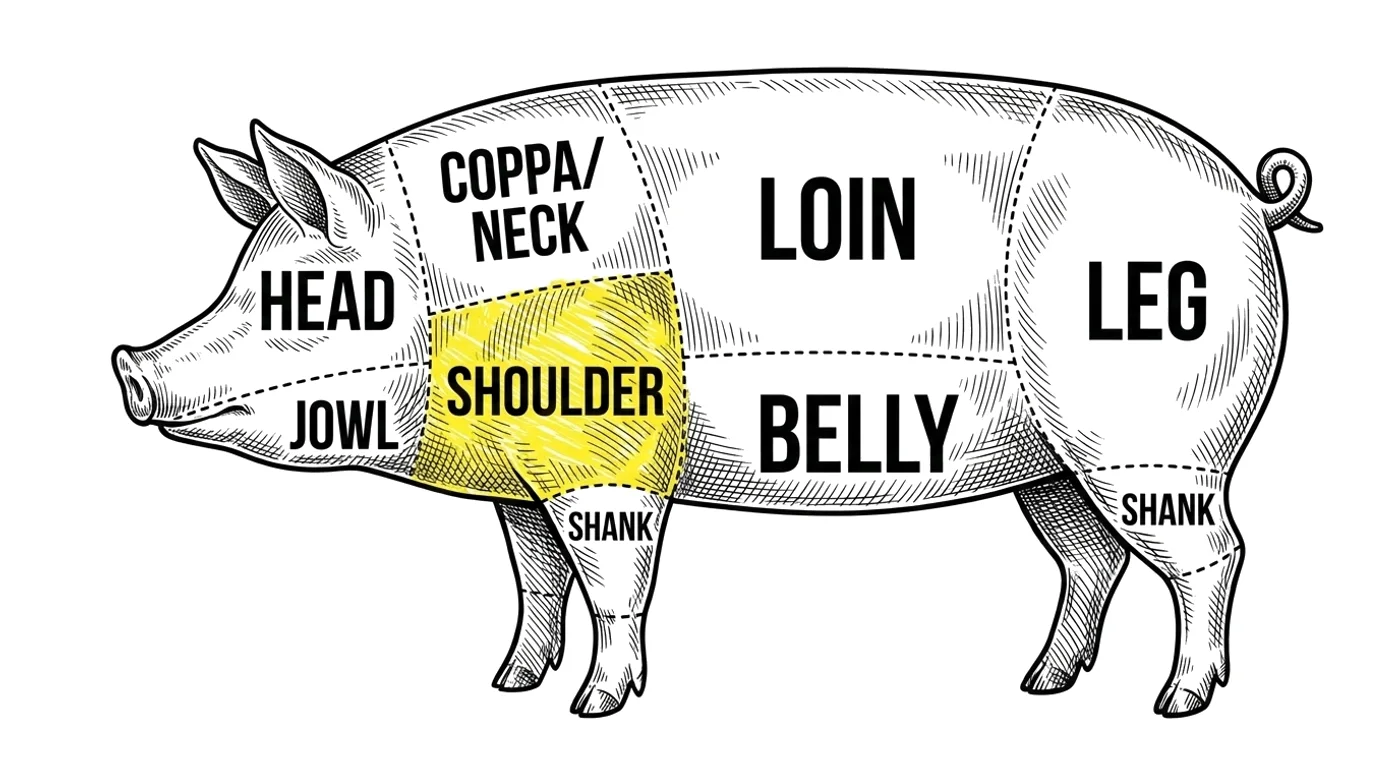
The cut
How to recognise it
A soft, pale pink-red sausage with visible fat, whole black pepper and restrained cinnamon and nutmeg. It should be sliceable but distinctly tender. Shape and size: Cylindrical, sometimes flattened. Lean colour: Pale red flecked with pepper. Fat and marbling: White. Casing or exterior: Hog casing, 30+ mm. Surface: Possible. The form is cylindrical, sometimes flattened. the lean is pale red flecked with pepper. the fat or marbling is white. and the exterior uses hog casing, 30+ mm. Grease smear, hollow pockets, case hardening, a wet centre, rancidity or uncontrolled dark mould is a production fault.
- Shape and size
- Cylindrical, sometimes flattened
- Lean colour
- Pale red flecked with pepper
- Fat and marbling
- White
- Casing
- Hog casing, 30+ mm
- Surface bloom
- Possible
Origins and history
Salchichon de Malaga belongs to Cartama, in the Guadalhorce Valley west of Malaga, where a family of Genoese origin is said to have brought an Italian curing recipe around two hundred years ago. The damp valley air kept the sausage from drying as it would further north, so it was eaten young and soft, and that barely dried, tender character settled in as the local style. The Prolongo company, working in the area since the 1820s, is closely tied to the product and helped carry it into Malaga homes, where it became a Christmas favourite through the later twentieth century.
Local accounts connect the style with nineteenth-century commercial charcuterie and a Genoese-influenced family tradition. The humid Málaga environment prevented the sausage from becoming as dry as northern salchichón, and the tender young texture became the defining feature.
Name. Salchichon, from salchicha, sausage; Malaga the province.
- Production today
- Producers in the Malaga area.
- Protection
- Not EU-protected as a general name.
- Tradition vs modern
- A peppered, paprika-free style.
- Seasonality
- Traditionally the winter matanza.
Compare with. Salchichón, Salchichón de Salamanca
Serving and cultural significance
This is a soft, lightly matured sausage rather than a hard dry salchichon, seasoned plainly with black pepper, garlic, nutmeg and salt. It is usually sliced thin and eaten just as it is, on fresh bread or among a plate of cold cuts, since its keeping humidity sits far higher than a fully dried sausage. Because the texture stays yielding, Malaga cooks also fold it into the region's sausage croquettes and serve it raw as a chopped salchichon tartare.
Recipe and cure
This is not a finished recipe. It is a window into how this meat is traditionally cured. Before you follow any process, please run it through one of our curing calculators, so the salt, cure and timings are right and safe for your own batch.
Make this — the measured Curesmith version →The cure below is the traditional reference. “Make this” opens the measured Curesmith home recipe, scaled to your batch.
Traditional or protected production
Salchichón de Málaga is distinguished by its unusually soft, lightly dried texture. It is commonly associated with Cártama and long-established local producers. Pepper, garlic and warm spice replace the pimentón used in chorizo.
The reference process can be summarised as follows: No EU specification governs the name. Traditional producers grind pork and belly, season without pimentón, stuff and mature only briefly so the centre remains soft.
- Meat
- pork
- Salt (%)
- 2.5
- Curing salt
- Cure #2
- Fermented
- Yes
- Target pH
- 4.9
- Starter or mould
- Natural surface mould
- Smoked
- No
- Target aW or weight loss
- ~30% weight loss
- Temperature (°C)
- ferment 22 to 24, then dry 13 to 15
- Humidity (%)
- ferment ~90, then 75 to 80
- Maturation
- 4 to 8 weeks
- Basis
- per 1000 g green meat
- Style
- Traditional fermented and dried sausage
Ingredients
- lean pork (base)100% · 1000 g/kg
- pork belly (pancetta)25% · 250 g/kg
- garlic0.3% · 3 g/kg
- nutmeg0.1% · 1 g/kg
- cinnamon0.1% · 1 g/kg
- black peppercorns, whole0.3% · 3 g/kg
Method
- Mince pork and fat and mix with all ingredients to green meat weight.
- Stuff into casing.
- Ferment to the target pH.
- Dry to the target weight loss.
Notes
- This traditional recipe uses no nitrite. For safety we recommend adding Cure #2: in a low-oxygen, slow-dried product nitrite is the specific guard against Clostridium botulinum, while salt, acidity and drying control Salmonella, E. coli, Listeria and Staphylococcus.
In the Codex
What this product teaches, and where to read more.
Temple. Roof, Water Activity