
Salchichón de Vic / Llonganissa de Vic
Also known as Salchichón de Vic, Llonganissa de Vic
Vic (Osona), Catalonia, Spain
Peppery, refined and clean, cured under white mould in the foggy Osona air.
Overview
Salchichón de Vic and Llonganissa de Vic are the Spanish and Catalan names of one protected sausage. Selected pork and firm fat are seasoned mainly with salt and black pepper, then matured in the cool, fog-prone Vic plain until the broad slice becomes firm, fragrant and gently sweet.
Where it's from
Climate. The Plana de Vic in the Osona plain, whose cold winter fog gives ideal slow drying.
Altitude. Inland Catalan plain
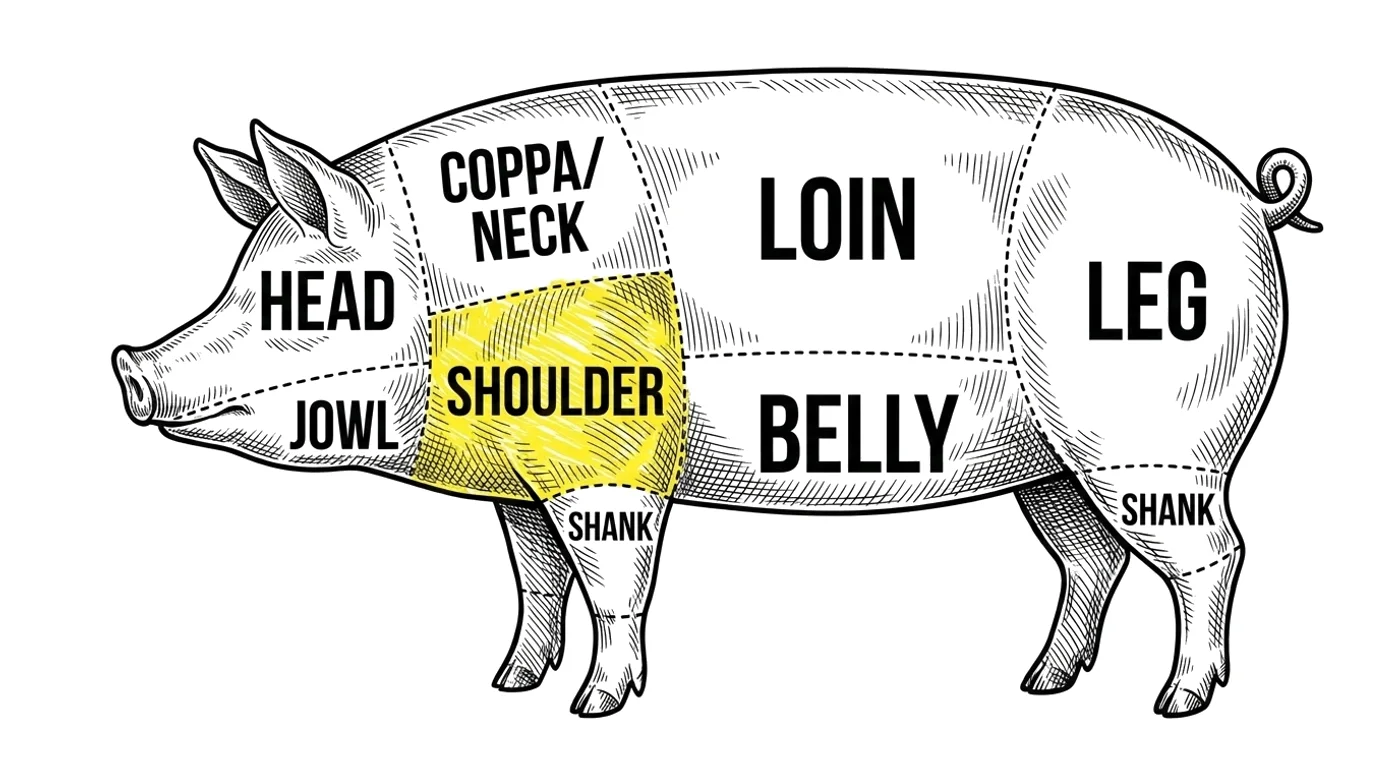
The cut
How to recognise it
The sausage is straight or gently curved, commonly broad and covered by a clean white-grey bloom. Its cut surface is red with sharply defined white fat and visible pepper. Aroma is mild, mature and cellar-like without paprika or heavy garlic. A hard shell, wet core, ammonia-heavy mould, smeared fat or sharp acid is defective.
- Shape and size
- Cylindrical, white-bloomed
- Lean colour
- Pale pink flecked with pepper
- Fat and marbling
- White
- Casing
- Hog casing (pork large intestine, cular), 35 to 75 mm
- Surface bloom
- Natural white mould
Origins and history
The Plana de Vic has long combined pig farming, cereal production and a winter climate suited to slow sausage curing. Farmhouse llonganissa became a market product as Vic developed into an important regional trading centre. The local air, with cold periods, fog and controlled ventilation, encouraged a characteristic surface flora and gradual maturation. Nineteenth-century descriptions and commercial records show the sausage's reputation spreading beyond Osona, while industrialisation increased the need to protect its simple formula from imitations. European PGI registration recognises both official language forms, Salchichón de Vic and Llonganissa de Vic. The dual name is not evidence of two different products.
Name. Salchichon, from salchicha, sausage; Vic names the town. Llonganissa is the Catalan name.
- Production today
- Producers on the Plana de Vic.
- Protection
- IGP (Salchichon de Vic / Llonganissa de Vic).
- Tradition vs modern
- Natural fog-drying and white mould are the signature.
- Seasonality
- Traditionally a winter cure.
Compare with. Salchichón, Fuet
Serving and cultural significance
Slice it thinly with pa amb tomàquet, Catalan cheese, olives and red wine. The simple pepper profile also makes it suitable for sandwiches and picnic food. Allow the slice to warm slightly so the fat becomes aromatic.
Recipe and cure
This is not a finished recipe. It is a window into how this meat is traditionally cured. Before you follow any process, please run it through one of our curing calculators, so the salt, cure and timings are right and safe for your own batch.
Curesmith home adaptation — not designation-compliant
Make this — the measured Curesmith version →The cure below is the traditional reference. “Make this” opens the measured Curesmith home recipe, scaled to your batch.
Traditional or protected production
The PGI specification controls pork, firm fat, salt and black pepper, along with stuffing and maturation in the protected Vic area. The deliberately simple seasoning makes pork quality and drying especially visible.
- Meat
- pork
- Cut
- minced pork and fat
- Salt (%)
- 2.5
- Curing salt
- Cure #2
- Fermented
- Yes
- Target pH
- 4.9
- Starter or mould
- Natural surface mould
- Smoked
- No
- Target aW or weight loss
- ~30% weight loss
- Temperature (°C)
- ferment 22 to 24, then dry 13 to 15
- Humidity (%)
- ferment ~90, then 75 to 80
- Maturation
- 6 to 10 weeks
- Basis
- per 1000 g of lean pork (main meat); back fat and other meats are added as a percentage of the lean
- Style
- Traditional fermented and dried sausage
Ingredients
- lean pork (base)100% · 1000 g/kg
- pork belly17.65% · 176 g/kg
- back fat5.88% · 59 g/kg
- white pepper0.3% · 3 g/kg
- black pepper, whole0.1% · 1 g/kg
Method
- Mince pork and fat and mix with all ingredients to green meat weight.
- Stuff into casing.
- Ferment to the target pH.
- Dry to the target weight loss.
Notes
- The official protected specification controls the named product. Any Curesmith EQ, starter-culture, curing-salt or home-scale adaptation is a separate method and must not be presented as designation-compliant.
- This traditional recipe uses no nitrite. For safety we recommend adding Cure #2: in a low-oxygen, slow-dried product nitrite is the specific guard against Clostridium botulinum, while salt, acidity and drying control Salmonella, E. coli, Listeria and Staphylococcus.
In the Codex
What this product teaches, and where to read more.
Temple. Roof, Microclimate