
Salchichón
sal-chee-CHOHN
Also known as Llonganissa de Vic
Salchichón de Vic / Llonganissa de Vic IGP (Catalonia), Nationwide, Spain
Peppery and savoury, milder and paler than chorizo, with a gentle tang.
Overview
Salchichón is Spain's pepper-led dry sausage. Unlike chorizo, it does not depend on a large paprika dose. Pork, firm fat, black pepper, nutmeg and regional spice produce a pale red slice with a clean salami character. The generic name covers many local sizes and recipes.
Where it's from
Climate. Made across Spain, notably the Plana de Vic in Catalonia.
Altitude. Nationwide
The cut
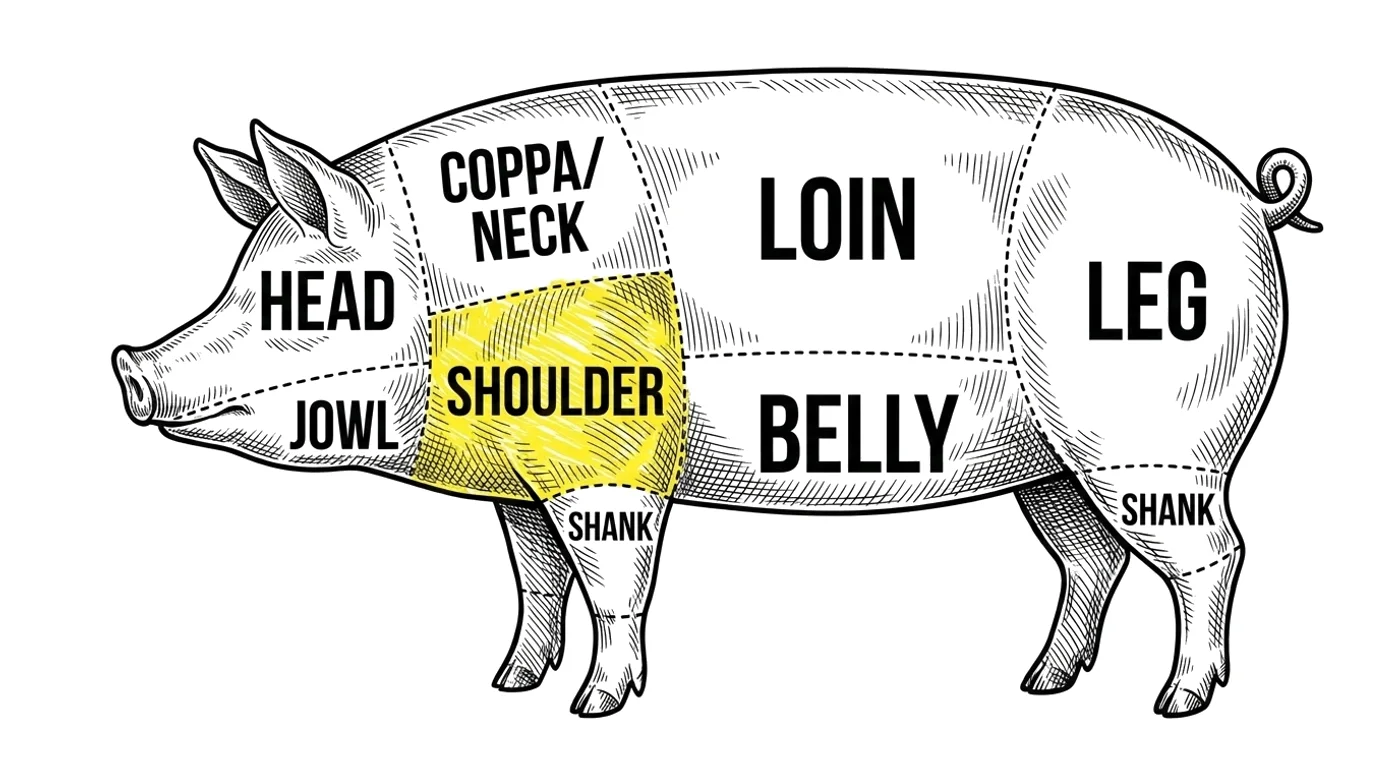
How to recognise it
The cut surface is pink-red to muted garnet with sharply defined white fat. Black pepper may be visible, and the casing often carries a clean white-grey bloom. Texture ranges from supple to firm according to diameter and age. Paprika should not dominate. Grease smear, excessive acidity, a hard rim, wet centre or ammonia-heavy mould is defective.
- Shape and size
- Cylindrical, tied, often with white bloom
- Lean colour
- Pale pink flecked with pepper
- Fat and marbling
- White through the lean
- Casing
- Hog casing (wide pork bung), 60 to 90 mm
- Surface bloom
- Natural white mould
Origins and history
Salchichón belongs to the broad Mediterranean tradition of salted, cased and dried meat. In Spain it became the natural counterpart to paprika-rich chorizo, preserving a flavour profile based on pepper and warm spice. Farm slaughter supplied shoulder meat and firm fat, while dry winter weather allowed links and larger sausages to mature. Regional forms developed according to local climate and casing. Catalan llonganissa, Castilian and Extremaduran salchichones, game versions and the unusually soft Salchichón de Málaga all sit within or beside the family. The Plana de Vic developed a particularly famous version, Llonganissa de Vic PGI, whose protected formula is deliberately simple: selected pork, fat, salt and black pepper. The generic Atlas entry must therefore explain the family without borrowing Vic's protection.
Name. From salchicha, sausage, ultimately the Latin salsus, 'salted'.
- Production today
- Made nationwide; Salchichon de Vic / Llonganissa de Vic carries IGP in Catalonia.
- Protection
- The general name is unprotected; the Vic version is IGP.
- Tradition vs modern
- Iberian-pork versions (Salamanca) are prized; seasoning varies by region.
- Seasonality
- Made year-round.
Compare with. Chorizo, Finocchiona
Serving and cultural significance
Serve in thin slices with bread, olives, cheese and wine, or use it in sandwiches and simple tapas. A well-made Salchichón is mild enough to show pork and pepper, so highly smoked or heavily spiced accompaniments are unnecessary.
Recipe and cure
This is not a finished recipe. It is a window into how this meat is traditionally cured. Before you follow any process, please run it through one of our curing calculators, so the salt, cure and timings are right and safe for your own batch.
Make this — the measured Curesmith version →The cure below is the traditional reference. “Make this” opens the measured Curesmith home recipe, scaled to your batch.
Traditional or protected production
There is no single specification for generic Salchichón. Pork and firm fat are seasoned mainly with salt and pepper, sometimes nutmeg, garlic or wine, then fermented and dried. Llonganissa de Vic PGI, Salchichón de Málaga and other regional entries have their own methods and must remain separate.
- Meat
- pork
- Cut
- minced pork and fat
- Salt (%)
- 2.5
- Curing salt
- Cure #2
- Other agents
- black pepper (no paprika)
- Fermented
- Yes
- Target pH
- 4.9
- Starter or mould
- Natural white surface mould
- Smoked
- No
- Target aW or weight loss
- ~30% weight loss
- Temperature (°C)
- ferment 22 to 24, then dry 13 to 15
- Humidity (%)
- ferment ~90, then 75 to 80
- Maturation
- 4 to 8 weeks
- Basis
- per 1000 g of lean pork (main meat); back fat and other meats are added as a percentage of the lean
- Style
- Traditional fermented and dried sausage
Ingredients
- lean pork (base)100% · 1000 g/kg
- back fat25% · 250 g/kg
- black pepper, ground0.3% · 3 g/kg
- black pepper, whole0.1% · 1 g/kg
- nutmeg0.1% · 1 g/kg
- dry white wine3% · 30 g/kg
Method
- Mix minced pork and fat with pepper and the rest to green weight.
- Stuff and inoculate the white mould.
- Ferment to the target pH.
- Dry to the target loss.
Notes
- This traditional recipe uses no nitrite. For safety we recommend adding Cure #2: in a low-oxygen, slow-dried product nitrite is the specific guard against Clostridium botulinum, while salt, acidity and drying control Salmonella, E. coli, Listeria and Staphylococcus.
- Recipe reconciled to the fuller traditional cure, with the starter culture, curing salt and the complete spicing recorded as ingredients.
Safety. The peppered, paprika-free counterpart to chorizo. Ferment to pH, then dry. Verify before serving.
In the Codex
What this product teaches, and where to read more.
Temple. Roof, Water Activity