
Saucisse de Montbéliard
Montbeliard, Bourgogne-Franche-Comte, France
Smoky and caraway-scented, a cooked Franche-Comte sausage.
Overview
Saucisse de Montbéliard is a slender, coarse pork sausage seasoned with caraway and smoked in the Franche-Comté tradition. It is sold raw and must be cooked. Its finer shape and caraway distinguish it from the larger Saucisse de Morteau.
Where it's from
Climate. Franche-Comte, home of the tall tuye smoking chimneys.
Altitude. Jura foothills
The cut
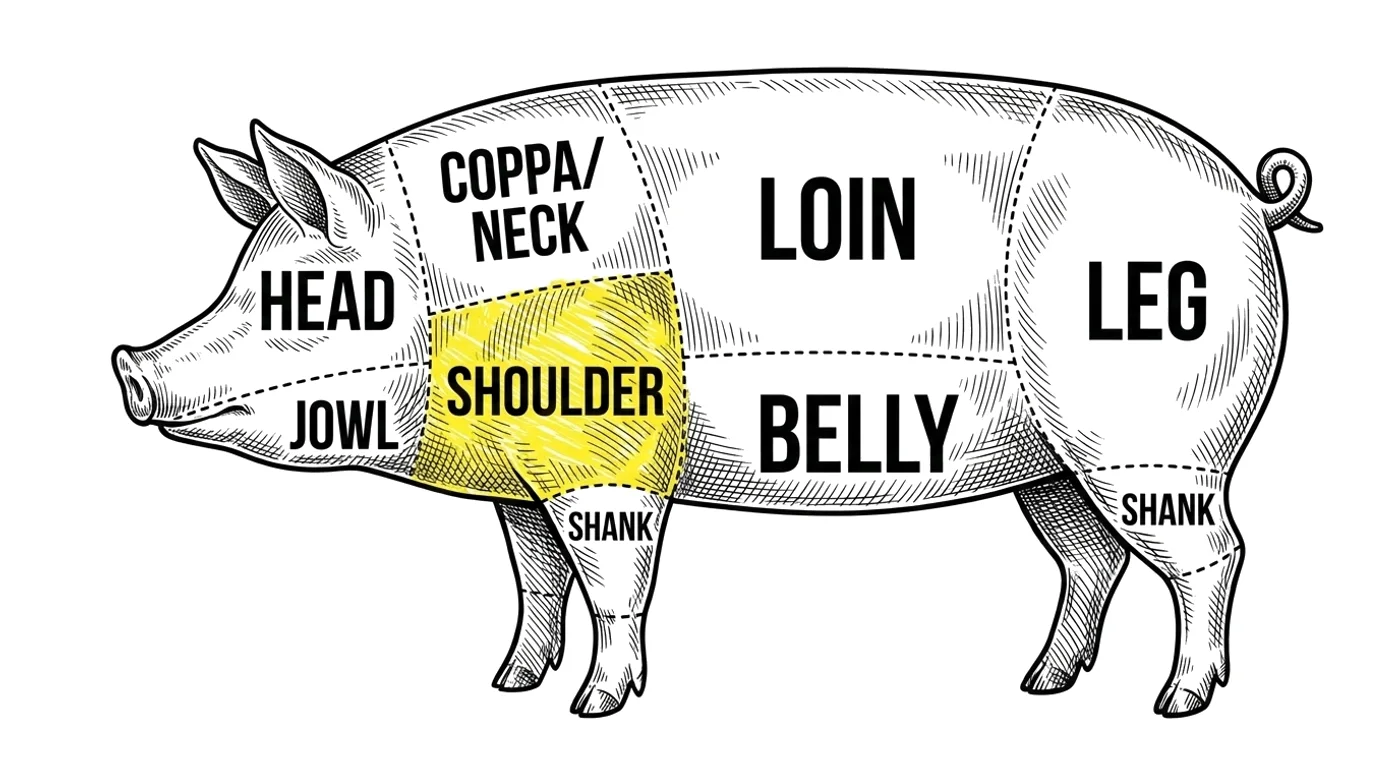
How to recognise it
The sausage is narrow, curved and amber-brown from smoke, in a natural pig casing. After cooking, the filling is coarse, juicy and pink, with clear caraway and clean smoke. A grey raw centre, sourness, tar bitterness or split dry filling is defective.
- Shape and size
- Slim smoked sausage
- Lean colour
- Coarse pink
- Fat and marbling
- White flecks
- Casing
- Natural casing
- Surface bloom
- None
Origins and history
The farms of Franche-Comté used the tall tuyé smoke chamber to preserve pork through cold mountain winters. Smaller sausages could be produced and cooked sooner than large hams, while smoke from local conifer wood gave them a durable regional aroma. Montbéliard, a town with strong Germanic as well as French cultural connections, developed a sausage in which caraway became an identifying spice. Local butchers carried the style into markets and domestic cooking, where it flavoured lentils, potatoes and cabbage. PGI recognition in 2013 protected Franche-Comté production and clarified the difference from Morteau: Montbéliard is narrower, commonly curved and caraway-scented, but it is equally a raw smoked product requiring cooking.
Name. Named for the town of Montbeliard.
- Production today
- Franche-Comte producers.
- Protection
- IGP.
- Tradition vs modern
- Tuye smoking and caraway are the signature.
- Seasonality
- Year-round.
Compare with. Saucisse de Morteau
Serving and cultural significance
Poach gently and serve with lentils, potatoes, cabbage, cancoillotte or Comté. It can also be baked into gratins or sliced into a warm salad after full cooking. Cook it whole whenever possible, because slicing before poaching allows smoke and fat to escape into the cooking water.
Recipe and cure
This is not a finished recipe. It is a window into how this meat is traditionally cured. Before you follow any process, please run it through one of our curing calculators, so the salt, cure and timings are right and safe for your own batch.
Curesmith home adaptation — not designation-compliant
Make this — the measured Curesmith version →The cure below is the traditional reference. “Make this” opens the measured Curesmith home recipe, scaled to your batch.
Traditional or protected production
The PGI uses pork processed in Franche-Comté, natural pig casing, caraway and regional smoking. It is marketed raw and intended for cooking.
- Meat
- pork
- Salt (%)
- 2
- Curing salt
- Cure #1 at 2.5 g/kg (0.25%)
- Fermented
- No
- Smoked
- Yes
- Target aW or weight loss
- cooked, not dried
- Temperature (°C)
- cooked through to a safe core temperature
- Humidity (%)
- n/a
- Maturation
- smoked, then poached before serving
- Basis
- per 1000 g green meat
- Style
- Traditional smoked, then cooked
Ingredients
- pork (base)100% · 1000 g/kg
- sea salt1.9% · 19 g/kg
- Cure #10.25% · 2.5 g/kg
- caraway0.2% · 2 g/kg
- black pepper0.3% · 3 g/kg
- garlic0.2% · 2 g/kg
Method
- Mix coarse pork with salt, Cure #1, caraway and seasoning.
- Stuff into casing.
- Smoke slowly in a tuye over conifer.
- Poach before serving.
Notes
- The official protected specification controls the named product. Any Curesmith EQ, starter-culture, curing-salt or home-scale adaptation is a separate method and must not be presented as designation-compliant.
- This is a cooked product. It must be cooked through before eating. Where a cure is used it is Cure #1 (nitrite), suited to the shorter, cooked process rather than long drying.
In the Codex
What this product teaches, and where to read more.
Temple. Roof, Microclimate