
Saucisson sec de l’Île de Beauté / Salciccia de l’Île de Beauté
Also known as Saucisson sec de l'Île de Beauté, Saucisson sec de l’Île de Beauté, Salciccia de l’Île de Beauté
Corsica (regional), Corsica, France
Coarse and rustic, wine-and-garlic scented, from chestnut-fed island pigs.
Overview
Saucisson sec de l'Île de Beauté is the protected Corsican dry sausage registered in 2023. Pork and firm fat are seasoned simply, often with pepper and wine, then fermented and matured into a rustic, meat-led slice.
Where it's from
Climate. Corsica, mountain and maquis air.
Altitude. Corsican hills
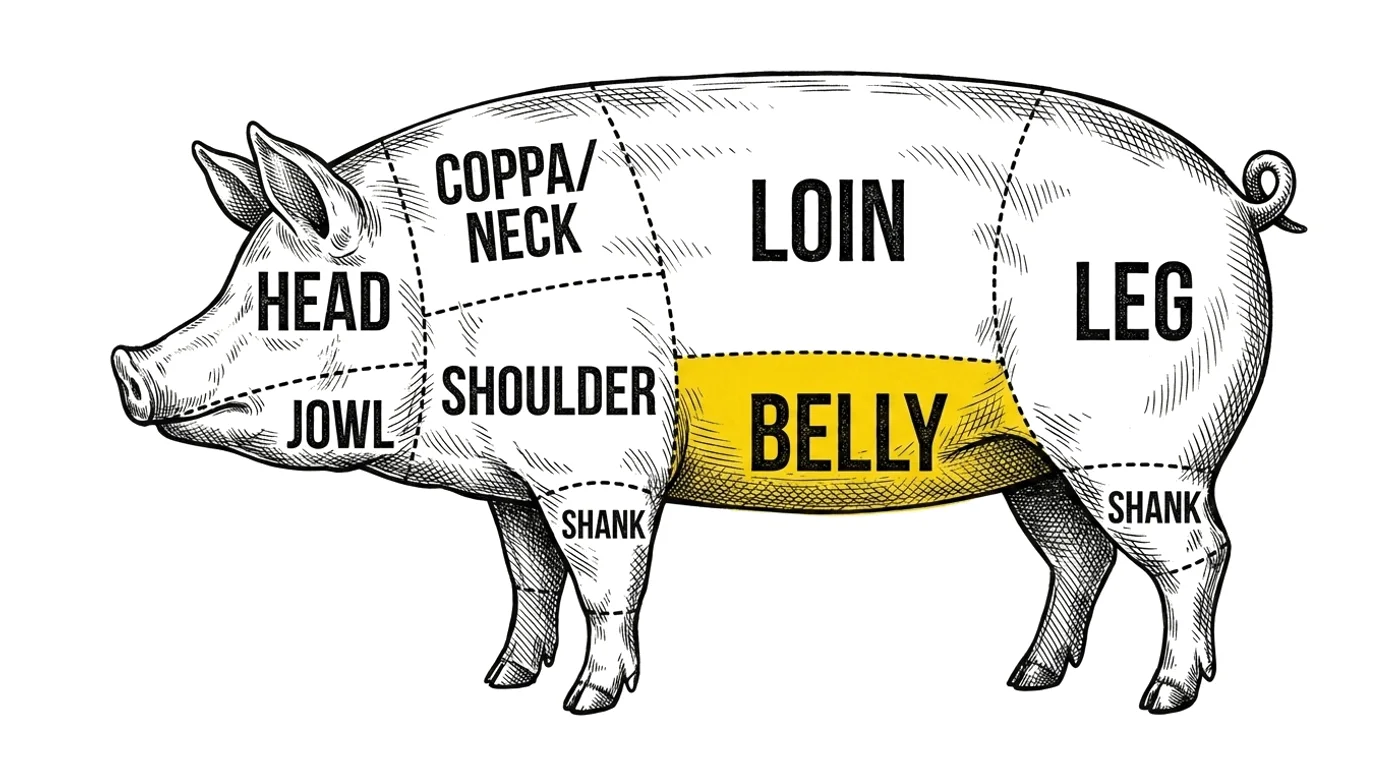
The cut
How to recognise it
The sausage is cylindrical with a natural casing and clean white-grey bloom. The slice is red with distinct white fat and a mild peppery, winey aroma. Smoke, where used, is restrained. A wet centre, grease smear, hollow pockets or uncontrolled dark mould are faults.
- Shape and size
- Cylindrical, coarse
- Lean colour
- Deep red
- Fat and marbling
- White cubes
- Casing
- Hog casing (large intestine), 40 to 60 mm
- Surface bloom
- Natural mould
Origins and history
Corsican families made dry sausage after the winter slaughter to use trimmings and smaller lean pieces that did not become whole-muscle cures. Links matured sooner than prisuttu and provided food through spring, while pepper, wine and smoke reflected household preference and microclimate. The generic salciccia name travelled widely and was increasingly applied to products with little connection to Corsica. Producers therefore built an Île de Beauté quality chain that could protect island manufacture beyond the narrower Nustrale-breed AOP system. European registration on 26 July 2023 placed Saucisson sec beside the new Pancetta, Figatelli and Bulagna PGIs, while Coppa, Lonzo and Prisuttu retained their separate AOP status.
Name. Saucisson sec, dry sausage; Ile de Beaute, a name for Corsica.
- Production today
- Corsican producers.
- Protection
- IGP (Ile de Beaute).
- Tradition vs modern
- Island pigs, rustic dry-curing.
- Seasonality
- Winter slaughter.
Compare with. Saucisson sec d’Auvergne / Saucisse sèche d’Auvergne
Serving and cultural significance
Slice with bread, Corsican cheese, olives, figs or wine. A mild example can be eaten before stronger Coppa or Prisuttu on a charcuterie board. Let the sausage lose its refrigerator chill before slicing, and keep the cut face covered afterward so the outer portion does not harden.
Recipe and cure
This is not a finished recipe. It is a window into how this meat is traditionally cured. Before you follow any process, please run it through one of our curing calculators, so the salt, cure and timings are right and safe for your own batch.
Curesmith home adaptation — not designation-compliant
Make this — the measured Curesmith version →The cure below is the traditional reference. “Make this” opens the measured Curesmith home recipe, scaled to your batch.
Traditional or protected production
The PGI controls raw material, Corsican manufacture, seasoning, casing, drying and maturation. It is a dry fermented sausage, not a fresh link.
- Meat
- pork
- Cut
- shoulder and belly
- Salt (%)
- 2.8
- Curing salt
- Cure #2
- Fermented
- Yes
- Target pH
- 4.9
- Starter or mould
- Natural surface mould
- Smoked
- Yes
- Target aW or weight loss
- ~30% weight loss
- Temperature (°C)
- ferment 22 to 24, then dry 13 to 15
- Humidity (%)
- ferment ~90, then 75 to 80
- Maturation
- 4 to 8 weeks
- Basis
- per 1000 g green meat
- Style
- Traditional fermented and dried sausage
Ingredients
- lean pork (base)100% · 1000 g/kg
- back fat25% · 250 g/kg
- black pepper0.2% · 2 g/kg
- garlic1.5% · 15 g/kg
- red wine3% · 30 g/kg
Method
- Mince pork and fat and mix with all ingredients to green meat weight.
- Stuff into casing.
- Ferment to the target pH.
- Dry to the target weight loss.
Notes
- The official protected specification controls the named product. Any Curesmith EQ, starter-culture, curing-salt or home-scale adaptation is a separate method and must not be presented as designation-compliant.
- This traditional recipe uses no nitrite. For safety we recommend adding Cure #2: in a low-oxygen, slow-dried product nitrite is the specific guard against Clostridium botulinum, while salt, acidity and drying control Salmonella, E. coli, Listeria and Staphylococcus.
In the Codex
What this product teaches, and where to read more.
Temple. Roof, Water Activity