
Ventricina del Vastese
Vasto area, Abruzzo, Italy
Deep red, chunky and fiery-sweet with pepper and fennel, kept soft and rich.
Overview
Ventricina del Vastese is deep red, chunky and fiery-sweet with pepper and fennel, kept soft and rich. A large rustic sausage with visible cubes of deep-red lean and white fat, coloured strongly by sweet pepper and warmed by chilli and fennel.
Where it's from
Climate. The Vasto area of Abruzzo, near the Adriatic.
Altitude. Adriatic hills
The cut
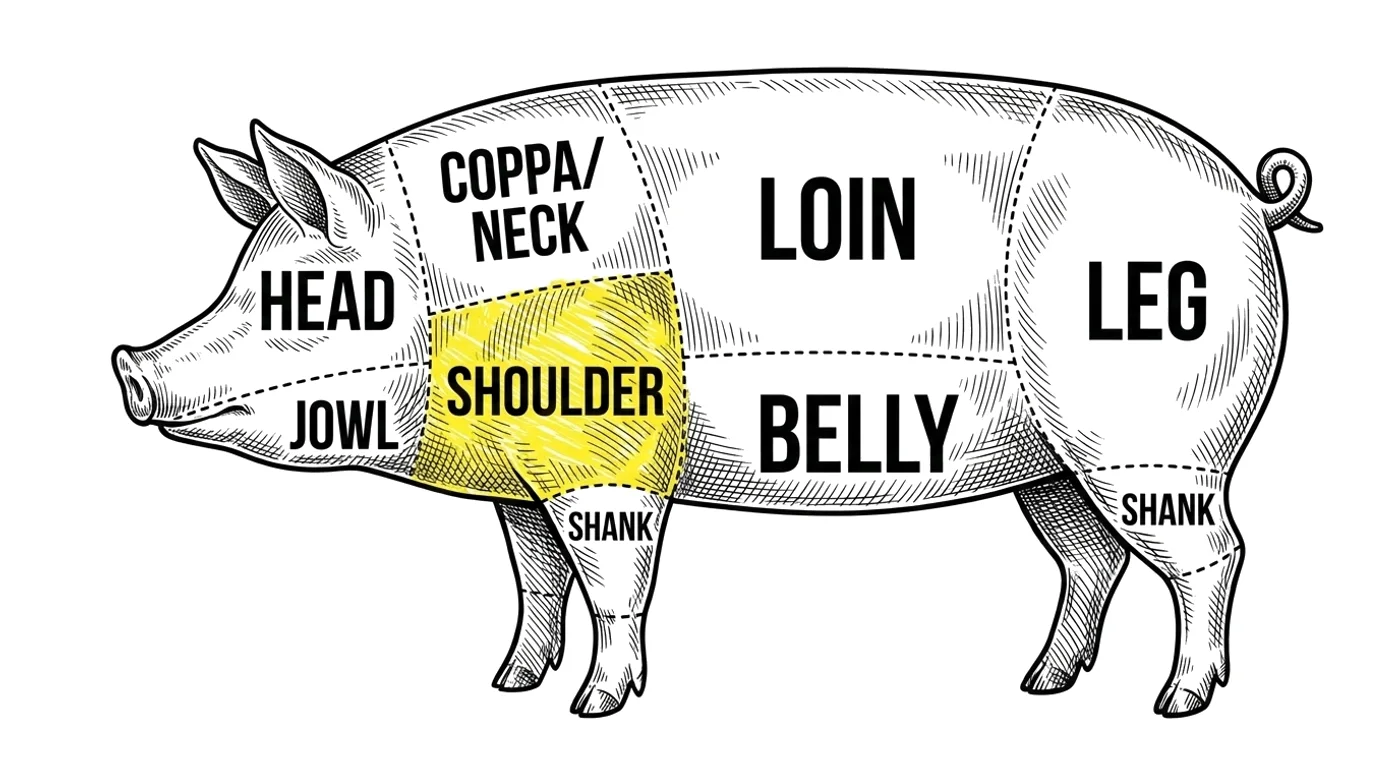
How to recognise it
A large rustic sausage with visible cubes of deep-red lean and white fat, coloured strongly by sweet pepper and warmed by chilli and fennel. The coarse hand-cut mosaic must remain visible; a smooth industrial paste or wet central seam is incorrect.
- Shape and size
- Large, irregular, deep red
- Lean colour
- Chunky red
- Fat and marbling
- Large white pieces
- Casing
- Pig's bladder, 120 to 180 (large format) mm
- Surface bloom
- Possible
Origins and history
This is an old upland speciality, long tied to the shepherds who once carried cured pork along the seasonal droving routes. It was the farmhouse way of turning the finest cuts of the pig into something that would keep through the year without special equipment. The coarse, hand-cut grain and the thick coat of deep-red sweet pepper set it apart from the smoother salami made further north. It survives as a small-scale, hand-made product, valued for the quality of meat it demands and the patience it takes.
The sausage takes its name from the pig's stomach, historically used as the broad casing. Families in the Vastese hills packed prized pork pieces with local pepper into a large format that matured slowly through winter and spring. The verified production area is Vastese inland hills, Abruzzo, Italy. Stories and etymologies are retained when they help explain the tradition, but legends are not used as evidence for the modern specification.
Name. Ventricina, from ventre, 'stomach', the casing it is traditionally stuffed into.
- Production today
- Producers around Vasto.
- Protection
- Not EU-protected (a Slow Food Presidium exists).
- Tradition vs modern
- Hand-cut and pepper-heavy, kept semi-soft.
- Seasonality
- Traditionally the winter slaughter.
Compare with. 'Nduja di Spilinga, Sobrasada de Mallorca
Serving and cultural significance
Cut the broad sausage into thin slices that show the hand-cut lean and fat. Serve with country bread, pecorino, grilled peppers and Montepulciano d'Abruzzo. A mature Ventricina is strongly flavoured, so it should lead the plate rather than compete with another heavily spiced salume.
Recipe and cure
This is not a finished recipe. It is a window into how this meat is traditionally cured. Before you follow any process, please run it through one of our curing calculators, so the salt, cure and timings are right and safe for your own batch.
Make this — the measured Curesmith version →The cure below is the traditional reference. “Make this” opens the measured Curesmith home recipe, scaled to your batch.
Traditional or protected production
Ventricina del Vastese is a coarse, often hand-cut pork salame using lean meat and firm fat with sweet and hot pepper, black pepper and fennel. It belongs to the Slow Food Presidium rather than an EU geographical indication.
- Meat
- pork
- Salt (%)
- 2.8
- Curing salt
- Not included in the base recipe below
- Fermented
- Yes
- Target pH
- 4.9
- Starter or mould
- Natural
- Smoked
- No
- Target aW or weight loss
- kept softer, limited drying
- Temperature (°C)
- ferment 22 to 24, then dry 13 to 15
- Humidity (%)
- ferment ~90, then 75 to 80
- Maturation
- a few months
- Basis
- per 1000 g green meat
- Style
- Traditional fermented and dried, kept soft
Ingredients
- Lean pork from leg, loin and shoulder, knife-cut into 2 to 3 cm pieces (base)100% · 1000 g/kg
- Firm pork back fat, knife-cut into 2 to 3 cm pieces42.86% · 429 g/kg
- Sweet red pepper powder2.4% · 24 g/kg
- Hot chilli pepper powder0.4% · 4 g/kg
- Black pepper, ground0.3% · 3 g/kg
- Wild fennel seed0.4% · 4 g/kg
Method
- Mince or hand-cut pork and fat and mix with all ingredients to green meat weight.
- Stuff into casing.
- Ferment to the target pH.
- Dry to the target point, kept soft.
Notes
- This traditional recipe uses no nitrite. For safety we recommend adding Cure #2: in a low-oxygen, slow-dried product nitrite is the specific guard against Clostridium botulinum, while salt, acidity and drying control Salmonella, E. coli, Listeria and Staphylococcus.
In the Codex
What this product teaches, and where to read more.
Temple. Roof, Water Activity