
Dry-cured sausage recipeOrigin Recipe
Chistorra de Navarra / Txistorra de Navarra / Nafarroako Txistorra
Protected child of the Chistorra family.
This recipe is a draft, pending verification by The Curesmith. Treat the salt, cure and timing figures as provisional and confirm them against your own judgement before curing.
Introduction
Chistorra de Navarra is the protected Navarrese form of the thin, paprika-red fresh sausage known in Spanish as chistorra and in Basque as txistorra. It is sold raw, kept refrigerated and cooked before eating.
No public home recipe is released under this protected name. The official specification controls the registered product, and any future Curesmith adaptation will be published separately and clearly labelled as non-compliant.
Where it comes from
Before you begin
Purpose and scope
The recipes published on The Curesmith are intended for educational and informational purposes only. Meat curing, fermentation and smoking involve processes that, if carried out incorrectly, can result in products that are unsafe to eat. By using any recipe on this website you acknowledge that you do so entirely at your own risk, and you agree that The Curesmith and its authors cannot be held liable for any outcome arising from its use.
Limitation of liability
The Curesmith and its authors accept no responsibility or liability for any illness, injury, loss or damage arising from the use of these recipes, including but not limited to illness caused by improperly cured, handled or cooked meat products, errors in measurement or technique, equipment failure, or deviation from the stated method or quantities.
Nitrite and cure safety
Meat curing involves the use of nitrite salts, which must be measured accurately and used strictly according to the quantities specified. Nitrite in excessive quantities is toxic. Please ensure you understand the following before proceeding:
- Always use a calibrated digital scale accurate to at least one gram. For smaller batches, a scale accurate to 0.1g is strongly recommended.
- Never exceed the stated cure amounts. Never substitute cure types without recalculating.
- Store all curing salts clearly labelled, separately from regular salt, and out of reach of children.
- Different cure products have different nitrite concentrations. Always check your manufacturer's label and adjust quantities accordingly.
Food hygiene and cross-contamination
Raw and cured meat products must be stored, handled and prepared in a clean environment using food-safe equipment. Hands, surfaces, tools and containers must be thoroughly cleaned and where appropriate sanitised before use. Cross-contamination between raw meat and ready-to-eat products must be avoided at all times.
Temperature control
Temperature control is critical throughout all curing and smoking processes. Inadequate temperature management can allow the growth of dangerous pathogens including Clostridium botulinum, Listeria monocytogenes, Salmonella and E. coli. A reliable refrigerator thermometer and a calibrated probe thermometer are essential pieces of equipment for anyone producing cured or smoked meat at home.
Uncooked cured products
Whole muscle products that are eaten without cooking, such as air-dried bresaola, coppa or prosciutto, must reach their target weight loss before consumption. Products that have not been cured and dried to the correct specification may not be safe to eat uncooked. Pancetta and guanciale cured to less than 38% weight loss must not be consumed uncooked.
Bacon and other uncooked cured products
Bacon and other uncooked cured products must be cooked thoroughly before eating. Cold smoking adds flavour and colour but does not cook the product. A cold-smoked bacon or sausage remains a raw product and must reach a safe internal temperature before it is safe to consume. For pork and beef this is 72°C / 162°F. For poultry this is 74°C / 165°F.
When in doubt, seek professional guidance
If you are unsure about any aspect of the curing, smoking or fermentation process, we strongly encourage you to seek formal training or guidance from a qualified food safety professional before proceeding. The information on this website is not a substitute for proper food safety education and training.
Commercial production
These recipes are produced for home and small-scale producers. They are not intended for commercial food production. Commercial meat processing is subject to regulatory requirements that vary by country and jurisdiction. If you intend to produce cured or smoked products for sale, you must ensure full compliance with all applicable food safety regulations in your region.
The recipe
New to curing, or want step-by-step guidance?
The Recipe Wizard walks you through this recipe one step at a time, with explanations at every stage.
Ingredients
scale the recipe
| Meat & fat | ||
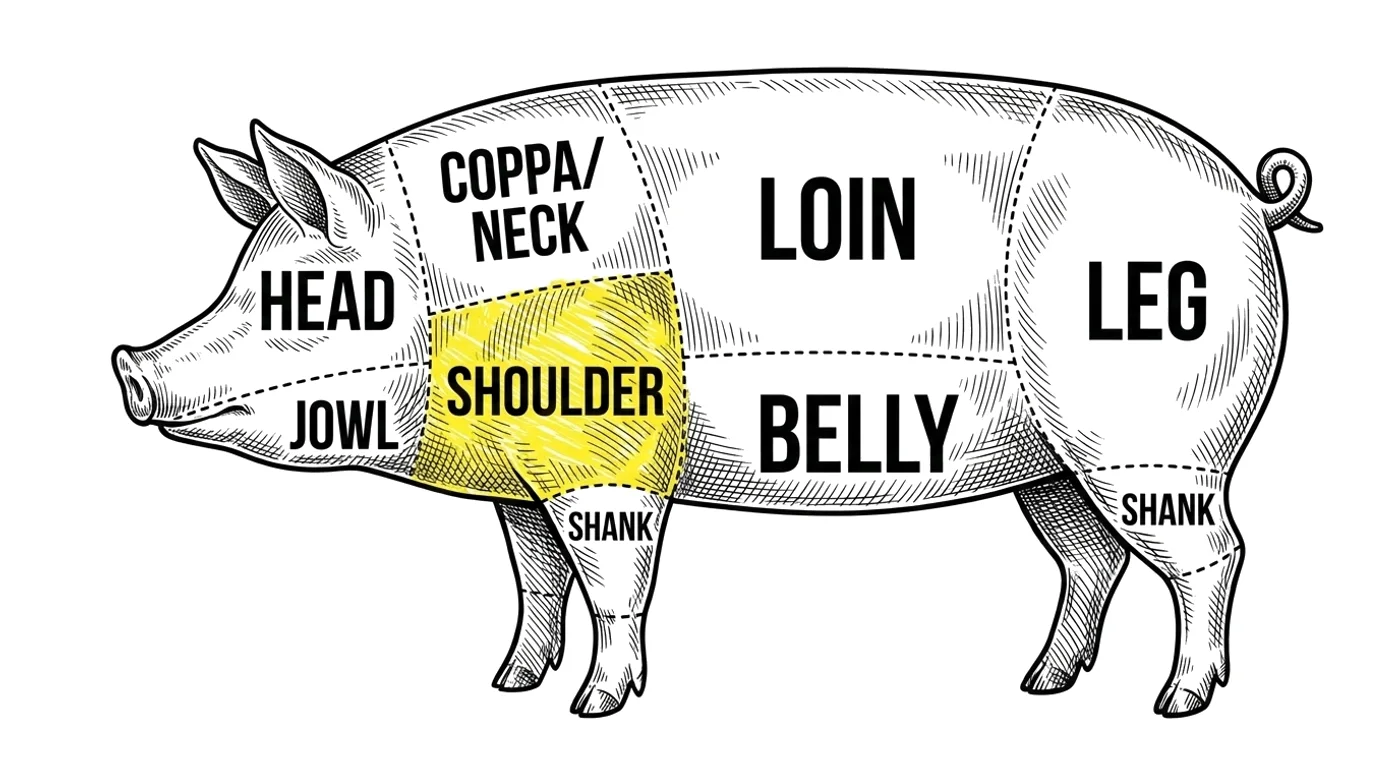
| Pork shoulder | Reference | 1000 g |
| Pork belly or back fat | 42.85% of pork shoulder | 430 g |
| Cure, salt & sugar | ||
| Salt (additional) | 2.25% | 30 g |
| Cure #2 is about 94% salt. This additional salt brings the total to the 2.5% target. | ||
| Cure #2 | for 156 ppm | 3.6 g |
| Dextrose | 0.1% | 1.0 g |
| Feeds the starter culture. If substituting sugar, use 60%: 0.6 g | ||
| Starter culture | ||
| Starter culture | 0.5 g per kg meat | 0.5 g |
| I prefer Flora Italia LC, but you can use your preferred starter culture. No precision scale? Use 1.0 g - you cannot meaningfully overdose a starter culture. Dissolve before mixing in. | ||
| Water (to dissolve culture) | 20 ml per kg meat | 20 g |
| Aromatics & seasoning | ||
| Sweet pimentón | 2.5% | 25 g |
| Hot pimentón | 0.2% | 2.0 g |
| Garlic | 0.35% | 3.5 g |
Nitrite safety check
Curing timeline
Method
Recipe by The Curesmith — thecuresmith.com
Chistorra de Navarra / Txistorra de Navarra / Nafarroako Txistorra — Step-by-step Wizard
Your guided companion to curing, one step at a time.