
Ammerländer Schinken
Ammerland, Lower Saxony, Germany
A PGI bone-in north German ham, long-matured and beech cold-smoked.
Overview
Ammerländer Schinken is a pgi bone-in north german ham, long-matured and beech cold-smoked. A dark smoked ham with red-brown lean, firm texture and a pronounced but clean smoke aroma. Bone-in and boneless forms should both show even cure through the centre. The Codex treats it as a complete production system, not merely a familiar name. Raw material, cut or particle size, casing, smoke, fermentation, cooking and maturation all contribute to the identity. The current status is IGP / PGI : Ammerländer Schinken / Ammerländer Knochenschinken. The protected or traditional reference and the Curesmith home method remain separate.
Where it's from
Climate. The Ammerland of Lower Saxony, cool and damp.
Altitude. North German lowland
The cut
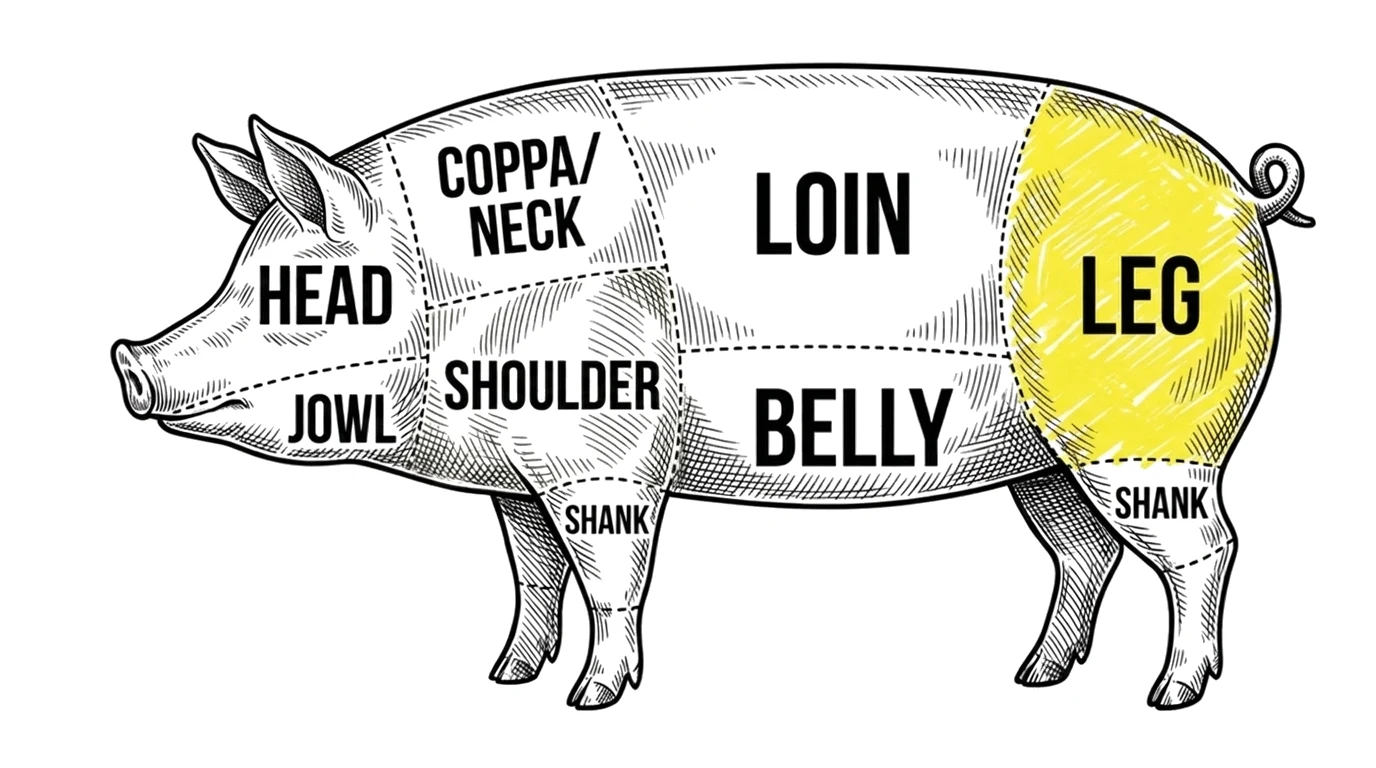
How to recognise it
A dark smoked ham with red-brown lean, firm texture and a pronounced but clean smoke aroma. Bone-in and boneless forms should both show even cure through the centre. A hard dry rim, wet grey centre, rancid fat, sourness, insect damage or uncontrolled mould indicates a failed process.
- Shape and size
- Bone-in leg
- Lean colour
- Deep red
- Fat and marbling
- White
- Casing
- None
- Surface bloom
- Smoked exterior
Origins and history
Ammerland's lowland farms preserved heavy pork legs in smokehouses through the damp North German winter. Salt, brown sugar, juniper and pepper suited the local pantry, while long beech smoking gave the meat enough resilience for household storage and market trade. Bone-in Knochenschinken developed as the darker and more intensely smoked form, while boneless Ammerländer Schinken became milder and easier to slice. A historic smokehouse founded in Apen in 1748 survives as part of the region's ham museum tradition. European PGI protection now covers both names and preserves the distinction between the bone-in and boneless presentations.
Name. Ammerlander Schinken, 'Ammerland ham'.
- Production today
- Producers of the Ammerland, Lower Saxony.
- Protection
- PGI/g.g.A., registered 1997, as Ammerlander Schinken / Ammerlander Knochenschinken.
- Tradition vs modern
- Bone-in, beech cold-smoked.
- Seasonality
- Year-round.
Compare with. Schwarzwälder Schinken
Serving and cultural significance
Serve thin slices with rye bread, butter, pickles, eggs or North German beer. Include some fat in each slice. Bone-in ham trimmings are excellent in beans and cabbage, but the central slices are best served uncooked.
Recipe and cure
This is not a finished recipe. It is a window into how this meat is traditionally cured. Before you follow any process, please run it through one of our curing calculators, so the salt, cure and timings are right and safe for your own batch.
Curesmith home adaptation — not designation-compliant
Make this — the measured Curesmith version →The cure below is the traditional reference. “Make this” opens the measured Curesmith home recipe, scaled to your batch.
Traditional or protected production
The PGI covers both boneless Ammerländer Schinken and bone-in Ammerländer Knochenschinken. The pork leg is salted and seasoned, rested, dried and cold smoked within the protected Ammerland area. The bone-in form normally receives a longer or more developed smoke treatment and retains a stronger traditional smokehouse character, while the boneless form is generally milder and easier to slice.
Sea salt; long-matured, then gently cold-smoked over beech. Salt-box method; no fixed percentage.
- Meat
- pork
- Salt (%)
- traditional, no fixed %
- Curing salt
- Sea salt; long-matured, then gently cold-smoked over beech.
- Fermented
- No
- Starter or mould
- Possible
- Smoked
- Yes
- Target aW or weight loss
- ~ weight loss
- Temperature (°C)
- cold salting, then 10 to 15
- Humidity (%)
- 70 to 80
- Maturation
- several months to a year
- Basis
- percentage of green meat weight
- Style
- Traditional dry salting (salt-box), then cold-smoked
Method
- Salt the leg by the traditional method and rest cold.
- Brush off surface salt and rub with the spice mix where used.
- Cold-smoke where traditional, then air-dry.
- Age to the target loss.
Notes
- The official protected specification controls the named product. Any Curesmith EQ, starter-culture, curing-salt or home-scale adaptation is a separate method and must not be presented as designation-compliant.
- A more efficient way of curing this product is using the EQ Method. No more than 2.5% salt to meat weight is required. To follow the EQ method, please use our whole-muscle EQ curing calculator to work out proper ratios and curing times.
In the Codex
What this product teaches, and where to read more.
Temple. Roof, Microclimate