
Dehesa de Extremadura
Caceres and Badajoz, Extremadura, Spain
Marbled, sweet and savoury, carrying the nutty depth of the acorn montanera.
Overview
Dehesa de Extremadura PDO links 100% Ibérico pigs with the oak woodland and curing houses of Extremadura. It protects bellota and cebo-de-campo hams and shoulders, preserving both the animal and one of Europe's largest managed pastoral landscapes.
Where it's from
Climate. The great Extremadura dehesa, hot and dry in summer, mild in winter.
Altitude. Open dehesa plains and hills
The cut
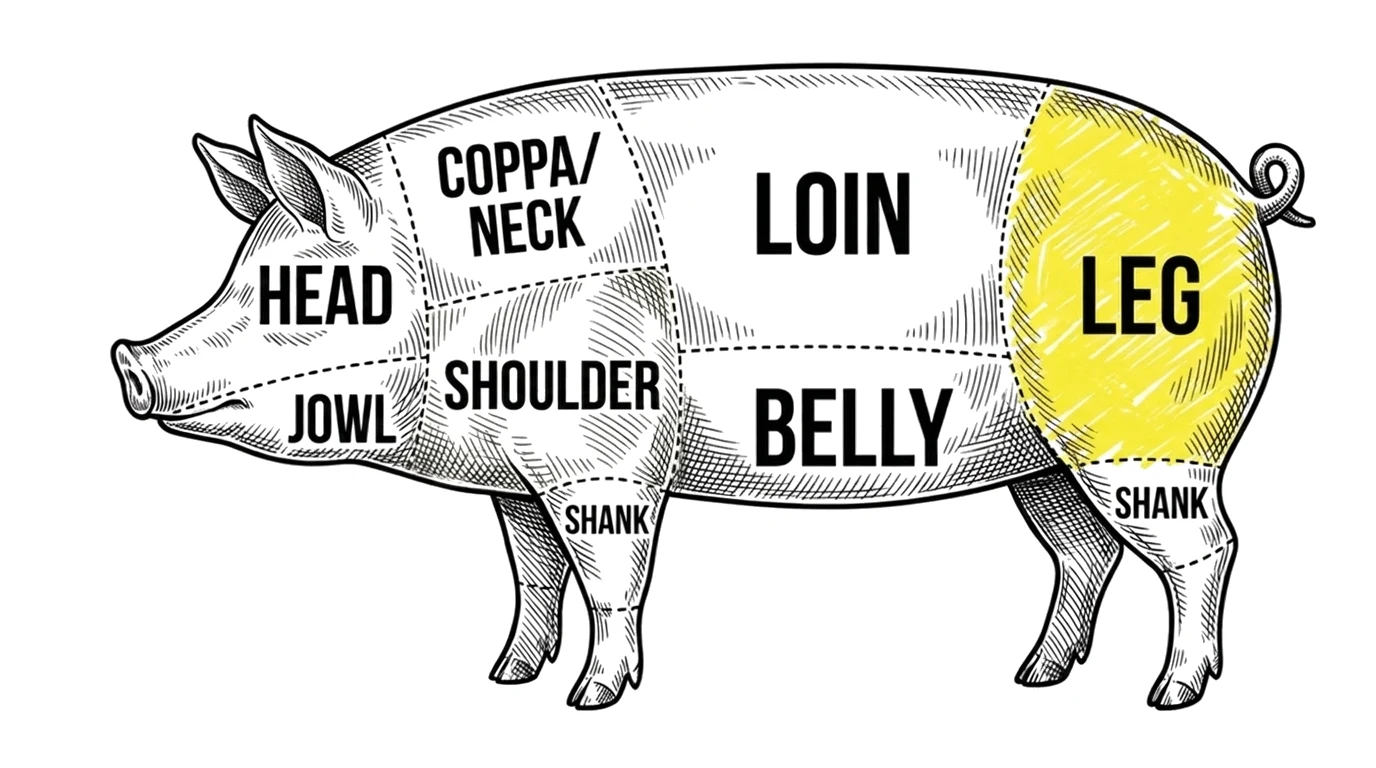
How to recognise it
The ham has a long profile, dark marbled lean and glossy soft fat. Bellota and cebo-de-campo products differ in finishing system and label, but both must be 100% Ibérico under the current PDO specification. The seal and traceability are therefore as important as sensory appearance.
- Shape and size
- Iberico leg, hoof on
- Lean colour
- Deep red, marbled
- Fat and marbling
- Melting
- Casing
- None
- Surface bloom
- Natural cellar mould
Origins and history
Extremadura's dehesa is an open woodland of holm oak, cork oak, pasture and livestock shaped over centuries by grazing and careful tree management. Iberian pigs convert seasonal acorns and herbs into soft aromatic fat, while cattle, sheep, cork and firewood share the same land. The winter montanera and matanza organised rural life long before modern certification. Specialist salting and curing houses later developed across Badajoz and Cáceres, but the product's value still begins in the landscape. The PDO, established in the modern period to protect Extremaduran production, now requires 100% Ibérico pigs and recognises bellota and cebo-de-campo systems. Its controls extend from the dehesa and animal identification through slaughter, salting and maturation.
Name. Jamon, ham; dehesa, the oak pasture; Extremadura the region.
- Production today
- Iberico producers across Extremadura.
- Protection
- DOP; iberico, acorn-graded.
- Tradition vs modern
- Dehesa rearing and long ageing are the protected essentials.
- Seasonality
- Montanera in autumn and winter.
Compare with. Jamón Ibérico de Bellota, Los Pedroches
Serving and cultural significance
Carve thinly and include the soft fat. Serve with bread, local sheep cheese, olives, nuts or Extremaduran wine. Bellota ham is best tasted with minimal garnish; cebo-de-campo ham can also be used generously in eggs, vegetables and warm dishes.
Recipe and cure
This is not a finished recipe. It is a window into how this meat is traditionally cured. Before you follow any process, please run it through one of our curing calculators, so the salt, cure and timings are right and safe for your own batch.
Curesmith home adaptation — not designation-compliant
Make this — the measured Curesmith version →The cure below is the traditional reference. “Make this” opens the measured Curesmith home recipe, scaled to your batch.
Traditional or protected production
The current PDO covers hams and shoulders from 100% Iberian pigs in bellota and cebo-de-campo categories. Production and processing occur in Cáceres and Badajoz. The current salting specification permits common salt and nitrifying salts under controlled conditions.
Sea salt only, salt-box method; no fixed percentage.
- Meat
- Iberian pig
- Cut
- whole hind leg, bone in
- Salt (%)
- traditional, no fixed %
- Curing salt
- Sea salt only
- Fermented
- No
- Starter or mould
- Natural cellar mould possible
- Smoked
- No
- Target aW or weight loss
- ~ weight loss
- Temperature (°C)
- cold salting, then rising through the cellar
- Humidity (%)
- 60 to 80
- Maturation
- 24 to 48 months for acorn-fed
- Basis
- percentage of green meat weight
- Style
- Traditional dry salting (salt-box)
Method
- Salt the leg cold in sea salt, roughly a day per kilo, then brush off.
- Rest cold so the salt equalises through the leg.
- Move to the cellar and age, letting the temperature rise through the warmer months.
- Age to the target loss, judging by feel and weight.
Notes
- The official protected specification controls the named product. Any Curesmith EQ, starter-culture, curing-salt or home-scale adaptation is a separate method and must not be presented as designation-compliant.
- A more efficient way of curing this product is using the EQ Method. No more than 2.5% salt to meat weight is required. To follow the EQ method, please use our whole-muscle EQ curing calculator to work out proper ratios and curing times.
In the Codex
What this product teaches, and where to read more.
Temple. Pillar, Meat Quality