
Hog's Pudding
Also known as Hogs pudding, Cornish hog's pudding, Devonshire hog's pudding, Groats pudding
Cornwall and Devon, United Kingdom
Overview
Hog's Pudding is a West Country sausage-pudding associated especially with Cornwall and Devon. It appears in two broad forms: a pale pork, fat and rusk sausage resembling a strongly seasoned white pudding, and a heavier groats form that can contain heart, liver and lungs. The final three source records preserve that range through Cornish and Devonshire pork-and-rusk branches plus an offal-and-buckwheat West Country branch. They belong in one article because the regional name historically covered variable butcher formulas.
Where it's from
The cut
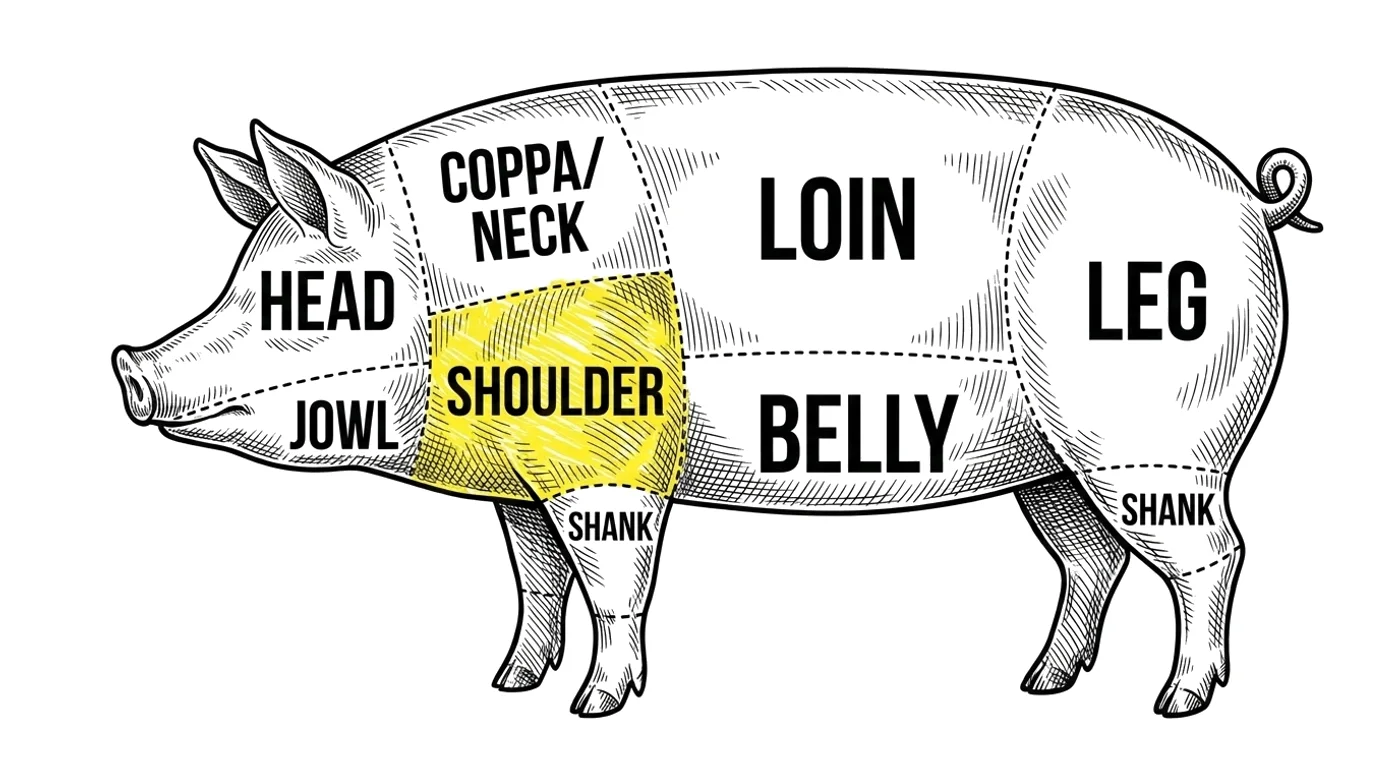
Identity and terminology
The apostrophe marks hog as the animal associated with the pudding, but the name has never guaranteed one fixed ingredient list. Hogs pudding without the apostrophe is a common spelling. Groats pudding refers to versions built around cracked grain such as buckwheat, oatmeal or barley. The product should not be confused with black pudding, which depends on blood, or Scottish haggis, which has its own sheep-pluck and national identity. No protected geographical registration was established for Hog's Pudding.
Composition and characteristics
The Cornish source branch uses lean pork, back fat, rusk and water with white pepper, mace, nutmeg, thyme and cayenne. The Devonshire branch increases salt, white pepper and cayenne. Both create a fine pale slice in a broad casing. The groats branch replaces rusk with cooked buckwheat and adds heart, liver and lung to semi-fat pork, producing a darker, looser and more mineral filling. The common features are broad casing, assertive seasoning, cooking before sale or service and a texture intended for slicing.
Production and process
Rusk branches require complete hydration under refrigeration before cold pork and fat are ground and mixed. Groats are cooked and weighed in their cooked state, while offal is inspected, pre-cooked as specified and chilled before grinding. Casings are filled moderately because cereal continues to expand. Pork-and-rusk puddings reach 71°C; the offal branch reaches 74°C. Every version is then cooled rapidly and refrigerated. Frying slices later creates the customary crisp surface but does not provide storage stability.
History and regional forms
British government household-food surveys listed hog's pudding among cooked meat products by the late 1960s, confirming that it was a recognised category rather than a recent restaurant invention. Local Devon research records nineteenth-century sales, thefts and butcher competition, while recipes remained guarded and variable. That secrecy helps explain why modern Cornish and Devon claims overlap and why precise origin stories conflict. It is a shared West Country tradition, and the evidence does not award it to one county.
Use, storage and related products
Slice Hog's Pudding thickly and fry it gently for breakfast with eggs, tomatoes and mushrooms, or serve it with potatoes and greens. Wheat must be declared in rusk versions. The lung-containing branch is prohibited for United States human-food production and should be made only where inspected edible lungs are lawful. Store every branch at 0–4°C and freeze promptly for longer keeping. White pudding is the nearest broader relative, while groats pudding and offal forms show the product's unusually wide internal range.
Recipe and cure
This is not a finished recipe. It is a window into how this meat is traditionally cured. Before you follow any process, run it through one of our curing calculators so the salt, cure and timings are right and safe for your own batch.
Make this — the measured Curesmith version →“Make this” opens the same cure as a measured recipe, scaled to your batch.
- Meat
- Lean pork shoulder
- Cut
- Lean pork shoulder
- Salt (%)
- 1.8
- Curing salt
- None
- Fermented
- No
- Starter or mould
- None; this product is not fermented
- Smoked
- No
- Maturation
- Refrigerate at 0–4°C; use within 4 days or freeze promptly
- Basis
- per 1,000 g lean pork shoulder
- Style
- uncured cooked West Country pork and rusk sausage
Ingredients
- Lean pork shoulder100% · 1000 g
- Pork back fat20% · 200 g
- Fine butcher's rusk22.7% · 272.5 g
- Ice water30.3% · 363.5 g
- Fine salt1.8% · 22 g
- White pepper0.61% · 7.5 g
- Ground mace0.15% · 2 g
- Ground nutmeg0.15% · 2 g
- Dried thyme, rubbed0.15% · 2 g
- Cayenne pepper0.04% · 0.5 g
Method
- Mix rusk with the measured water and refrigerate for 20 minutes.
- Grind chilled pork and fat separately through 3 mm.
- Mix pork with salt until tacky, then add spices, hydrated rusk and fat evenly.
- Fill the broad casing moderately and tie securely.
- Poach at 78–80°C until the cold point reaches 71°C.
- Shower briefly, complete rapid cooling, dry and refrigerate.
Safety. Declare wheat in rusk branches, respect edible-lung restrictions, leave cereal expansion space, probe to 71–74°C and cool rapidly.