
Jambon de Bayonne
zhahm-BOHN duh bay-ON
Bayonne (Adour basin), Nouvelle-Aquitaine, France
Sweet, tender and lightly nutty, with a clean Basque character.
Overview
Jambon de Bayonne is the salt-cured ham of the Adour Basin. It is made from pigs raised across a wider south-western supply area, but the salting and maturation take place in the protected basin between the Atlantic and the Pyrenees. The flavour is mild, sweet and only moderately salty.
Where it's from
Climate. The Adour basin around Bayonne, with alternating mild and humid spells.
Altitude. Adour basin, Basque country
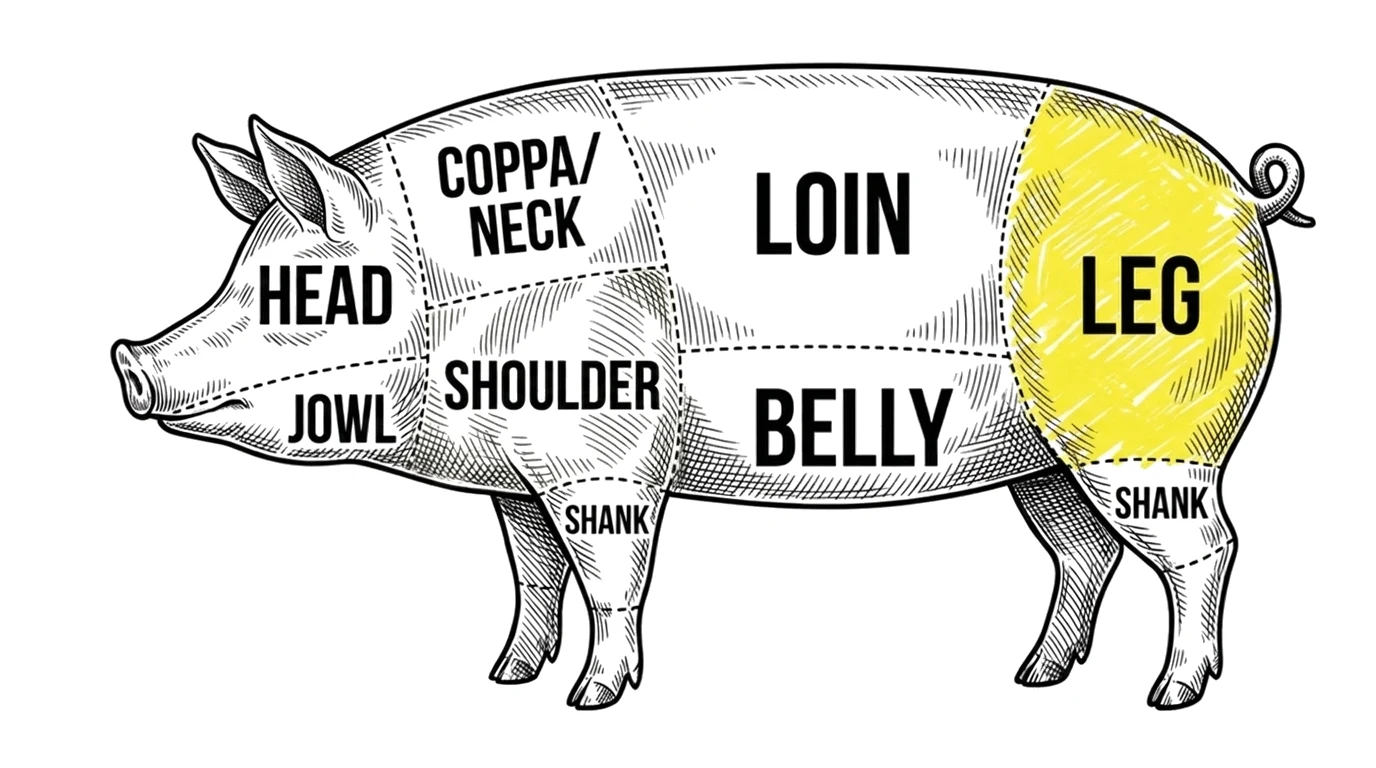
The cut
How to recognise it
The whole ham is elongated and neatly trimmed, with red to pink-red lean and clean white fat. The aroma is sweet and cured, without smoke. A light pepper coating may appear on the exposed surface. The slice should be tender and balanced, not hard, sour or aggressively salty. Authentic product carries the PGI identification.
- Shape and size
- Whole leg, marked with the Basque cross (lauburu)
- Lean colour
- Rosy red
- Fat and marbling
- White cover
- Casing
- None
- Surface bloom
- None
Origins and history
The ham was not originally made inside the city of Bayonne. Rural districts of Béarn, Gascony and the Basque country produced hams under local names, using salt from the Adour and nearby Salies-de-Béarn. Bayonne's busy port and markets became the point from which those hams travelled, so the trading city supplied the name. The Bayonne Ham Fair traces its history to the fifteenth century and remains a public celebration of the product. References in literature and royal dining helped establish its wider reputation. Modern PGI protection, registered in 1998, formalised the old commercial geography: pigs come from a defined south-western zone, while salting and maturation occur within the Adour Basin.
Name. Named for the town of Bayonne, its historic trading port.
- Production today
- Producers of the Adour basin consortium under the IGP.
- Protection
- IGP; salted with Adour-basin salt and matured to a set standard, finished with the Basque cross.
- Tradition vs modern
- The salt source and the Adour climate are the traditional essentials kept under the IGP.
- Seasonality
- Traditionally salted in winter and matured into summer.
Compare with. Prosciutto di Parma, Jambon du Kintoa
Serving and cultural significance
Slice very thinly and serve with bread, melon, figs, mild sheep's cheese or the wines of south-western France. It can also wrap vegetables or fish, but prolonged cooking should be avoided because the lean quickly becomes firm.
Recipe and cure
This is not a finished recipe. It is a window into how this meat is traditionally cured. Before you follow any process, please run it through one of our curing calculators, so the salt, cure and timings are right and safe for your own batch.
Curesmith home adaptation — not designation-compliant
Make this — the measured Curesmith version →The cure below is the traditional reference. “Make this” opens the measured Curesmith home recipe, scaled to your batch.
Traditional or protected production
PGI hams come from qualifying pigs raised and slaughtered in the protected south-western supply territory. The legs are salted with salt from the Adour Basin salt area, rested, dried and matured in the Adour Basin for at least the protected minimum period. Traditional pannage may protect the exposed lean during ageing.
Adour-basin salt (salt-box), with an Espelette pepper rub on the outside. No fixed salt percentage.
- Meat
- pork
- Cut
- whole hind leg
- Salt (%)
- traditional, no fixed %
- Curing salt
- Adour-basin salt; no nitrate in the traditional cure
- Other agents
- salt from the Adour basin, sometimes a light Espelette pepper rub
- Fermented
- No
- Smoked
- No
- Target aW or weight loss
- ~ weight loss
- Temperature (°C)
- cold salting, then 6 to 14
- Humidity (%)
- 70 to 80
- Maturation
- 7 to 12 months
- Basis
- percentage of green meat weight
- Style
- Traditional dry salting (salt-box)
Method
- Salt cold with Adour-basin salt.
- Rest so the salt draws through.
- Rub the outside with Espelette pepper.
- Age through the mild, humid seasons to the target loss.
Notes
- The official protected specification controls the named product. Any Curesmith EQ, starter-culture, curing-salt or home-scale adaptation is a separate method and must not be presented as designation-compliant.
- A more efficient way of curing this product is using the EQ Method. No more than 2.5% salt to meat weight is required. To follow the EQ method, please use our whole-muscle EQ curing calculator to work out proper ratios and curing times.
Safety. Salt source and climate are the signature. Judge by weight loss. Verify before serving.
In the Codex
What this product teaches, and where to read more.
Temple. Roof, Microclimate