
Jabugo
Also known as Jamón de Jabugo
Jabugo (Huelva), Andalusia, Spain
Complex, sweet and nutty, with silky marbled fat and great length, often called Spain's finest ham.
Overview
Jabugo PDO protects hams and shoulders from 100% Ibérico pigs finished on acorns and natural dehesa resources. The hams mature in the Sierra de Aracena, where cellar climate and the soft fat of the pig produce an exceptionally aromatic, persistent slice.
Where it's from
Climate. The mild, humid Sierra de Aracena, an oak dehesa in the Huelva mountains.
Altitude. Sierra de Aracena, mountainous
The cut
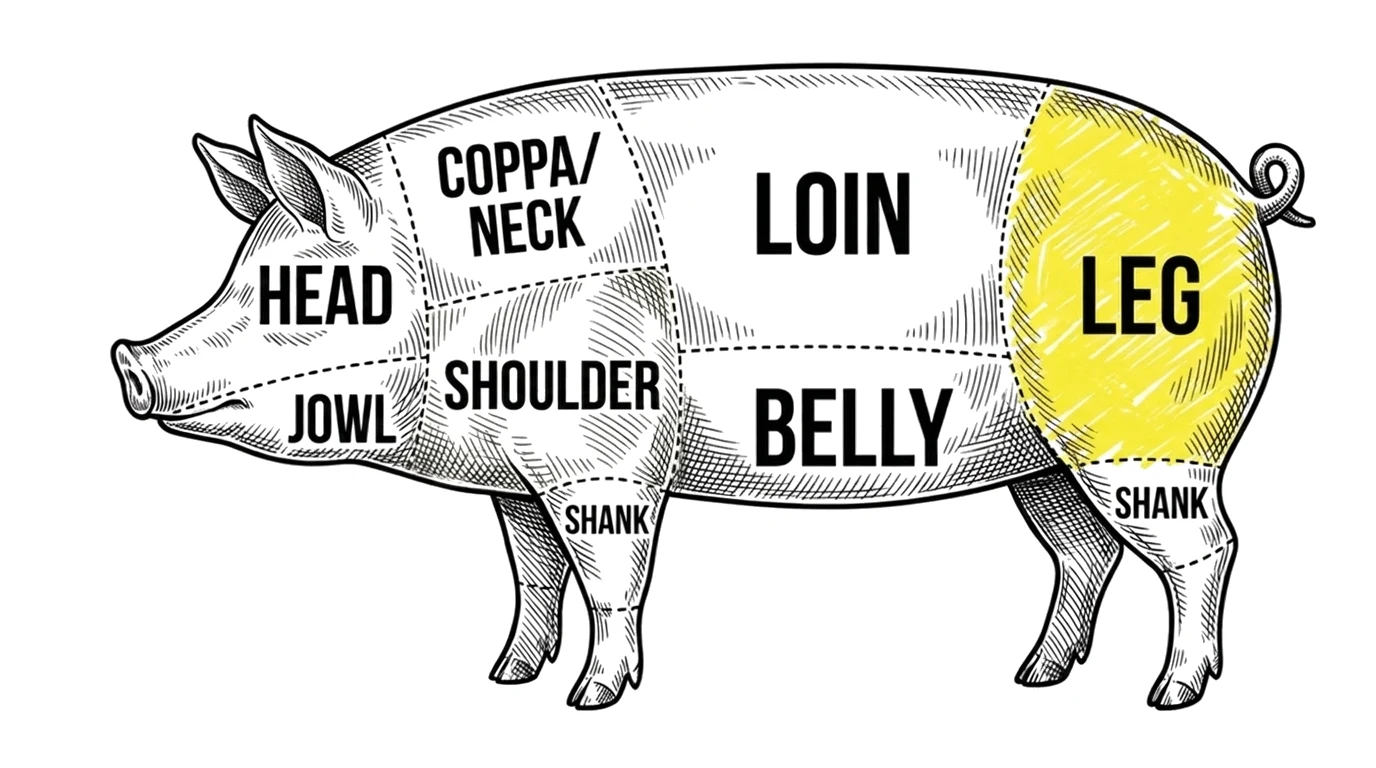
How to recognise it
The slice is dark red and highly marbled, with ivory fat that softens immediately at room temperature. Aroma is sweet, nutty and cellar-matured, with exceptional persistence. Official PDO labelling and traceability are essential. A black hoof alone does not prove Jabugo origin or category.
- Shape and size
- Slender iberico leg, hoof on
- Lean colour
- Deep red, marbled
- Fat and marbling
- Silky, melting
- Casing
- None
- Surface bloom
- Natural cellar mould
Origins and history
The Sierra de Aracena combines oak dehesa, mountain villages and curing cellars whose windows are opened and closed with the seasons. Iberian pigs ranged beneath holm and cork oaks during the montanera, while towns such as Jabugo became specialist centres for salting and maturation. Railway development in the nineteenth century helped carry the area's hams to Seville, Madrid and export markets, turning a regional craft into an international luxury. The protected designation was originally known as Jamón de Huelva. The name was changed to Jabugo, the place most strongly associated with the product, and the European registration now protects hams and shoulders from 100% Ibérico bellota pigs within the defined system. Jabugo therefore represents both the dehesa animal and the mountain cellar.
Name. Jamon, ham; Jabugo names the town in the Sierra de Aracena.
- Production today
- Iberico producers across the Sierra de Aracena.
- Protection
- DOP Jabugo (formerly Jamon de Huelva); iberico, acorn-graded.
- Tradition vs modern
- Mountain-dehesa ageing; acorn feeding is central.
- Seasonality
- Montanera in autumn and winter.
Compare with. Jamón Ibérico de Bellota, Guijuelo
Serving and cultural significance
Carve by hand into small thin slices containing both lean and fat. Serve at cool room temperature with plain bread, dry sherry or a light red wine. The fat should be eaten, not trimmed away, because it carries much of the aroma and texture.
Recipe and cure
This is not a finished recipe. It is a window into how this meat is traditionally cured. Before you follow any process, please run it through one of our curing calculators, so the salt, cure and timings are right and safe for your own batch.
Curesmith home adaptation — not designation-compliant
Make this — the measured Curesmith version →The cure below is the traditional reference. “Make this” opens the measured Curesmith home recipe, scaled to your batch.
Traditional or protected production
Jabugo PDO protects hams and shoulders from 100% Iberian pigs under the protected feeding and processing system. The current specification sets long minimum production periods by finished weight, including 600 or 730 days for hams.
Sea salt only, salt-box method; no fixed percentage.
- Meat
- Iberian pig
- Cut
- whole hind leg, bone in
- Salt (%)
- traditional, no fixed %
- Curing salt
- Sea salt only
- Fermented
- No
- Starter or mould
- Natural cellar mould possible
- Smoked
- No
- Target aW or weight loss
- ~ weight loss
- Temperature (°C)
- cold salting, then rising through the cellar
- Humidity (%)
- 60 to 80
- Maturation
- 24 to 48 months for acorn-fed
- Basis
- percentage of green meat weight
- Style
- Traditional dry salting (salt-box)
Method
- Salt the leg cold in sea salt, roughly a day per kilo, then brush off.
- Rest cold so the salt equalises through the leg.
- Move to the cellar and age, letting the temperature rise through the warmer months.
- Age to the target loss, judging by feel and weight.
Notes
- The official protected specification controls the named product. Any Curesmith EQ, starter-culture, curing-salt or home-scale adaptation is a separate method and must not be presented as designation-compliant.
- A more efficient way of curing this product is using the EQ Method. No more than 2.5% salt to meat weight is required. To follow the EQ method, please use our whole-muscle EQ curing calculator to work out proper ratios and curing times.
In the Codex
What this product teaches, and where to read more.
Temple. Pillar, Meat Quality