
Jamón de Trevélez
Trevelez (Granada), Andalusia, Spain
Sweet, lightly salted and delicate, shaped by the thin cold air of the high Alpujarras.
Overview
Jamón de Trevélez is a low-salt, additive-free mountain ham matured above 1,200 metres in the Granada Alpujarra. Marine salt, natural ventilation and long maturation produce a delicate white-pig ham whose protected minimum is 14, 17 or 20 months according to fresh-leg weight.
Where it's from
Climate. The high Alpujarras below the Sierra Nevada, thin, cold and dry.
Altitude. Very high, 1200 to 1900 m
The cut
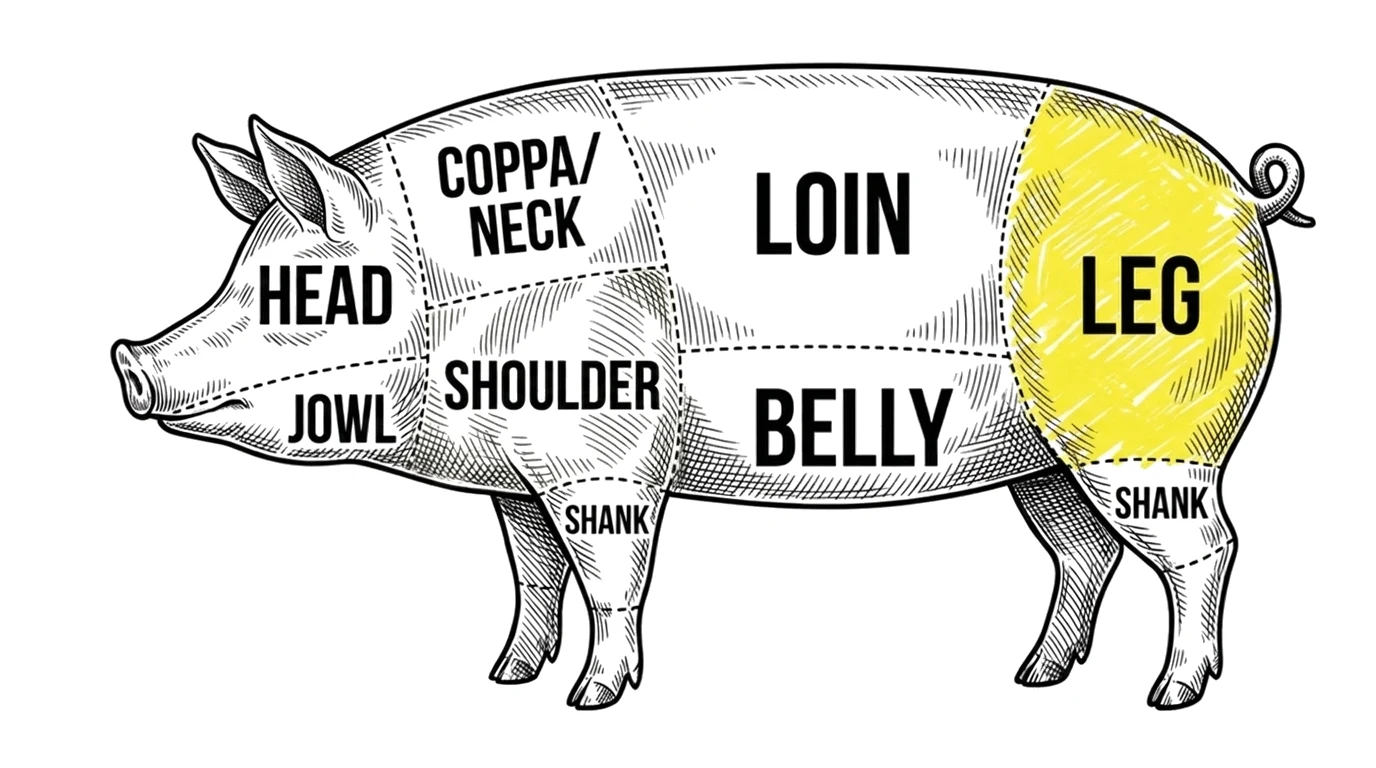
How to recognise it
The protected ham is rounded, retains rind and hoof, and has a bright red, glossy slice with partial fat infiltration. The fat is soft, shiny and white-yellow. Flavour should be delicate and only lightly salty; finished salt is controlled. The official maturation is 14, 17 or 20 months according to green weight.
- Shape and size
- White-pig leg, pale exterior
- Lean colour
- Rosy red
- Fat and marbling
- White
- Casing
- None
- Surface bloom
- Possible
Origins and history
The high Alpujarra villages on the southern side of Sierra Nevada combine snowy winters, cool summers and dry moving air. For more than two centuries, ham makers used these conditions to cure large legs gradually with less salt than would be practical in warmer country. Nineteenth-century writers praised the product, and the most celebrated historical event came on 12 October 1862, when Queen Isabel II granted Trevélez the privilege of supplying the Royal Household and authorised the royal seal on its hams. The specification also records the role of Empress Eugénie de Montijo in carrying its reputation to the French court. PGI protection now covers eight municipalities above 1,200 metres and preserves salt-only curing without nitrite, nitrate or other additives.
Name. Jamon, ham; Trevelez names the Alpujarras village.
- Production today
- Producers in and around Trevelez.
- Protection
- IGP; white pigs, salt only, altitude-cured.
- Tradition vs modern
- Altitude ageing is the whole point; no additives.
- Seasonality
- Year-round.
Compare with. Jamón de Serón, Jamón de Teruel / Paleta de Teruel
Serving and cultural significance
Carve thinly and serve with bread, tomato, almonds, olives or dry Andalusian wine. Its low salt and delicate aroma suit simple summer plates and gazpacho. The finest slices should be served cool rather than refrigerator-cold.
Recipe and cure
This is not a finished recipe. It is a window into how this meat is traditionally cured. Before you follow any process, please run it through one of our curing calculators, so the salt, cure and timings are right and safe for your own batch.
Curesmith home adaptation — not designation-compliant
Make this — the measured Curesmith version →The cure below is the traditional reference. “Make this” opens the measured Curesmith home recipe, scaled to your batch.
Traditional or protected production
Jamón de Trevélez is produced from heavy fresh white-pig legs in the high Alpujarra. Fresh-leg weight categories begin above 11.3 kg and determine the protected product category and maturation requirements. The cure is known for restrained salting and mountain-air drying.
Sea salt only, salt-box method; no fixed percentage.
- Meat
- white pig
- Cut
- whole hind leg, bone in
- Salt (%)
- traditional, no fixed %
- Curing salt
- Sea salt only (white-pig ham)
- Fermented
- No
- Starter or mould
- Natural cellar mould possible
- Smoked
- No
- Target aW or weight loss
- ~ weight loss
- Temperature (°C)
- cold salting, then rising through the cellar
- Humidity (%)
- 60 to 80
- Maturation
- 14 to 24 months
- Basis
- percentage of green meat weight
- Style
- Traditional dry salting (salt-box)
Method
- Salt the leg cold in sea salt, roughly a day per kilo, then brush off.
- Rest cold so the salt equalises through the leg.
- Move to the cellar and age, letting the temperature rise through the warmer months.
- Age to the target loss, judging by feel and weight.
Notes
- The official protected specification controls the named product. Any Curesmith EQ, starter-culture, curing-salt or home-scale adaptation is a separate method and must not be presented as designation-compliant.
- A more efficient way of curing this product is using the EQ Method. No more than 2.5% salt to meat weight is required. To follow the EQ method, please use our whole-muscle EQ curing calculator to work out proper ratios and curing times.
In the Codex
What this product teaches, and where to read more.
Temple. Roof, Microclimate