
Beef Chuck
Also known as chuck, shoulder clod, neck and shoulder, Rindernacken, paleron, cappello del prete, aguja
Beef's answer to pork shoulder: the working front end, well marbled, heavy in collagen and deeply coloured. The default beef for sausage in every tradition that uses beef at all.
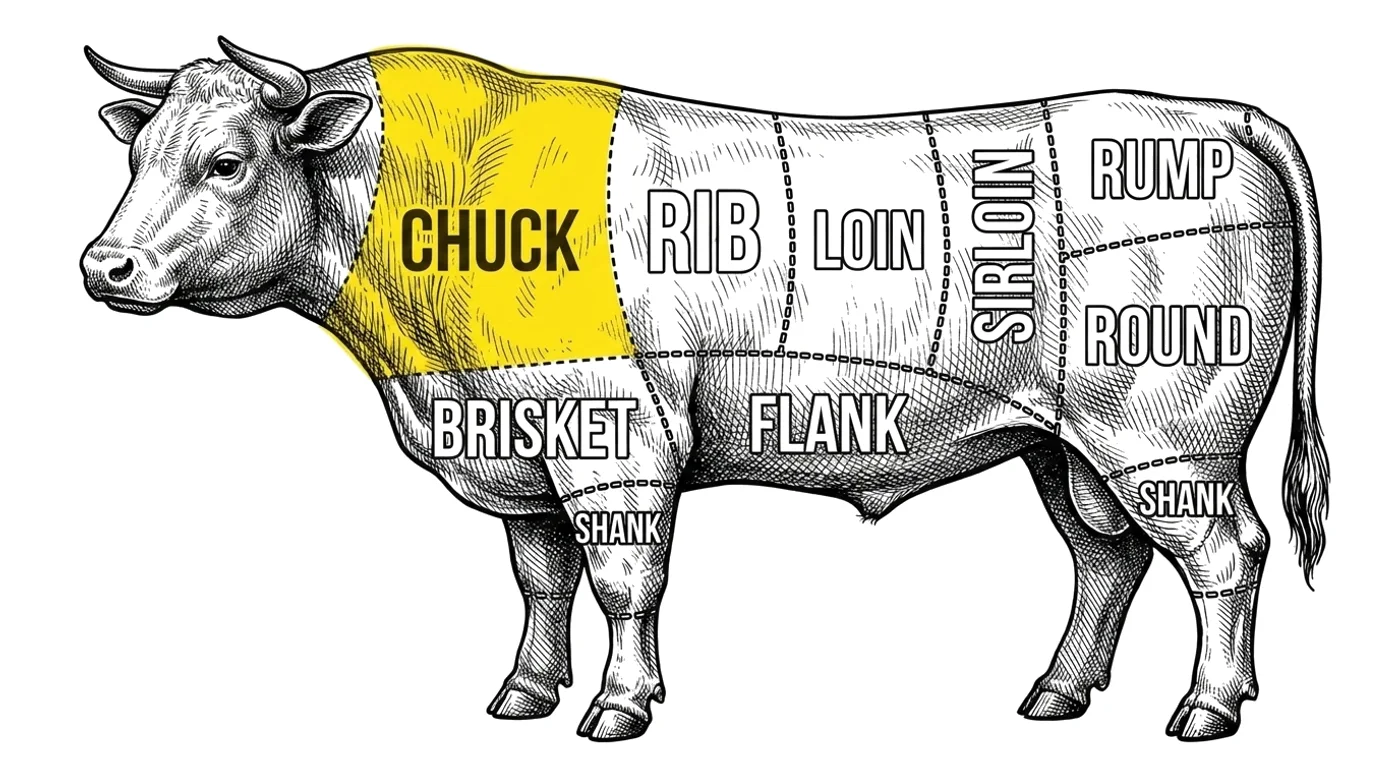
Chuck is the neck and shoulder of the animal, and it does for beef exactly what shoulder does for pork. It works hard, so it carries plenty of collagen and a good distribution of intramuscular fat, and it is dark with myoglobin. In sausage terms that is the useful trio: bind, fat that is already dispersed, and colour.
Colour is where beef differs from pork most usefully. Cattle are larger, longer-lived and their muscle carries considerably more myoglobin than a pig's, so beef gives a much deeper red in a cured product. This is why so many mixed formulas use beef for colour and pork for fat and flavour: the German and Austrian Brühwurst family, the Polish and Hungarian sausages, the Jewish and halal all-beef traditions, the Turkish sujuk and the American summer sausages all lean on it. In a fermented salami the beef fraction is often doing colour work rather than flavour work.
Beef fat behaves differently from pork fat and this is worth planning for. It is harder at room temperature, with a higher melting point, so it does not smear as readily; it is also waxier on the palate and it goes rancid faster, carrying a distinct tallow flavour when it does. Most traditions that use beef for the lean use pork back fat for the fat phase rather than beef fat, and that is a deliberate choice rather than a convenience.
Chuck comes in several named subprimals that behave differently. The flat iron and the chuck eye are tender enough to be sold as steak. The clod and the neck are the sinewy working parts and are the sausage material. Because chuck carries heavy sheets of gristle and silverskin rather than fine marbling alone, trimming matters: in a cooked sausage that collagen becomes gelatin and is welcome, but in a dry-cured product it stays, and an untrimmed seam is a chewy thread.
One consideration is particular to beef. Beef carries a higher risk profile for E. coli O157:H7 than pork does, and the organism is acid-tolerant enough to survive a fermentation that would deal with many other pathogens. That is the reason the American dry-sausage rules require a validated 5-log reduction for beef products, and it is a genuine reason to buy beef for raw fermented work from a source you trust.
Temple element. Pillar, Meat Quality