
Coppa Piacentina
Piacenza, Emilia-Romagna, Italy
Sweet and well-marbled, with a mellow, rounded flavour from long cellar ageing.
Overview
Coppa Piacentina is the large whole-neck cure of Piacenza, sweetly spiced and matured until its broad seams of fat become soft and aromatic. It is one of three PDO salumi that make Piacenza unique among Italian provinces.
Where it's from
Climate. The Piacenza hills of Emilia.
Altitude. Emilian hills
The cut
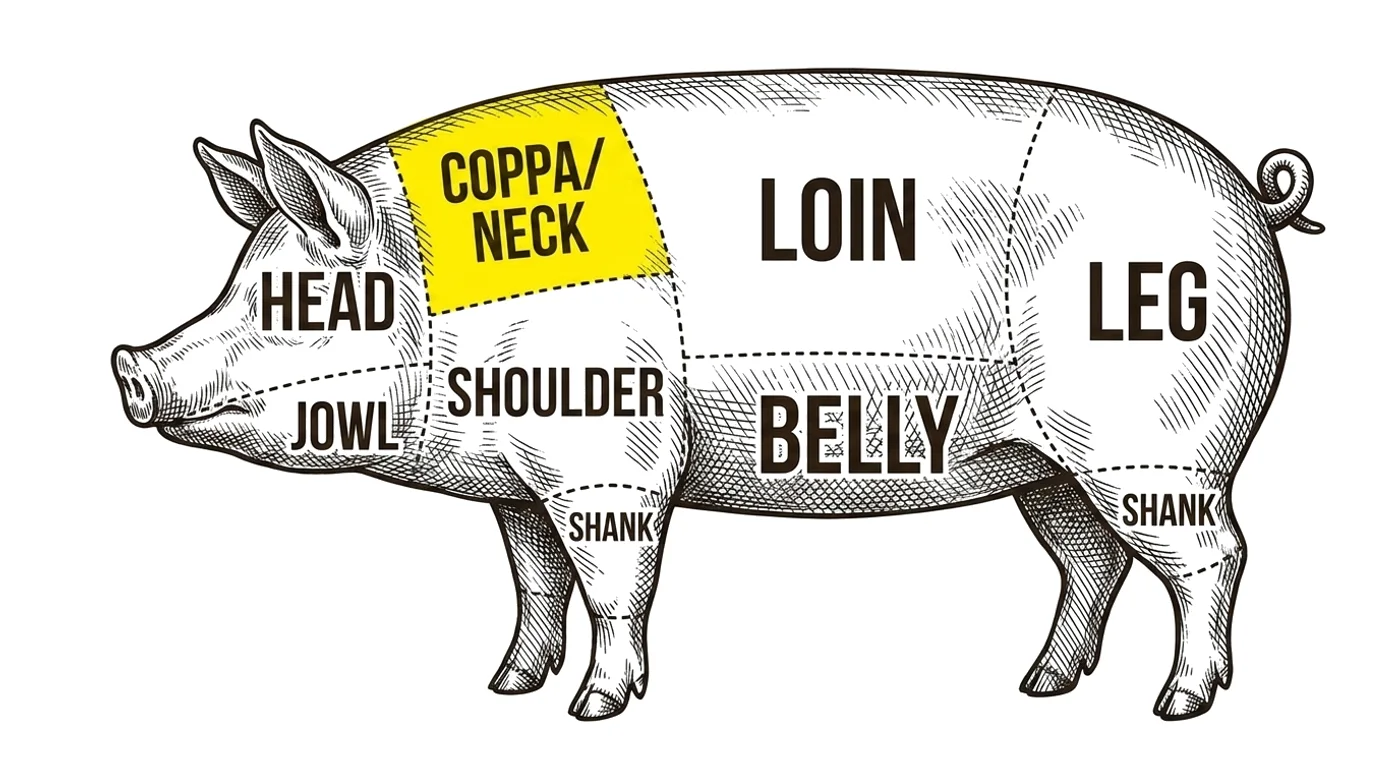
How to recognise it
A whole Coppa Piacentina is broad, cylindrical and tightly cased or tied. The slice is deep red with substantial white marbling, often in sweeping irregular seams. Aroma is sweet, peppery and mature. It should be tender rather than leathery. Hollow casing, grey centre meat, a hard dry ring or rancid fat are faults.
- Shape and size
- Cylindrical cased neck muscle
- Lean colour
- Deep red
- Fat and marbling
- Well-marbled
- Casing
- Natural casing
- Surface bloom
- Light mould possible
Origins and history
Pig keeping in the Piacenza area reaches back to pre-Roman settlement, and later records, abbey art and rural custom show pork slaughter as a recurring part of the local year. The province sits between the Po plain and Apennine valleys, giving it agricultural wealth, trade routes and curing environments that could be managed from lowland winter to hill cellar. Neck meat was selected for coppa because its natural marbling remained tender during a long cure. Historical commerce in Piacentine salumi expanded through noble households, monasteries and urban markets. Today Piacenza is the only Italian province with three PDO cured meats: Coppa, Pancetta and Salame Piacentino. Their shared protection reflects both common raw-material rules and distinct local craft.
Name. Coppa refers to the neck muscle, the capocollo, from which it is made.
- Production today
- Consortium producers in Piacenza.
- Protection
- DOP.
- Tradition vs modern
- Traditional hill-cellar ageing.
- Seasonality
- Year-round.
Compare with. Coppa di Parma
Serving and cultural significance
Slice it thinly and serve with Piacentine fried breads such as torta fritta, local cheese, pickles or sparkling wine. The marbling should soften before eating. It also makes a rich sandwich with bitter leaves or mustard.
Recipe and cure
This is not a finished recipe. It is a window into how this meat is traditionally cured. Before you follow any process, please run it through one of our curing calculators, so the salt, cure and timings are right and safe for your own batch.
Curesmith home adaptation — not designation-compliant
Make this — the measured Curesmith version →The cure below is the traditional reference. “Make this” opens the measured Curesmith home recipe, scaled to your batch.
Traditional or protected production
Coppa Piacentina uses the pork neck, seasoned and enclosed in natural casing before long maturation in the Piacenza production area. The protected product belongs to the same regional trio as Pancetta and Salame Piacentino.
- Meat
- pork
- Salt (%)
- 3
- Curing salt
- Salt with a little Cure #2, traditionally
- Fermented
- No
- Starter or mould
- Light natural mould possible
- Smoked
- No
- Target aW or weight loss
- ~30% weight loss
- Temperature (°C)
- 12 to 15
- Humidity (%)
- 75 to 80
- Maturation
- 2 to 3 months and up
- Basis
- percentage of green meat weight
- Style
- Traditional dry salting, cased
Ingredients
- sea salt3% · 30 g/kg
- black pepper0.4% · 4 g/kg
- clove0.03% · 0.3 g/kg
- nutmeg0.05% · 0.5 g/kg
- dry white wine1.5% · 15 g/kg
Method
- Rub the muscle with salt and seasoning and rest cold.
- Rinse and rest so the salt equalises.
- Case, tie and net.
- Dry and age to the target loss.
Notes
- The official protected specification controls the named product. Any Curesmith EQ, starter-culture, curing-salt or home-scale adaptation is a separate method and must not be presented as designation-compliant.
- A more efficient way of curing this product is using the EQ Method. No more than 2.5% salt to meat weight is required. To follow the EQ method, please use our whole-muscle EQ curing calculator to work out proper ratios and curing times.
In the Codex
What this product teaches, and where to read more.
Temple. Pillar, Meat Quality