
Jambon du Kintoa
zhahm-BOHN kin-TO-ah
Also known as Jambon Kintoa
Aldudes valley, Basque country, France
Deep, nutty and richly coloured, a ham defined as much by the pig as the place.
Overview
Jambon du Kintoa is the protected ham of the Basque Pie Noir pig, a slow-growing black-and-white breed raised outdoors in the western Pyrenean landscape. Long maturation develops dark marbled lean, soft aromatic fat and a concentrated flavour closer to the great extensive Iberian hams than to ordinary white-pig jambon sec.
Where it's from
Climate. The Aldudes valley of the Basque country.
Altitude. Basque mountain valley
The cut
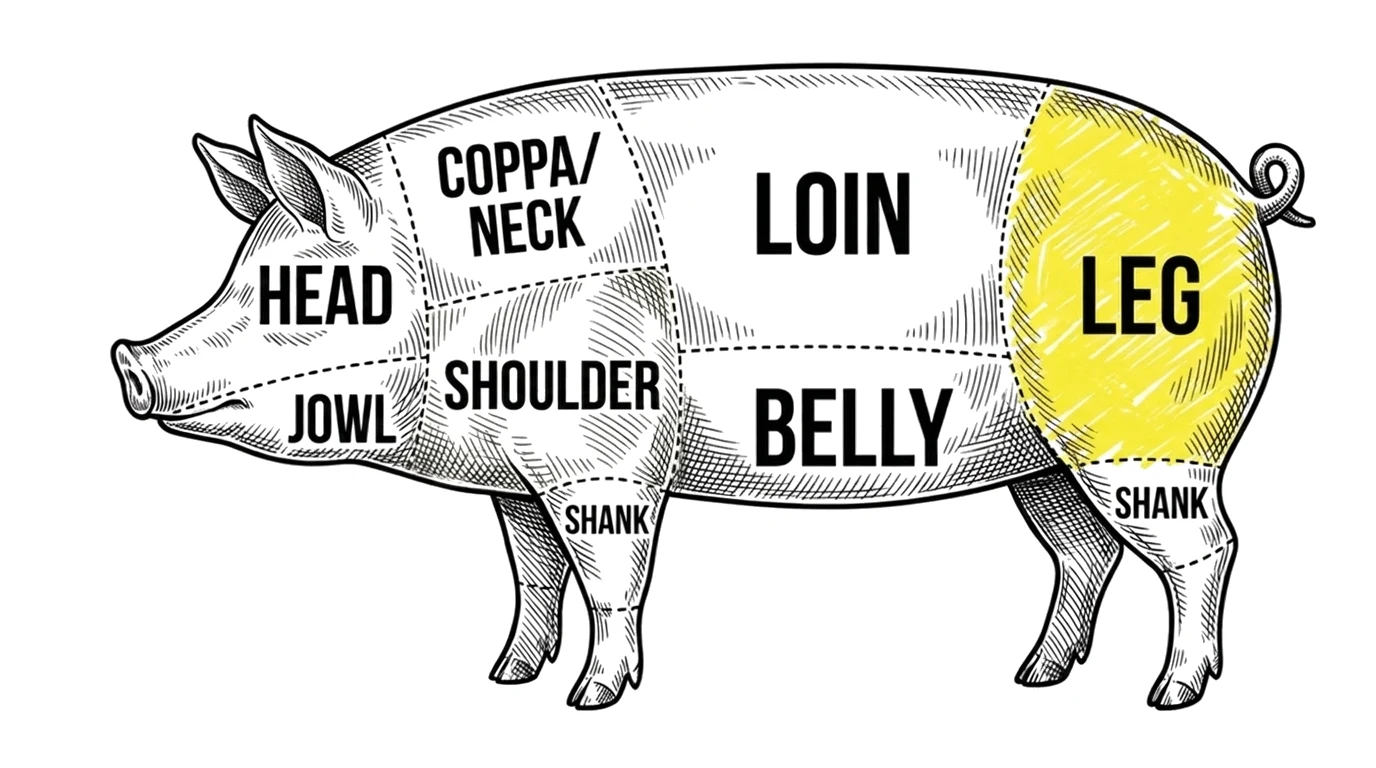
How to recognise it
The ham has a deep red to garnet slice with visible marbling and thick ivory fat that softens readily. Aroma is intense, nutty and mature without heavy smoke. The texture should be supple and persistent. The AOP mark and traceability identify the protected product; colour alone cannot prove Kintoa breed or production.
- Shape and size
- Whole leg, deeply coloured
- Lean colour
- Strikingly deep red
- Fat and marbling
- Rich, well-marbled
- Casing
- None
- Surface bloom
- Natural mould
Origins and history
The Basque pig once ranged widely across the western Pyrenees, feeding in woodland and farm country. Modern intensive breeds pushed it close to disappearance during the twentieth century. In the 1980s, a small group of farmers and processors began rebuilding the population from the remaining animals, reconnecting the breed with extensive outdoor production. The name Kintoa refers to an old tax or fifth levied on pigs crossing or grazing in the region, linking the modern product to a long history of transhumance, forest rights and border trade. Pork Kintoa received PDO protection first, followed by Jambon du Kintoa at European level in 2019. The ham therefore represents both a cured product and the successful recovery of a regional breed and landscape.
Name. Kintoa refers to the quinta, the historic right to graze pigs, and the local breed.
- Production today
- A small AOP producer group in the Basque country.
- Protection
- AOP; from the Kintoa pig, reared and cured to a strict standard.
- Tradition vs modern
- A modern heritage-breed revival built on a very old grazing tradition.
- Seasonality
- Tied to the autumn fattening.
Compare with. Jamón Ibérico de Bellota, Jambon de Bayonne
Serving and cultural significance
Carve thinly and serve at cool room temperature with plain bread, Basque sheep's cheese, cherries, peppers or cider. The fat is a central part of the experience and should be included in each slice rather than trimmed away.
Recipe and cure
This is not a finished recipe. It is a window into how this meat is traditionally cured. Before you follow any process, please run it through one of our curing calculators, so the salt, cure and timings are right and safe for your own batch.
Curesmith home adaptation — not designation-compliant
Make this — the measured Curesmith version →The cure below is the traditional reference. “Make this” opens the measured Curesmith home recipe, scaled to your batch.
Traditional or protected production
AOP production begins with qualifying Pie Noir du Pays Basque pigs raised within the defined system and area. The legs are salted and matured for an extended period under the protected Basque process. Breed, outdoor management, feed, slaughter, transformation and ageing are all part of the designation rather than interchangeable marketing claims.
Sea salt only, salt-box method. No fixed percentage.
- Meat
- Pie Noir Basque (Kintoa) pig
- Cut
- whole hind leg
- Salt (%)
- traditional, no fixed %
- Curing salt
- Sea salt only
- Other agents
- salt
- Fermented
- No
- Starter or mould
- Natural cellar mould
- Smoked
- No
- Target aW or weight loss
- ~ weight loss
- Temperature (°C)
- cold salting, then cellar
- Humidity (%)
- 70 to 80
- Maturation
- long, air-dried
- Basis
- percentage of green meat weight
- Style
- Traditional dry salting (salt-box)
Method
- Salt the Kintoa leg cold in sea salt.
- Rest so the salt equalises, then move to the cellar.
- Age long on the breed's rich, marbled meat.
Notes
- The official protected specification controls the named product. Any Curesmith EQ, starter-culture, curing-salt or home-scale adaptation is a separate method and must not be presented as designation-compliant.
- A more efficient way of curing this product is using the EQ Method. No more than 2.5% salt to meat weight is required. To follow the EQ method, please use our whole-muscle EQ curing calculator to work out proper ratios and curing times.
Safety. Heritage-breed ham, the pig is central. Verify before serving.
In the Codex
What this product teaches, and where to read more.
Temple. Pillar, Meat Quality