
Jambon noir de Bigorre
Hautes-Pyrenees, Occitanie, France
Marbled, nutty and deep, a heritage black-pig ham to rival the finest Spanish hams.
Overview
Jambon noir de Bigorre is the long-aged ham of the pure Gascon black pig, raised outdoors in the Pyrenean foothills. The breed's slow growth and soft marbled fat support at least twenty months of maturation, producing a deep red, nutty and exceptionally persistent ham.
Where it's from
Climate. The Pyrenean foothills of Bigorre in Gascony, where the black pigs range free.
Altitude. Pyrenean foothills
The cut
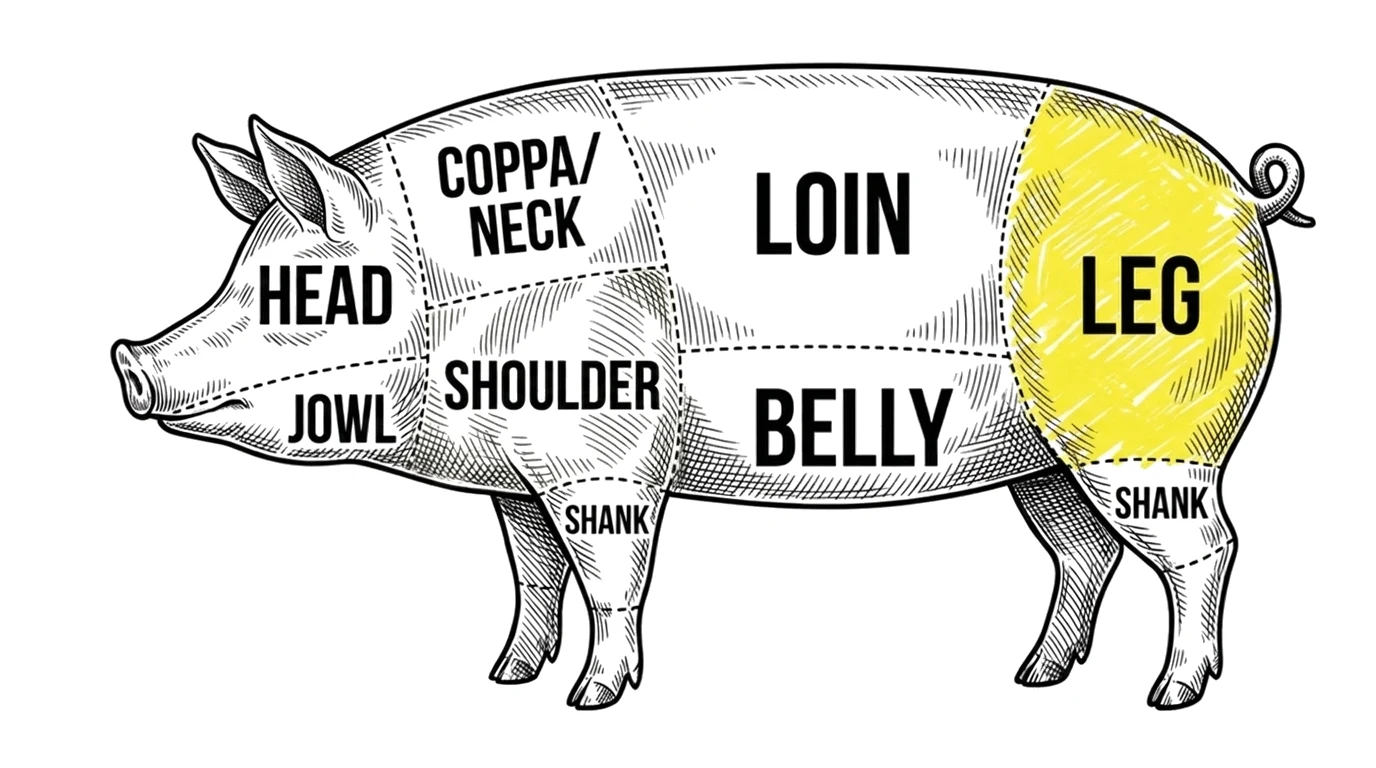
How to recognise it
The ham has dark garnet lean with abundant fine marbling and ivory fat that softens readily. Aroma is nutty, mature and persistent, without heavy smoke. Official identification is essential because appearance alone cannot prove breed. Rancidity, sour bone odour or excessive salt are serious faults.
- Shape and size
- Whole leg, deeply coloured
- Lean colour
- Deep marbled red
- Fat and marbling
- Rich, melting
- Casing
- None
- Surface bloom
- Natural cellar mould
Origins and history
The Gascon black pig once belonged naturally to farms across the Pyrenean foothills, where it grazed grassland, woodland and crop stubble. Intensive white breeds and standardised production pushed it close to extinction after the Second World War. By 1981 the recovery programme could locate only thirty-four sows and two males, making the modern ham inseparable from breed conservation. Farmers, butchers and curers rebuilt numbers slowly and created an outdoor production system that rewarded the pig's ability to forage and deposit aromatic fat. The protected chain later secured AOP recognition for both Porc noir de Bigorre and its ham. Long curing, including at least twelve months in dryers connected with outside air, turns the breed rescue into a product with genuine landscape and genetic meaning.
Name. Jambon noir, black ham; Bigorre the Gascon county.
- Production today
- A small AOP producer group in Bigorre.
- Protection
- AOP; from the Porc Noir de Bigorre, free-range and long-cured.
- Tradition vs modern
- A modern breed revival built on an old free-range tradition.
- Seasonality
- Tied to the autumn fattening.
Compare with. Jamón Ibérico de Bellota, Jambon du Kintoa
Serving and cultural significance
Carve small thin slices and include the soft fat. Serve at cool room temperature with plain bread, nuts, mild cheese or Madiran wine. The intense finish needs little garnish. A small tasting portion is preferable to a large pile of slices, because the long finish and melting fat are central to the experience.
Recipe and cure
This is not a finished recipe. It is a window into how this meat is traditionally cured. Before you follow any process, please run it through one of our curing calculators, so the salt, cure and timings are right and safe for your own batch.
Curesmith home adaptation — not designation-compliant
Make this — the measured Curesmith version →The cure below is the traditional reference. “Make this” opens the measured Curesmith home recipe, scaled to your batch.
Traditional or protected production
The AOP controls pure Gascon black pigs, outdoor husbandry, feed, slaughter, salting and maturation. The ham ages for at least twenty months, including at least twelve months in dryers linked to outside air. The designation covers an integrated breed-and-place system.
Sea salt only, salt-box method; no fixed percentage.
- Meat
- Noir de Bigorre pig
- Salt (%)
- traditional, no fixed %
- Curing salt
- Sea salt only
- Fermented
- No
- Starter or mould
- Natural cellar mould possible
- Smoked
- No
- Target aW or weight loss
- ~ weight loss
- Temperature (°C)
- cold salting, then 10 to 15
- Humidity (%)
- 70 to 80
- Maturation
- 20 months and up
- Basis
- percentage of green meat weight
- Style
- Traditional dry salting (salt-box)
Method
- Salt and season the cut by the traditional method and rest cold so the salt draws through.
- Wash or brush off surface salt and begin the slow dry.
- Case or hang as the style requires.
- Age to the target loss, judging by weight.
Notes
- The official protected specification controls the named product. Any Curesmith EQ, starter-culture, curing-salt or home-scale adaptation is a separate method and must not be presented as designation-compliant.
- A more efficient way of curing this product is using the EQ Method. No more than 2.5% salt to meat weight is required. To follow the EQ method, please use our whole-muscle EQ curing calculator to work out proper ratios and curing times.
In the Codex
What this product teaches, and where to read more.
Temple. Pillar, Meat Quality