
Jamón Ibérico de Bellota
ha-MOHN ee-BEH-ree-koh deh beh-YOH-tah
Also known as pata negra (colloquial)
DOPs: Guijuelo, Jabugo, Dehesa de Extremadura, Los Pedroches, Western and south-western Spain, Spain
Deeply savoury and nutty with marbled fat that dissolves on the tongue.
Overview
Jamón Ibérico de Bellota is a regulated Spanish sales category for ham from qualifying Ibérico pigs finished on acorns and natural dehesa resources during the montanera. It is not, by itself, a protected designation of origin. Individual PDOs impose additional breed, area and process rules.
Where it's from
Climate. The dehesa oak pastures of western and south-western Spain.
Altitude. Dehesa woodland pasture
The cut
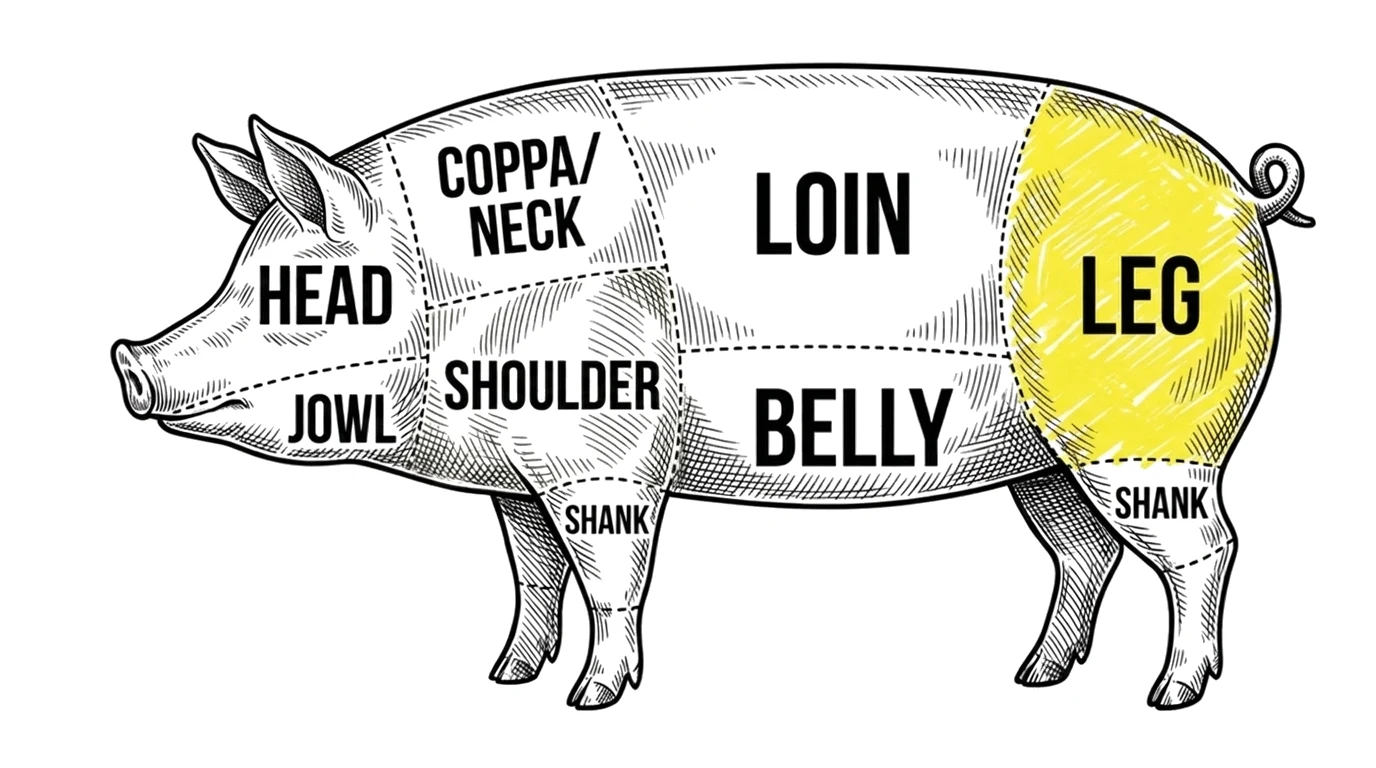
How to recognise it
A high-quality bellota ham has an elongated leg, dark red marbled lean and glossy ivory-to-yellow fat that softens readily at room temperature. The slice should be supple, aromatic and persistent, with sweet nutty and cured-meat notes rather than heavy smoke. The label and seal are essential because shape and colour alone cannot prove breed percentage, acorn finishing or PDO status.
- Shape and size
- Slender whole leg with a V-cut, hoof left on
- Lean colour
- Deep red, glossy
- Fat and marbling
- Marbled, fat that melts at room temperature
- Casing
- None
- Surface bloom
- Natural cellar mould
Origins and history
The product cannot be separated from the dehesa, the open woodland of holm oak, cork oak, pasture and livestock that covers parts of western Spain. Iberian pigs are adapted to range widely and deposit soft intramuscular fat. During the autumn and winter montanera they forage for fallen acorns and pasture, linking the ham's composition directly to a managed landscape. Pig slaughter and long ham curing were central to rural household economies, but modern prestige developed through specialist mountain cellars and the commercial recognition of breed and feed differences. Spain's current Ibérico quality standard regulates terms such as bellota, cebo de campo and breed percentage, with coloured seals supporting traceability. Four separate PDO systems protect specific regional forms. The generic phrase Jamón Ibérico de Bellota therefore describes legal breed and feeding conditions, not one geographical origin.
Name. Jamon from the same root as the French jambon; iberico for the breed; bellota means acorn.
- Production today
- Producers across four DOPs: Guijuelo, Jabugo, Dehesa de Extremadura and Los Pedroches.
- Protection
- DOP; grades run by breed purity and feed, with 100% pure-bred bellota at the top.
- Tradition vs modern
- Long natural ageing in cellars; the acorn diet and free ranging are the protected essentials.
- Seasonality
- The montanera fattening runs autumn to winter.
Compare with. Jamón Serrano, Culatello di Zibello
Serving and cultural significance
Carve by hand into small thin slices, keeping a balance of lean and soft fat in each piece. Serve at a temperature where the fat becomes glossy, with plain bread, almonds, olives or dry sherry. Strong cheese and heavy garnish can mask the long finish that makes bellota ham valuable.
Recipe and cure
This is not a finished recipe. It is a window into how this meat is traditionally cured. Before you follow any process, please run it through one of our curing calculators, so the salt, cure and timings are right and safe for your own batch.
Make this — the measured Curesmith version →The cure below is the traditional reference. “Make this” opens the measured Curesmith home recipe, scaled to your batch.
Traditional or protected production
The Spanish Ibérico quality standard regulates breed percentage, feeding category, traceability and labelling. Bellota pigs complete the montanera using acorns and other natural dehesa resources. Hams are salted, rested, dried and matured for extended periods. A product carries a PDO name only when it also complies with the separate specification of Jabugo, Guijuelo, Dehesa de Extremadura or Los Pedroches.
Sea salt only, salt-box method. No fixed percentage.
- Meat
- Black Iberian pig, acorn-fattened
- Cut
- whole hind leg
- Salt (%)
- traditional, no fixed %
- Curing salt
- Sea salt only
- Other agents
- sea salt
- Fermented
- No
- Starter or mould
- Natural cellar mould
- Smoked
- No
- Target aW or weight loss
- ~30%+ weight loss
- Temperature (°C)
- cold salting, then rising through 15 to 30 over ageing
- Humidity (%)
- 60 to 80
- Maturation
- 24 to 48 months
- Basis
- percentage of green meat weight
- Style
- Traditional dry salting (salt-box)
Method
- Salt the leg cold in a bed of sea salt, roughly a day per kilo, then brush off.
- Rest cold so the salt equalises through the leg.
- Move to the cellar and age through the warmer months.
- Age to the target loss, judging by feel and weight.
Notes
- A more efficient way of curing this product is using the EQ Method. No more than 2.5% salt to meat weight is required. To follow the EQ method, please use our whole-muscle EQ curing calculator to work out proper ratios and curing times.
Safety. A very long cure where the acorn-fed raw material is as decisive as the method. Verify before serving.
In the Codex
What this product teaches, and where to read more.
Temple. Pillar, Meat Quality