
Pork Belly
Also known as side, streaky, pancetta cut, Bauch, poitrine, pancetta, panceta, boczek
The layered slab from the abdominal wall, where alternating seams of fat and lean are the product rather than an accident. Its fat is softer than back fat and its lean cures faster, so it never cures evenly on its own terms.
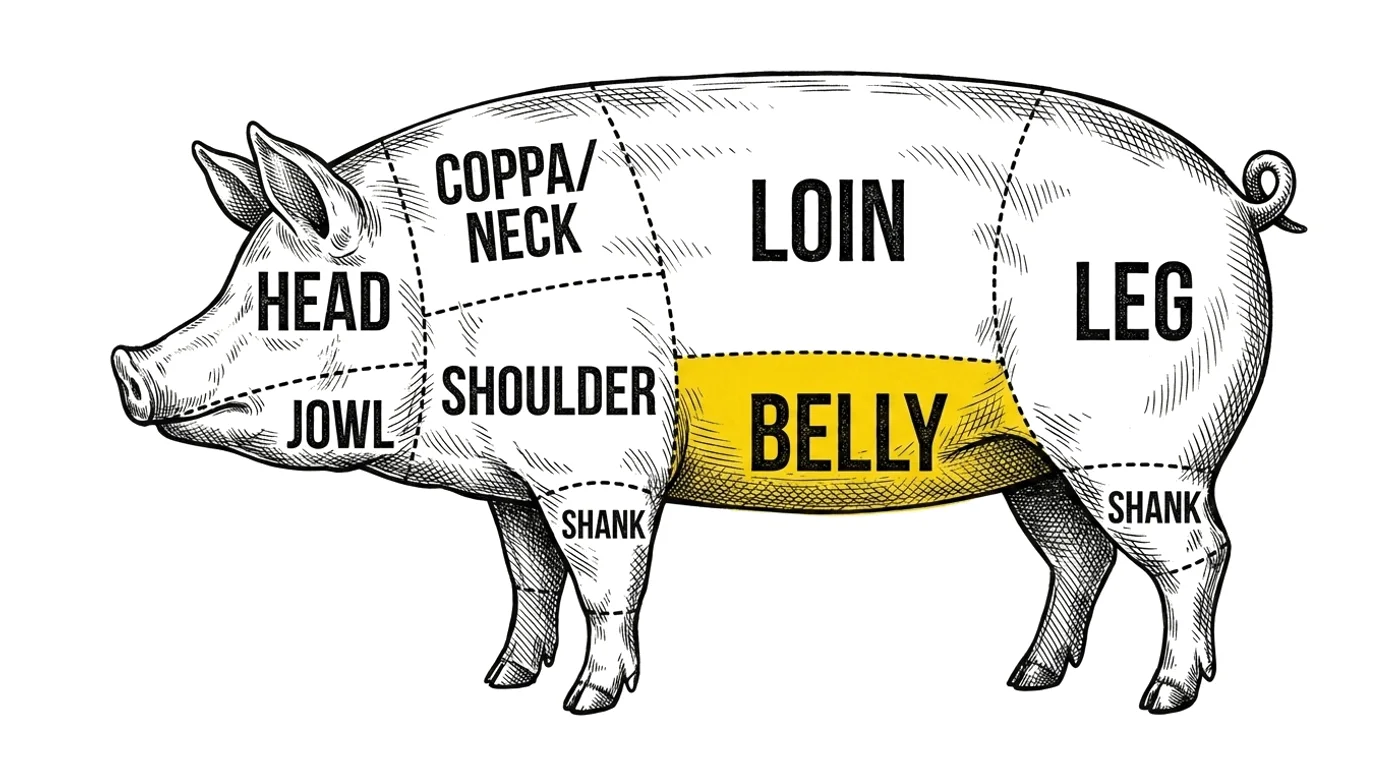
The belly is the abdominal wall: thin sheets of muscle that hold the viscera in place, separated by layers of fat, running from behind the shoulder to the ham. Those muscles do almost no locomotive work, which is why the lean in a belly is tender and pale compared with shoulder, and why the layering is so regular. The stripe of a good streaky bacon or a rolled pancetta is anatomy, not butchery.
That layering is the whole point and the whole difficulty. Salt moves through lean muscle far faster than it moves through fat, so a belly does not cure as a single homogeneous block; the lean seams take up salt and lose water while the fat layers barely change. In a thin belly this equalises acceptably over a normal cure. In a thick one, or one with an unusually heavy fat layer on the skin side, it can leave the innermost lean under-salted while the outer edges are well past. This is the argument for equilibrium curing on a belly, where a weighed percentage of salt goes onto a weighed piece and time does the distributing, rather than a salt box where the outside takes what it wants.
The fat itself is different from back fat and the difference matters. Belly fat is softer, carrying more unsaturated fatty acid, so it has a lower melting point, it smears more readily in a grinder, and it oxidises faster. That is why belly is a poor choice for the dice in a dry salami and an excellent one for bacon, pancetta and the cooked sausages where softness is a virtue. Where a formula uses belly in a mix it is usually after fat and flavour together rather than clean white flecks.
Thickness varies along the slab, tapering towards the flank, and a whole belly is rarely uniform. Where evenness matters, and it matters most in bacon, squaring the slab and setting aside the thin tail for something else is standard practice rather than fussiness.
The skin decision is a real one. Skin left on protects the fat from oxidation and drying, holds the shape of a rolled pancetta, and gives the finished product a surface to slice against; it also slows salt uptake from that face almost to nothing, so a skin-on belly effectively cures from one side. Skin off cures faster and more evenly and leaves the fat exposed. Neither is right in general and traditional products specify one or the other for good reasons.
The belly is the base of pancetta, bacon, streaky, ventrèche, the Chinese cured pork belly, and the fat component of a great many sausages. It is also the cut most often sold with the rib bones still in or only partly removed, and a bone left in a dry cure is a spoilage route.
Temple element. Pillar, Meat Quality