
Pork Head Meat and Tongue
Also known as head meat, pig's head, snout, ear, pork tongue, Schweinskopf, tête de porc, testa, cabeza de cerdo, ozorki
The material brawn is made of: a patchwork of small working muscles, skin, ear and snout cartilage and connective tissue, bound by the gelatin it releases when it is simmered. The tongue is the one part that behaves like a proper muscle.
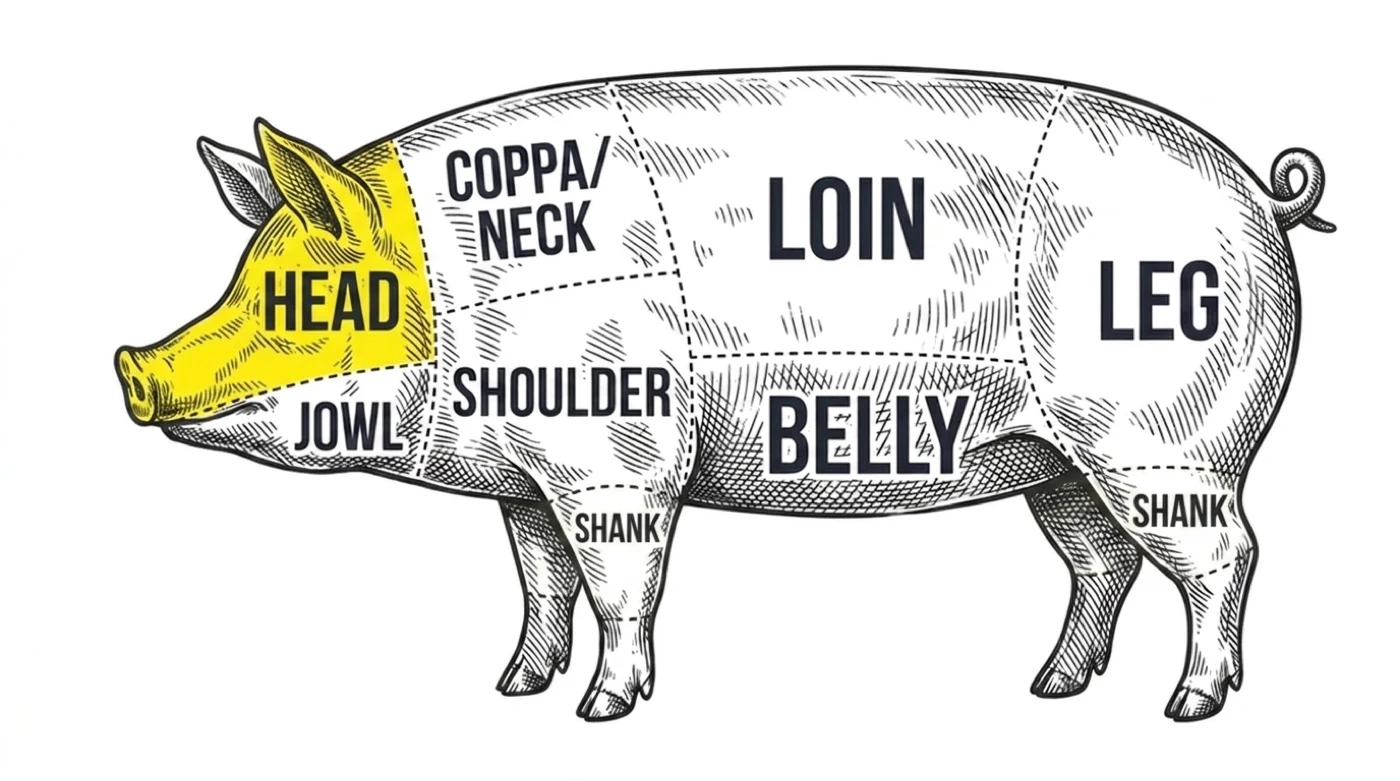
A pig's head is not one cut but a collection of small, awkward, hard-working tissues that no other part of the animal supplies: cheek muscle, the muscles around the jaw and skull, snout, ear, skin and a great deal of connective tissue. Its defining property is how much collagen it carries relative to lean, and the whole family of brawns, head cheeses, fromage de tête, presskopf, sülze and zampone filling exists because of it. Simmer a head long enough and it produces its own setting agent, so a brawn holds together on nothing but the gelatin it made.
The traditional method is the simplest thing in charcuterie and the most laborious. The head is split, cleaned, and simmered with aromatics until the meat parts from the bone. Everything edible is picked off by hand while warm, chopped rather than ground so the pieces stay distinct, seasoned, mixed back with the reduced and defatted cooking liquor, and set in a mould or a casing. What sets it is the collagen that dissolved out of the skin, ear and connective tissue and is now gelatin in the stock. Add too much water, or skim too hard, and it will not set.
Preparation is the part that separates a good brawn from an unpleasant one. The head needs thorough cleaning, the ears scrubbed and the snout scraped or singed for bristle. The eyes, brain and any glandular tissue are removed and discarded; in the European Union the brain and skull of pigs are not classed as specified risk material as they are in cattle, but they are removed as a matter of ordinary practice and many jurisdictions have their own rules worth checking. Lymph nodes around the jaw and throat come out. Bristle roots are the commonest quality failure.
The tongue is the exception in the group. It is a genuine muscle, dense, fine-grained and worked constantly, and it behaves quite differently from the rest of the head. It carries a thick, papillose outer skin that is inedible and must be peeled, which is only possible while the tongue is hot from cooking: let it cool and the skin sets hard. Because it is dense it cures slowly, so a tongue destined for a cured product usually needs longer in brine than its size suggests, or a pumped brine. Cured and pressed tongue is a product in its own right across Europe, and a whole tongue set in the centre of a brawn or a Zungenwurst is a deliberate visual signature.
Head meat also appears as an economical lean in coarse cooked sausages, where its collagen is an asset, and it should not be used in a fine emulsion where that same collagen becomes rubbery threads.
Temple element. Pillar, Meat Quality