
Pork Jowl and Cheek
Also known as jowl, cheek, guanciale cut, Bäckchen, joue, guanciale, papada, carrillera
The throat and cheek of the pig, carrying a fat that is firmer and more granular than belly fat and renders quite differently. Its lymph nodes must come out, which is the one non-negotiable of preparing it.
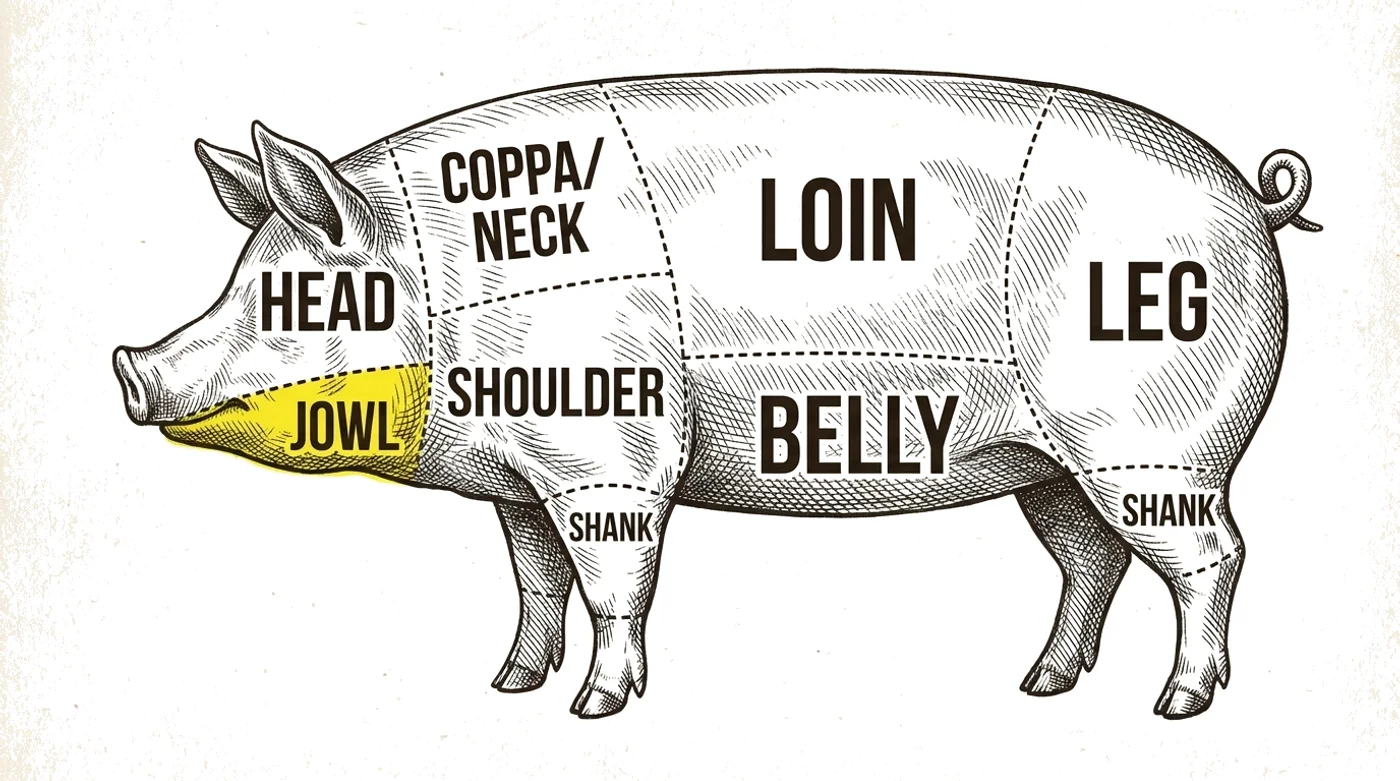
The jowl is the fatty cut taken from the throat and cheek of the pig. Two things live in it and they are worth separating: the cheek muscle proper, chiefly the masseter, and the mass of firm fat around and beneath it. Some traditions use the whole cut together, as guanciale does, and some take out the cheek meat alone for braising or for a coarse sausage.
The masseter is an unusual muscle. It works constantly, because a pig chews for a large part of its waking life, and it is a slow-twitch muscle built for sustained low-level effort rather than bursts. The result is meat that is very dark, dense, heavily veined with connective tissue and quite unlike loin or even shoulder. Cooked long it becomes gelatinous and rich; ground raw into a sausage it contributes deep colour and a chew that some traditions want and others avoid.
The fat is the reason most curesmiths buy jowl. It is firmer and more granular than belly fat, closer to back fat in behaviour but with a texture of its own, and it renders to a different consistency: guanciale melts to a fat that coats rather than pools, which is precisely why Roman cooking insists on it for carbonara and amatriciana and why pancetta is regarded as a substitute rather than an equal. In a sausage mix jowl fat holds its dice reasonably well and brings more flavour than back fat does.
Preparation has one requirement that is not optional. The jowl sits at the throat, and the throat is where a cluster of lymph nodes lives. These are firm, pale, roughly pea to bean sized nodules embedded in the fat, and they must be cut out. They are part of the immune system, they concentrate whatever the animal has been dealing with, and they taste unpleasant. Any competent jowl preparation begins by finding and removing them, along with any gland tissue and the tough exterior skin where the recipe does not want it. This is standard butchery rather than a special precaution, but it is the step most often skipped by someone meeting the cut for the first time.
Guanciale is the flagship product, cured with salt, pepper and often a little sugar and rosemary or thyme, and hung until firm. Jowl also becomes jowl bacon in the American South, appears in the Spanish papada, and is used as the fat component in nduja, in many Italian salami and across the coarse continental sausages.
Temple element. Pillar, Meat Quality