
Pork Leg
Also known as hind leg, fresh ham, gammon, prosciutto cut, jamón cut, Keule, cuisse, coscia, pierna, szynka
The hind leg, and the most demanding cut in charcuterie: a large, dense, multi-muscle mass that must be salted through to its centre before spoilage reaches it. Every great dry-cured ham is this cut and the whole difficulty is its size.
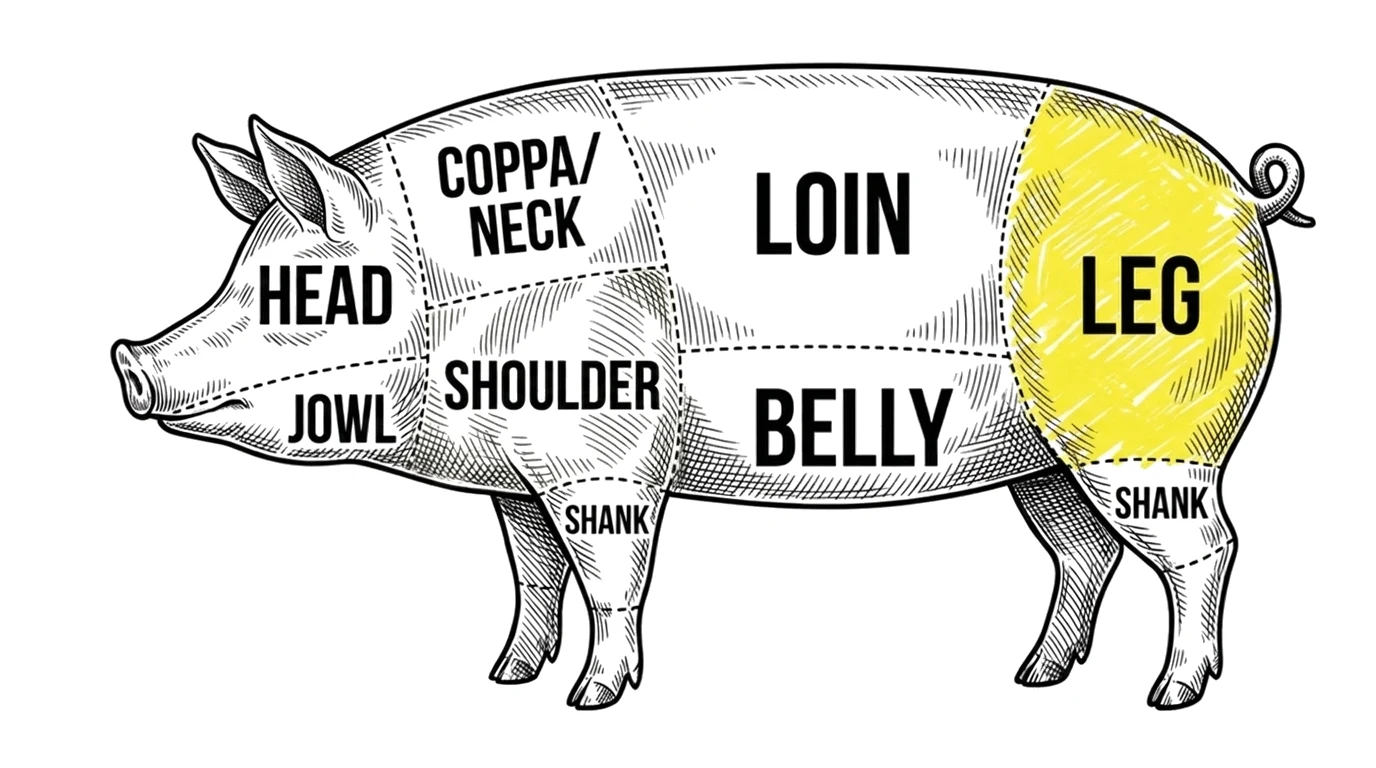
The hind leg is the largest single piece a curesmith works with, and everything that makes dry-cured ham difficult comes from that. It is a bundle of several muscles, wrapped in fat and skin over part of its surface, with a bone running through it and a joint at each end. Prosciutto, jamón, presunto, speck, country ham, Bayonne and the whole aristocracy of cured meat are this cut.
The muscles do different jobs, and a ham is not uniform. The inner face, the topside or punta, is the largest and leanest mass. The silverside and the thick flank differ in grain and in fat. The muscles nearest the bone are the last to be reached by salt and the first to spoil if they are not reached in time. This is why a boned ham and a bone-in ham are genuinely different problems: the bone is a channel for salt to fail to reach and for spoilage to start, and the classic ham fault is bone taint at the hip joint, sour and unmistakable, in a leg that looks perfect on the outside.
The cut is also asymmetric in the way it dries. Skin and fat cover part of the surface and pass almost no moisture. The trimmed lean face is wide open. Left to itself the exposed face hardens while the deep interior is still wet, which is why sugna exists. Time is the other half of the answer: a large ham is salted for weeks, then rested for months so the salt equalises through the mass before drying properly begins. Rushing either phase produces a leg that is over-salted at the edge and unsafe at the centre.
The boned versus bone-in decision runs through the whole tradition. Bone-in is traditional and gives the best flavour and keeping, and it demands the most skill. Boned legs cure faster and more evenly and are far easier for a beginner, at the cost of a wide exposed face and a cavity where the bone was, which must be salted and closed carefully or it becomes an anaerobic pocket. Culatello is the extreme case: the best muscle of the leg, taken out entirely, boned and cased on its own.
Gammon and fresh ham are the same cut under different names, the first cured and the second not. In the sausage traditions the leg is also simply lean meat, prized as the leanest large muscle on the pig, and where a recipe says lean pork it very often means leg.
Weight loss is the measure that matters. A dry-cured ham is judged by how much it has lost, commonly a third or more, and the house floor for an uncooked dry-cured product is 38 per cent. A leg that has not lost that has not finished, whatever the calendar says.
Temple element. Pillar, Meat Quality