
Beef Round
Also known as topside, silverside, eye of round, punta d'anca, girello, Oberschale, tapa, haunch
The hind leg: large, lean, close-grained muscles with very little fat, and the cut behind every great dried beef. Bresaola, bündnerfleisch and biltong are all this part of the animal.
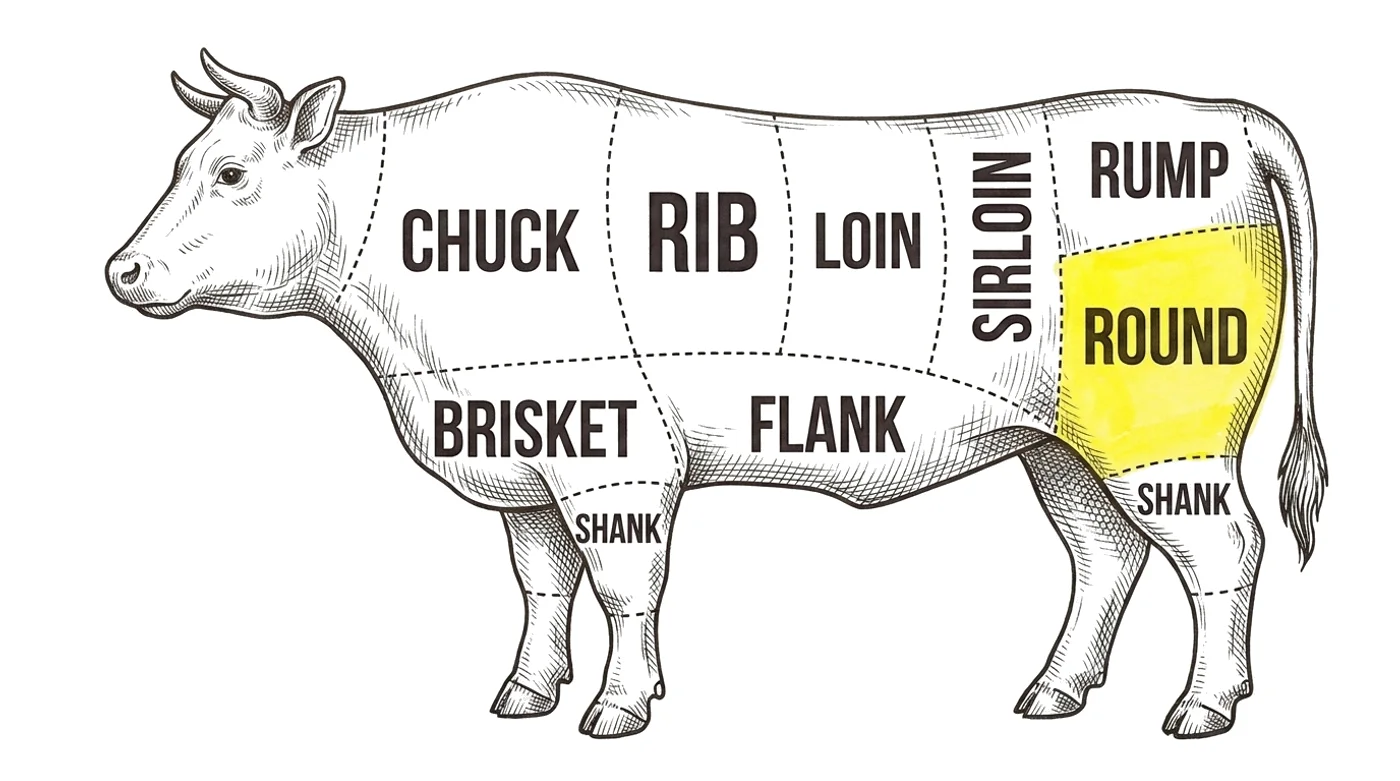
The round is the hind leg of the animal, and it divides into several large muscles that a butcher separates and names differently in every country: topside or inside round, silverside or outside round, the eye of round, and the thick flank or knuckle. What they share is what matters here. They are big, they are uniform in grain, they are very lean, and they have little internal fat and few seams of gristle running through them.
That combination is why the round is the cut for air-dried beef. Bresaola della Valtellina takes the punta d'anca, the topside; bündnerfleisch, cecina de León, pastirma, viande des Grisons and the whole family of dried beef come from the same region of the animal, and biltong is usually made from silverside or topside. Leanness is the requirement rather than a compromise: beef fat is prone to rancidity over a long dry, so a cut with very little of it keeps far better than a marbled one would.
The muscles are separated along their natural seams and cured individually, which is the important technique. A whole round cured as a lump would have gristle sheets running through it and would dry unevenly, since the separate muscles have different densities and grain directions. Seam butchery gives clean, uniform, single-muscle pieces that take salt evenly and slice without interruption, which is why a good bresaola cuts as a single unbroken sheet of lean.
The same leanness makes the round unforgiving in exactly the way the pork loin is. There is no fat to buffer the drying, and once it is past its target it goes hard and dry rather than firm and yielding. Weight loss is the control, not the calendar.
In sausage making the round is the lean beef of most formulas, and where a recipe says lean beef it usually means this. It is also the standard cut for corned beef and salt beef in the brined traditions, where the leanness is offset by the long wet cure and the eventual long boil.
One practical note: the round carries a tough silverskin over parts of its surface, particularly the silverside, and it must be removed before curing. It does not soften, salt does not pass through it well, and it will contract as the piece dries.
Temple element. Pillar, Meat Quality