
Duck Breast
mag-RAY
Also known as magret, magret de canard, duck prosciutto cut, Entenbrust, petto d'anatra, pechuga de pato
The one poultry cut that dry-cures properly: a single dense dark muscle under a thick fat cap, which is essentially a small whole-muscle ham. Magret means a fattened bird specifically, and it is not a synonym for duck breast.
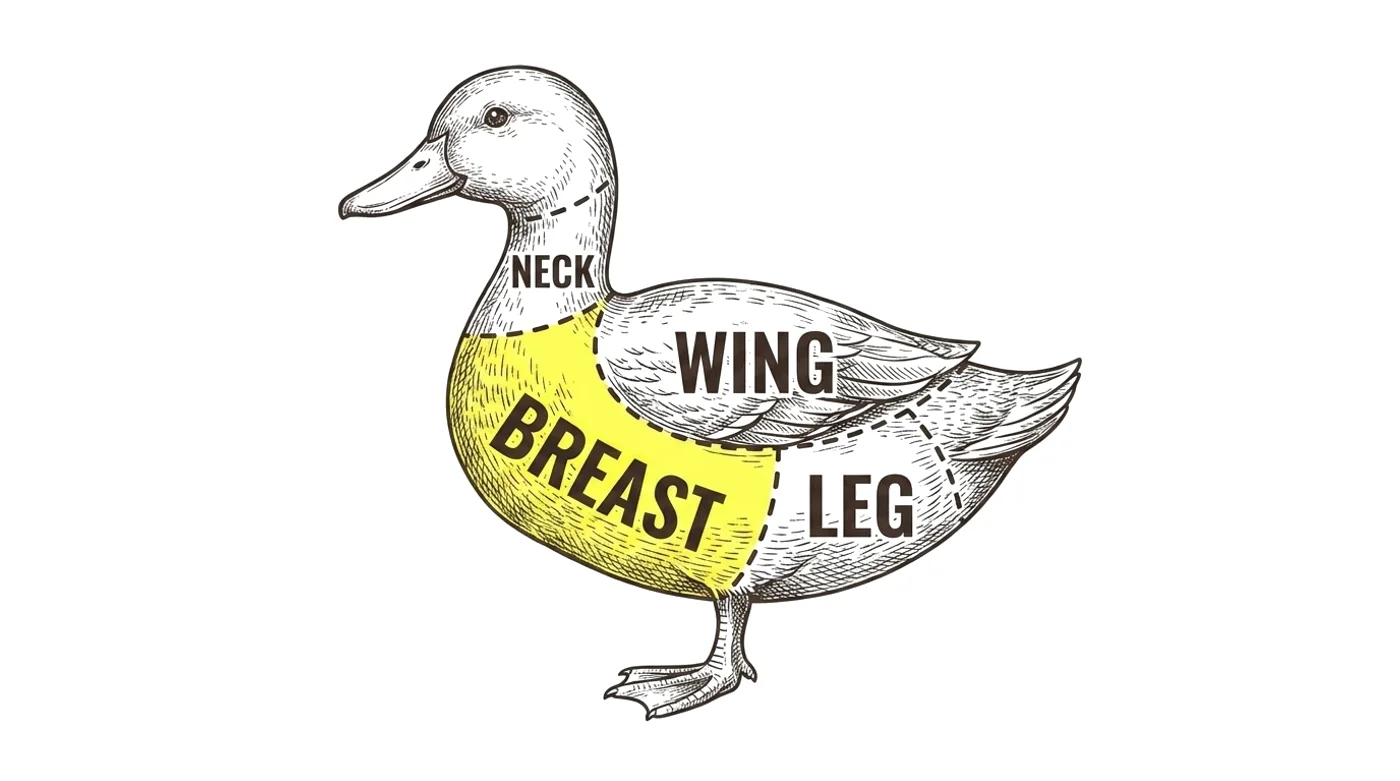
Almost no poultry survives a dry cure, and duck breast is the exception that proves why. It is a single, dense, uniform muscle, dark because a duck actually flies and its breast is worked slow-twitch muscle rather than the pale fast-twitch breast of a chicken, and it comes with a thick fat cap and skin on one face. That is the same architecture as a lonza with its fat cap: a clean cylinder of dark lean, protected on one side, small enough to cure in weeks. Magret séché, duck prosciutto and their relatives are whole-muscle cures rather than poultry preparations.
Magret is a specific thing and the word is widely misused. A magret is the breast of a moulard or Barbary duck fattened for foie gras, so it is much larger, considerably fattier and deeper in flavour than an ordinary duck breast. A recipe written for magret and made with a supermarket Pekin breast will finish faster, drier and blander, and the fat cap will be a third of the thickness. Both work; they are not the same cure.
The method is the simplest whole-muscle cure there is. The breast is buried in salt for a day or two depending on thickness, rinsed, dried, seasoned with pepper and whatever the tradition wants, wrapped in cloth and hung cool for two to three weeks until it has lost around a third of its weight. It slices across the grain into dark red sheets with a white fat edge.
Duck fat is the technical caution. It is highly unsaturated and soft at any working temperature, with a melting point low enough that a warm room begins to render it, and it oxidises considerably faster than pork fat. A duck breast hung too warm weeps, and one kept too long goes rancid in the fat before the lean is anywhere near spoiled. Cool and reasonably brief is the rule.
The safety position deserves to be stated plainly rather than glossed. This is a raw poultry product eaten without cooking, which is an exception to everything else the Codex says about poultry, and it rests entirely on salt, drying and a clean starting material. Source matters more here than in any other cure in this section.
Temple element. Pillar, Meat Quality