
Lamb and Mutton
Also known as lamb, mutton, hogget, Lamm, agneau, agnello, cordero, jagnięcina
The base of the North African, Middle Eastern and much of the Balkan sausage tradition, and the meat whose fat causes the most trouble. Lamb fat is hard, high-melting and strongly flavoured, and it does not behave like pork fat.
Lamb is a young sheep, hogget is a yearling, and mutton is an adult animal. The difference matters more here than the equivalent distinction in pork, because sheep flavour intensifies sharply with age: lamb is mild and slightly sweet, mutton is strong, and a formula built for one will taste quite different made with the other.
In charcuterie sheep belongs to the traditions that had sheep. Merguez is the flagship, a fresh North African sausage of lamb or beef heavy with harissa, cumin and garlic. Sujuk in its Turkish, Armenian and Levantine forms is often lamb or lamb and beef. The Balkan grilled sausages, the Greek and Cypriot preparations, the Central Asian products, the Sardinian and Corsican sheep charcuterie and the British lamb sausages all draw on it. It is essentially absent from the Italian, German and Polish canons, where the pig dominates.
The defining technical problem is the fat. Lamb fat is highly saturated and has a melting point well above body temperature, which is why cold lamb fat coats the palate in a way pork fat does not and why it is described as waxy. It also carries branched-chain fatty acids that give sheep its characteristic flavour, and those compounds concentrate with age and intensify further on oxidation. The consequence for a sausage maker is direct: lamb fat goes rancid faster and more objectionably than pork fat, and its flavour dominates.
Most traditions solve this in one of two ways. Either they keep the lamb fat low and lean on tail fat or beef fat, which is the North African and Central Asian route, or they use pork fat with lamb lean where religion and culture allow, which is the Balkan and southern European route. Where a formula uses lamb throughout, it is usually a fresh sausage eaten quickly rather than a dry-cured one, and that is a deliberate choice about keeping.
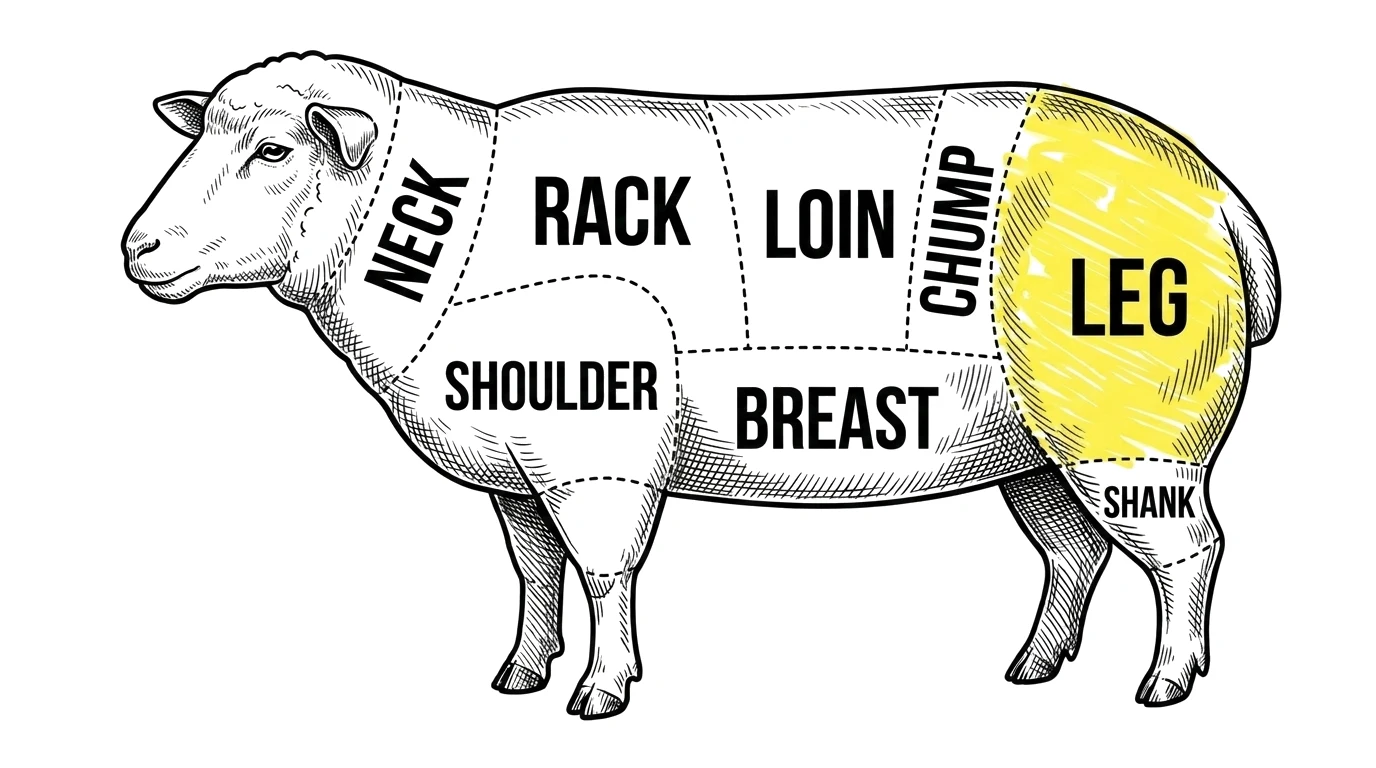
For cuts, the shoulder is the sausage meat for the same reasons it is in pork, the leg is the lean, and the breast and flank are the fatty trim. Fat-tailed breeds, common across North Africa, the Middle East and Central Asia, carry a large tail fat depot that is prized in exactly the traditions that use them.
Sheep casings, from the small intestine, are the finest natural casings available and are used far beyond lamb products: the classic thin frankfurter and chipolata are sheep casing regardless of what is inside them.
Temple element. Pillar, Meat Quality