
Pork Hock and Shank
Also known as hock, shank, knuckle, eisbein, codillo, jarret, stinco, golonka, ham hock
The lower leg above the trotter: the hardest-working muscle on the animal and the most sinewy. Tough by any ordinary standard, and exactly right where long moist cooking turns that connective tissue into richness.
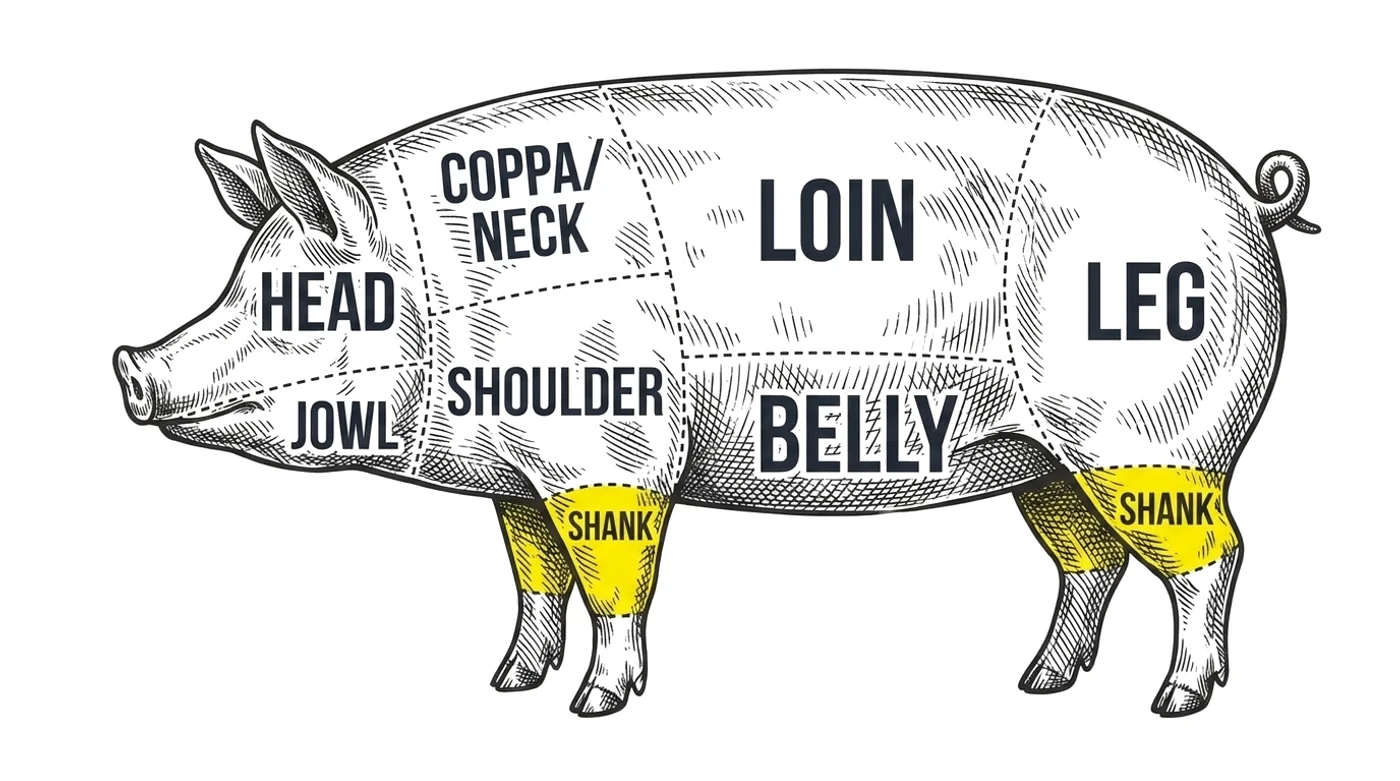
The hock is the section of leg between the knee or elbow joint and the foot, and there are four on a pig. The front hocks come off the picnic shoulder and the hind hocks off the leg. They are worked constantly, they carry the animal's weight, and they are built accordingly: small dense muscles wrapped in heavy sheets of connective tissue and tendon, on a substantial bone, under thick skin.
That composition makes the hock useless for anything quick and superb for anything slow. Eisbein, golonka, the smoked ham hock that flavours a pot of beans or a choucroute, codillo, stinco, and the boiled and pressed hock products all rely on hours of moist heat converting collagen to gelatin. The result is meat that is unctuous rather than merely tender, and a broth that sets. A hock roasted hard and fast is a disappointment; the same hock simmered for three hours is one of the best things on the pig.
In charcuterie it does three jobs. Cured and smoked whole, it becomes a flavouring ingredient in its own right, and a smoked hock in a pot is a seasoning as much as a meat. Simmered and picked, it contributes to brawns and pressed products, where its gelatin helps the set. And the skin and tendon are a deliberate gelatin source added to cooked sausages that would otherwise be too loose.
Curing a hock whole has a particular difficulty. It is an irregular shape around a bone, with joints at both ends, so brine and salt reach some parts far faster than others, and the tissue nearest the bone and the joint is the last to be reached and the first to sour. Traditional practice brines hocks rather than dry-salting them, often with the brine pumped along the bone, precisely because immersion reaches the awkward geometry that a rub cannot.
The zampone connection is worth knowing: zampone is a stuffed trotter, and the shank skin is what several traditions use when they want a natural, edible, collagen-rich casing for a large cooked sausage.
A hock also freezes well and is cheap, which is why it survives in every peasant tradition in Europe and why it is worth a beginner's attention.
Temple element. Pillar, Meat Quality