
Pork Neck and Collar
Also known as collar, coppa cut, capocollo cut, money muscle, Schweinenacken, échine, capocollo, cabecero de lomo, presa, karkówka
The most marbled muscle on the pig, and the reason coppa and lonza are different products despite coming from the same animal a hand's width apart. Its intramuscular fat is what lets it dry for months without going chalky.
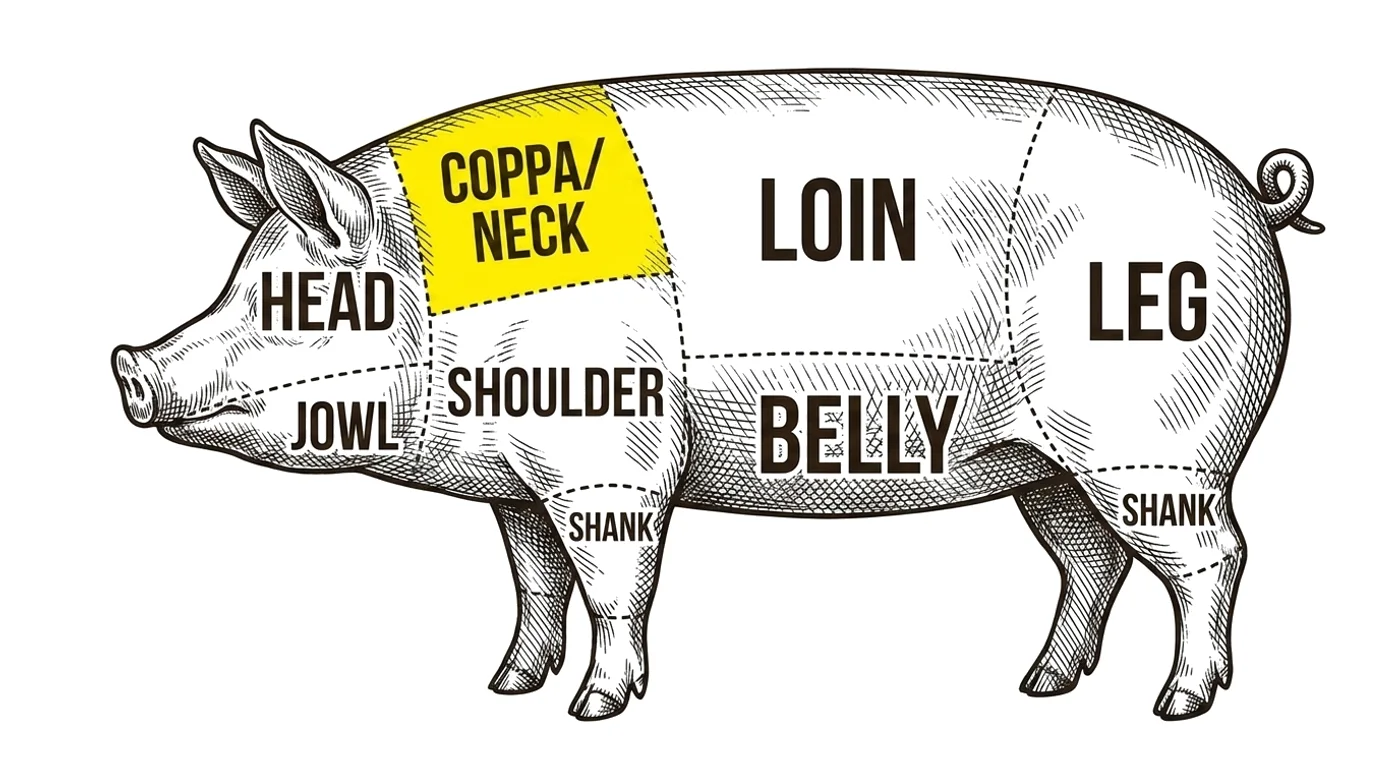
The neck is where the loin muscle runs forward past the shoulder blade into the collar. Anatomically it is largely the same longissimus that becomes the loin further back, but it behaves as a different meat because of where it sits. The neck carries and moves the head all day, so unlike the loin it works, and the muscle is laced with fat between the fibres rather than only capped with it.
That marbling is the whole point. Take the loin and the neck from the same pig, cure both, and you get lonza and coppa: one lean, pale and firm, the other richly veined, deeper in colour and softer on the tooth. The fat is distributed through the muscle, so it protects from the inside as the piece dries, and where a loin can go from firm to chalky in a fortnight the neck stays yielding for months. It is the single best whole-muscle cut on a pig for a long dry cure, and every tradition that found it says so.
The products carry its name across Europe. Coppa and capocollo in Italy, with a shelf of protected designations from Piacentina to Calabria. Cabecero de lomo and presa in Spain, presa being the prized fan-shaped muscle at the shoulder end. Karkówka in Poland, both fresh and cured. Nacken in Germany, Austria and Switzerland. It is also, in barbecue, the money muscle at the end of a Boston butt, prized for the same reason.
The boundary between neck and shoulder is a cutting convention rather than a fact of anatomy, and butchers draw it in different places. A Boston butt sold whole includes the collar end; a coppa is that collar taken out as its own muscle. Where a recipe specifies coppa or capocollo it wants the seam-butchered neck muscle, not a slab of shoulder, and the difference in the finished slice is obvious.
For curing, the neck is forgiving in the way the leg is demanding. It is a manageable size, boneless, roughly cylindrical once trimmed and tied, and the marbling buffers uneven drying. It is the cut to reach for after a first successful loin and before attempting a leg.
In sausage it is excellent and expensive, and where a formula lists neck alongside shoulder it is usually chasing the fat distribution rather than the lean.
Temple element. Pillar, Meat Quality